
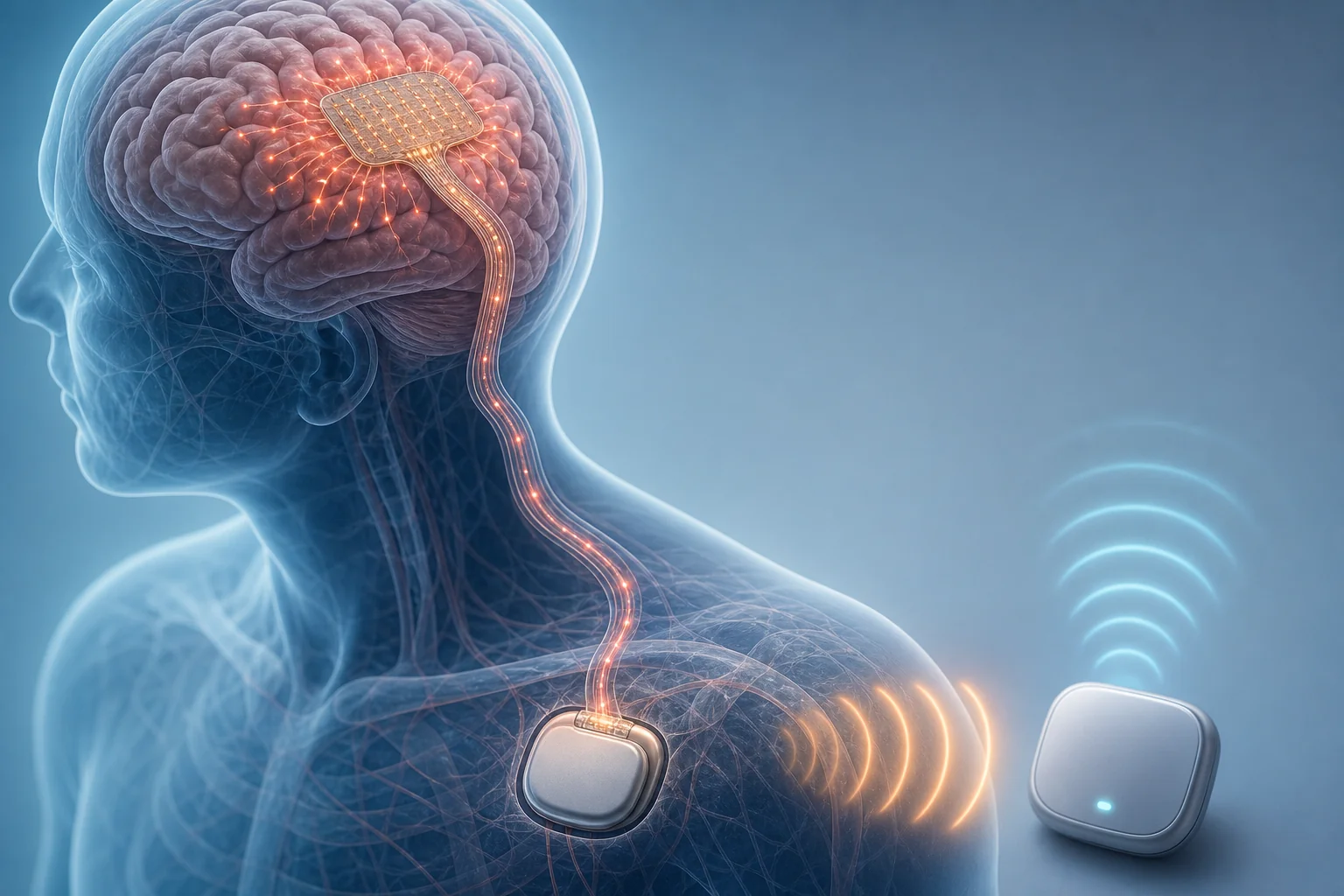
Imagine knowing exactly what you want to say and having no way to say it. Your thoughts are intact. The sentence is fully formed in your head. But the muscles that would carry it out have stopped answering. The Paradromics speech-restoring brain-computer interface is one of the boldest attempts yet to change that.
If you’re new to the technology, start with how brain-computer interfaces work.
That silence is the daily reality for many people with advanced ALS, a brainstem stroke, or a high spinal cord injury. And it is the exact problem this device is built to solve. In November 2025 it cleared a milestone no fully implantable speech BCI had reached before: an FDA green light to test it in humans.
Here’s what that approval actually means, what the device does, and where the honest limits sit. Because the gap between “first human implant” and “your voice back” is wider than most headlines admit.
What the FDA actually approved
The FDA granted Paradromics an Investigational Device Exemption for the Connect-One study of its Connexus brain-computer interface. It was the first-ever IDE for a fully implantable, speech-restoring BCI (BusinessWire).
An IDE is not a product approval. It is permission to run a clinical trial. The trial is registered as NCT07357428 and classified as an Early Feasibility Study, which is the FDA’s category for very small, first-in-human tests of novel implants (ClinicalTrials.gov). Read that as: prove it is safe and that the basic idea works in a few people, not prove it is ready for the market.
Then it moved from paper to surgery. In June 2026, Paradromics and the University of Michigan completed the first human Connexus implantation, in a Michigan woman with speech difficulty from motor neuron disease (Michigan Medicine).
So the score today is one confirmed surgery under a small safety study. Real, but early.
How the Paradromics speech-restoring brain-computer interface works
The Connexus system starts at the source. A cortical array of 421 microelectrodes, each thinner than a human hair, sits on the brain and records the activity of individual neurons (MassDevice).
Those signals need a way out of the skull. Instead of a plug on the scalp, the array feeds a transceiver implanted in the chest. That transceiver sends data wirelessly through the skin to an external receiver worn by the patient, which also powers the implant inductively, a bit like wireless phone charging.
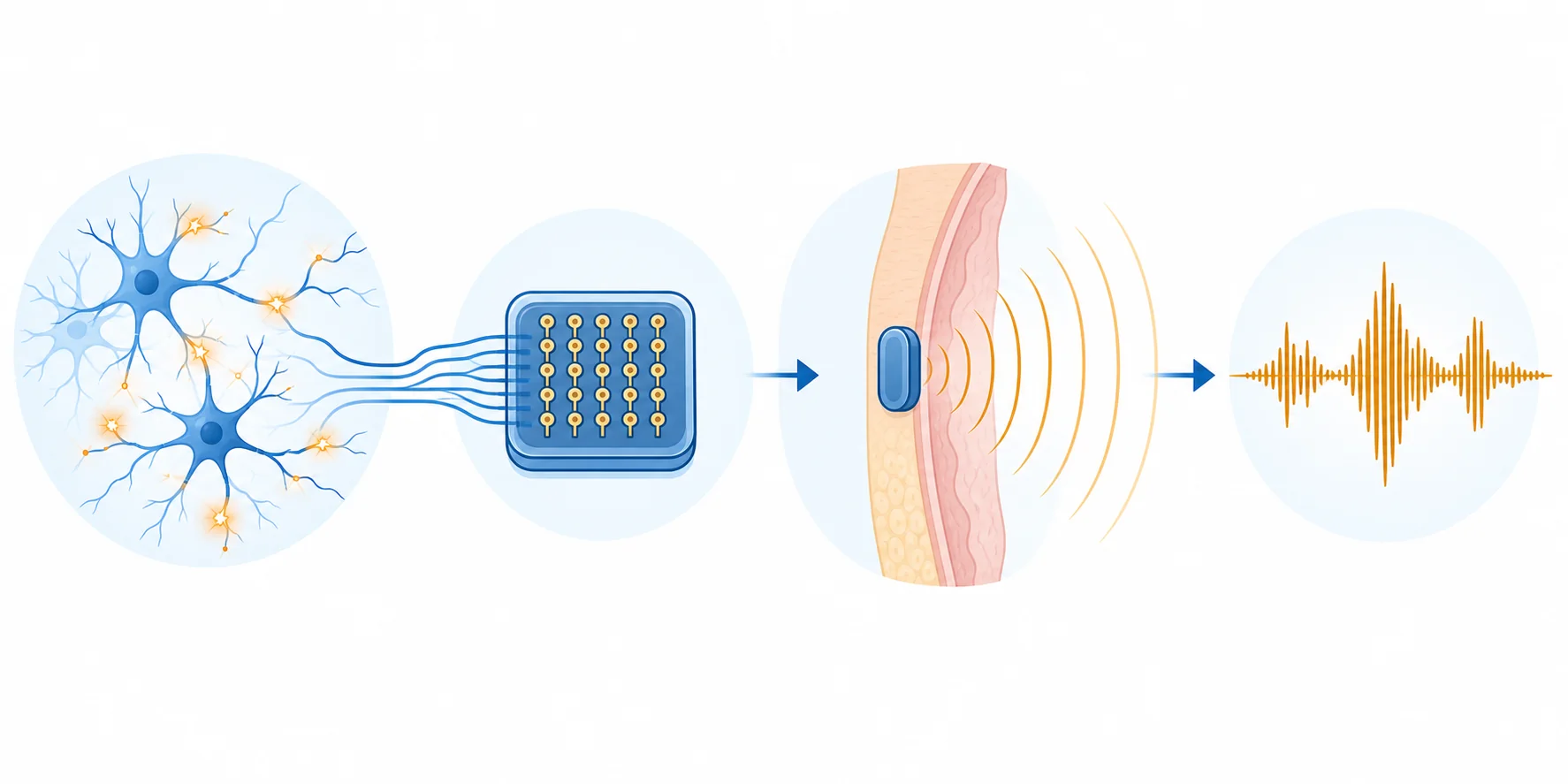
From there, software does the hard part. It decodes the neural patterns tied to intended speech and turns them into words. In preclinical models, Paradromics reports the system moving 200-plus bits per second with roughly 50 milliseconds of delay (New Atlas). That bandwidth matters, because speech is fast and a slow interface feels like talking through molasses.
Paradromics vs. Neuralink: two bets on the same problem
Neuralink gets most of the attention, so the comparison is worth making carefully.
Neuralink’s N1 uses 64 ultra-flexible polymer threads carrying 1,024 electrode channels, packed into a coin-shaped implant about 25mm across that sits in the skull. One device, one location, in the head.
Paradromics splits the job. The electrodes stay on the cortex; the electronics live in the chest. It is a different wager about where the hardware should sit and how to keep it running for years.
The speed numbers get quoted a lot, so read them with care. Paradromics’ 200-plus bits per second is a preclinical bench figure. Neuralink’s first human participant has been reported communicating at roughly 4 to 10 bits per second in real use, according to New Atlas. Those are not the same kind of measurement. A lab benchmark against a living person’s everyday performance is not a fair race, and anyone claiming Paradromics is simply “20 times faster” is skipping that caveat.
Different architecture, similar goal, and both still very early. If you want the wider ethical frame on implanting hardware that talks to the brain, we’ve dug into that in The Ethics of Writing Signals Into the Brain.
This didn’t come from nowhere
It’s tempting to treat Connexus as a bolt from the blue. It isn’t. It is the commercialization of a research line that academics have been building for years.
A 2023 Nature paper by Willett, Kunz, Fan and colleagues, from a UC Davis, Stanford and Brown collaboration, decoded intracortical brain signals into real-time text and synthesized voice for a person with severe ALS-related speech loss (Springer). Then in March 2025, a Berkeley-covered study pushed further, translating neural signals into naturalistic speech through a speaker at very low latency, on the order of a fortieth of a second (Berkeley Engineering).
The research keeps advancing, too. In June 2026, UC Davis Health reported a BCI enabling independent, accurate communication for a man living with ALS (UC Davis Health).
So Paradromics is scaling a proven approach, not inventing physics. That’s a good thing. It also means the honest framing is “promising engineering on solid science,” not “miracle.”
What’s confirmed, and what’s still years away
Let me separate the two piles clearly, because the coverage rarely does.
Confirmed:
- The FDA granted an IDE for Connect-One in November 2025, per BusinessWire.
- One human implantation was completed in June 2026 at the University of Michigan, as Michigan Medicine reported.
- The study targets people with ALS, stroke, or spinal cord injury who can’t speak but keep the intent to, according to MassDevice.
Still speculative:
- How well it restores fluent speech in daily life. That data doesn’t exist yet.
- The timeline to any general availability. An Early Feasibility Study sits many phases before market approval.
- Long-term reliability of the electrodes and the wireless link inside a living body over years.
Hold both piles in your head at once. The milestone is genuine. The finish line is far off.
The harder question: whose voice is it?
Say the system works beautifully. A person thinks a sentence and a voice speaks it. Whose voice, and whose words, are those?
This isn’t a philosophy-seminar hypothetical. Neural data is unusual because it is generated continuously, often without conscious intention, and it sits closer to the source of thought than any other kind of personal data (Stanford Law School). Decode it, and you are handling raw material from someone’s inner life.
The rules are only starting to catch up. UNESCO adopted a non-binding recommendation on neurotechnology ethics in November 2025, framing mental privacy and cognitive liberty as human rights. In the US, four states, California, Colorado, Montana and Connecticut, now classify neural data as sensitive personal information by statute.
“Where regulation touches the integrity of mental life, doctrines of autonomy, dignity, and freedom of thought must play a central role,” argues Stanford’s Bo Hyoung Lee.
And the core questions stay open. Who owns the synthesized speech output? Who controls the raw signal? Does an AI-reconstructed voice legally count as the patient’s own? None of these has a settled answer anywhere in 2026, per the legal-ethics literature (NCBI/PMC). We’ve mapped the surveillance side of this in Neuroprivacy: What Governments Can Really Subpoena, and the ownership tangle in If Your Mind Lived in the Cloud, Who Owns the Data?.
There’s an access question, too. Early neural implants will be scarce and expensive, which raises the same fault line we explored in Will Brain Chips Deepen the Human Class Divide?.
So where does this leave us?
If you love someone who has lost their voice, the Paradromics milestone is worth being glad about. A real device is in a real person, cleared by a real regulator, built on a decade of solid science. That’s not nothing.
But temper the excitement with patience. One safety study is the start of a long road, and the questions about who owns a synthesized voice are still wide open. The right response isn’t hype or dismissal. It’s attention. Watch the trial data as it comes, ask who’s writing the rules for neural data, and decide for yourself what “getting your voice back” should really mean. If these questions grab you, keep reading through our neural tech coverage and tell us where you land.