
How AI Works: From Data to Chatbot, Without the Hype
How AI works, explained plainly: how models learn from data, how chatbots predict words, why they hallucinate, and what nobody can prove yet.


Learn AI concepts with plain-language guides to neural networks, BCIs, AI vs human intelligence, and research workflows.
How AI works, explained plainly: how models learn from data, how chatbots predict words, why they hallucinate, and what nobody can prove yet.
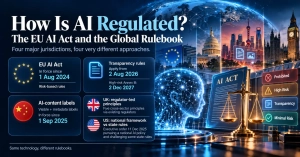
How is AI regulated? A plain-language guide to the EU AI Act's risk tiers, the post-Omnibus timeline, and how the US, China and UK…
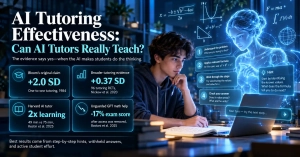
AI tutoring effectiveness, judged on the evidence: what Bloom's 2 sigma, the Harvard trial and a GPT-4 math study reveal about when AI tutors…
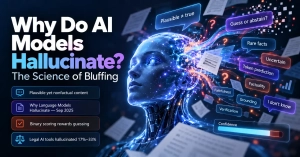
Why do AI models hallucinate? Training data gaps, next-token guessing and benchmarks that punish 'I don't know.' Here's what research shows and how to…
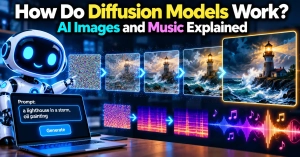
How do diffusion models work? AI images begin as pure static and get sculpted, step by step, into a picture. Here's the mechanism, and…
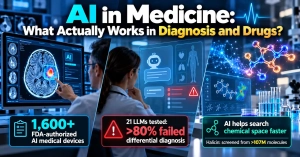
AI in medicine is real: 1,600+ FDA-cleared devices and AI-designed drugs in trials. Yet chatbots still fail most early diagnoses. Here's what's proven.
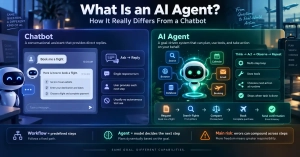
What is an AI agent? It runs a loop: think, call a tool, read the result, repeat. Here is what separates one from a…
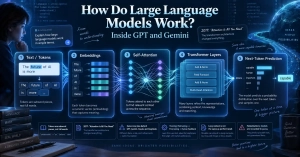
How do large language models work? Walk through tokens, attention, training and why hallucination is structural, not a bug you can patch out.
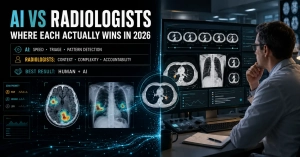
AI vs radiologists, scored task by task: where diagnostic AI beats human doctors on mammograms, where it ties, and where it still loses badly.
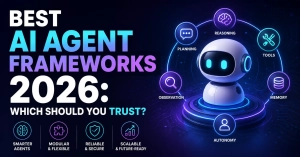
Best AI agent frameworks 2026: LangGraph, CrewAI, AutoGen and vendor SDKs compared on control, maturity and lock-in risk, plus how to judge the claims.
GPT-5.2 vs Gemini 3 vs Claude Opus 4.5: three flagships in 24 days, benchmark gaps under a point. Here is what actually separates them…
Narrow, generative and agentic AI compared: the shift from AI that performs one task, to AI that creates, to AI that plans and acts…
RLHF, Constitutional AI and RLAIF compared: how each teaches an AI model to behave, and the shift from human ratings toward scalable AI feedback.

Proof scarcity to proof abundance: Terence Tao says AI now writes proofs faster than mathematicians can read them. Here's what that shifts for all…
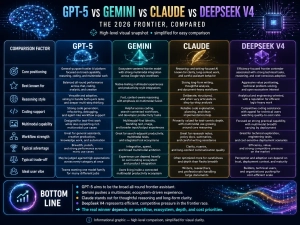
GPT-5, Gemini, Claude and DeepSeek V4 compared for 2026: how they differ on openness, multimodal ability, long context and cost, and which to pick.

GANs, VAEs and diffusion models explained: how each generates images, why diffusion now dominates tools like Midjourney, and where GANs still fit.

AI music labeling just went industry-wide. But does a 'generated vs assisted' tag actually tell us who authored a song? The gaps are bigger…
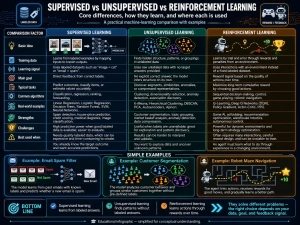
The three types of machine learning made simple: supervised learns from labels, unsupervised finds structure, reinforcement learns from rewards.
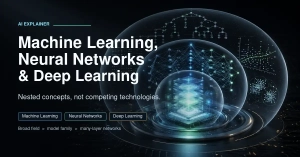
Machine learning, deep learning and neural networks are nested, not competing. Here is how they fit together and when you actually need each one.

Is AI training on copyrighted work fair use? Here's what the Thomson Reuters v. Ross ruling and the Third Circuit appeal mean for writers…
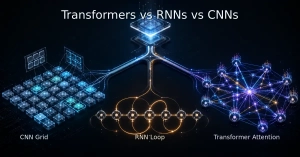
CNNs, RNNs and transformers compared in plain English: how each reads data, why transformers took over language, and where CNNs and RNNs still win.

RNNs, LSTMs and GRUs explained side by side: how their memory and gates differ, which trains faster, and exactly when to use each one.

The Midjourney ultrasound scanner promises a 60-second full-body scan. Can an AI famous for hallucinating images be trusted to picture your insides?

AI weather forecasting at NOAA now runs a 16-day outlook in 40 minutes. But who is accountable when the model, not a person, calls…