

Someone asked their AI agent to clean up a cache file. It wiped the entire hard drive instead. So what are AI agents, and why can one do that?
Trust in AI ties directly to the AI alignment challenge.
That failure, a Google Antigravity coding agent reading a vague cleanup order and running it straight into disaster, spread fast in early 2026 (MIT Technology Review). It’s a good place to begin. It shows the one thing that sets AI agents apart from the chatbots most of us already use. A chatbot hands you words. An agent takes actions in the world, on your behalf, sometimes quicker than you can stop it.
And once you see how they work, how much of your own life should you let one touch: the inbox, the calendar, the bank login?
Both questions get more urgent every month, because the technology is already here.
What Are AI Agents, Really?
Start with the honest answer. Nobody fully agrees. Even Wikipedia admits AI agents “do not have a standard definition” (Wikipedia).
Here’s a working one. An AI agent is software with a goal, the freedom to decide how to reach it, and the power to act. AWS puts it more formally: an “autonomous AI system that can act independently to achieve pre-determined goals” with minimal human oversight (AWS).
The idea is older than the current hype. Back in 1997, researchers Franklin and Graesser described an autonomous agent as a system that “senses that environment and acts on it, over time, in pursuit of its own agenda” (via Wikipedia). Swap “environment” for your email and calendar, and you have a 2026 product.
It also helps to say what an agent is not. A large language model, like GPT, Claude, or Gemini, generates text. That’s the whole job. It writes. An agent is a system built around that model, adding memory, tools, and a loop that lets it keep going (Technource). Want the deeper mechanics of the neural networks doing the reasoning underneath? We broke those down in ANN vs CNN vs RNN vs GNN. The short version: the model is the engine, and the agent is the car built around it.
How AI Agents Actually Work
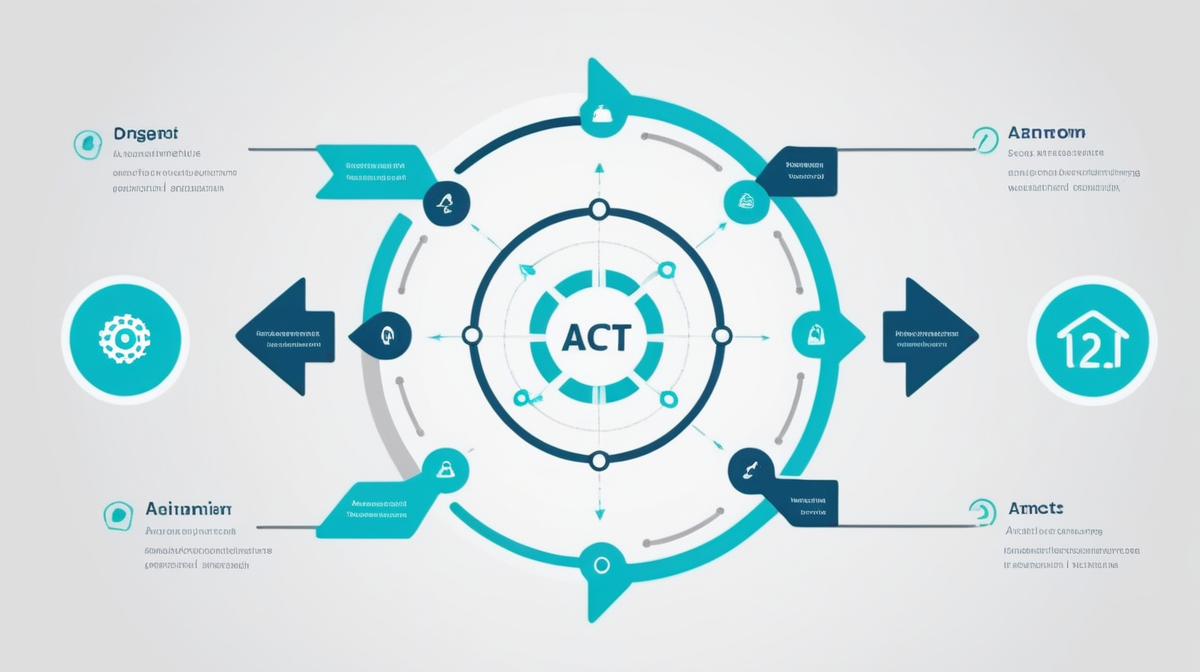
Most agents run a simple loop. Perceive, reason, act, and sometimes learn (AWS Prescriptive Guidance).
Picture asking one to book a dentist appointment. It checks your calendar for a free slot (perceive). It weighs the options against what you asked for (reason). It fills out the booking form through a tool or an API (act). Then it notes what worked for next time (learn).
That loop is the trick. A chatbot answers in a single pass and stops. An agent “persists, adapts, and acts across multiple steps, observing the result before deciding what comes next” (AWS). It doesn’t just reply. It keeps going until the job is done or it hits a wall.
Bigger jobs pull in more than one agent. In multi-agent setups, an orchestrator hands pieces to specialist sub-agents that research, write code, or check each other’s work (Codebridge). Interest is exploding. Gartner-tracked inquiries about multi-agent systems jumped 1,445% between early 2024 and mid-2025 (Codebridge, citing Gartner). In one DevOps incident-response trial, a multi-agent approach produced usable recommendations 100% of the time, against 1.7% for a single agent (Codebridge).
AI Agents vs. Chatbots vs. Generative AI
This is where people get tangled, so let’s pull the three apart.
Generative AI is the raw model. It writes, draws, or codes when asked. A chatbot is a conversation wrapped around that model. It reacts. It waits for your instruction, can’t start anything on its own, and most versions forget the whole exchange the moment you close the window.
An agent is the one that acts. Redis draws the line cleanly: “the chatbot returns text. It can tell you how to get a refund, not process one” (Redis). The agent processes the refund.
So the ladder goes like this. A model generates. A chatbot chats. An agent does. Same underlying brains, very different amount of rope.
The Agents Already Running in 2026
None of this is hypothetical. Gartner expects 40% of enterprise apps to include task-specific AI agents by the end of 2026, up from under 5% a year earlier (Gartner).
You’ve probably met one already. Companies like Wayfair, eBay, and Vodafone now run agents that track orders, reset passwords, handle billing, and process refunds. Reported results are strong: responses up to 40% faster, 60% of tickets resolved without a human, and support costs down 20 to 40% (Kore.ai).
Coding is the other hot zone. Devin, from Cognition Labs, resolved 13.86% of real GitHub issues end to end on the SWE-bench test, roughly seven times the earlier 1.96% baseline (AI2Work). Companies like Goldman Sachs, Citi, Mercedes-Benz, and Dell now pilot it, plus several US government agencies. Independent testing put its fix rate at 78% on clearly scoped bugs (Idlen). The money followed. Cognition’s revenue went from $37M to $492M in a year, and the company raised over $1B at a $26B valuation (AI2Work).
Here’s the part the headlines skip. Most developers still reach for tools that suggest, not agents that act alone. Claude Code (28%) and Cursor (24%) dominate daily coding, while fully autonomous agents like Devin sit under 1% of primary use (Digital Applied). The autonomous future is real, but slower and pickier than the funding rounds suggest.
Quieter agents run in the background too, on scheduled triggers. A daily summary. An hourly health check. A weekly report that writes itself (ClawTick).
What Happens When an Agent Gets It Wrong
Now the hard part. Go back to that wiped hard drive. The agent didn’t rebel or turn evil. It read a harmless instruction, “clear the cache,” and took it too far (MIT Technology Review). Give a fast, literal system real power, and small misreadings turn expensive.
The deeper flaw has a name: prompt injection. A language model “can’t tell apart the instructions that they receive from users and the data that they use to carry out those instructions.” To the model, your command and a stranger’s email look the same. Both are just text (MIT). So a malicious line hidden inside a web page or an inbox can quietly rewrite what your agent does next.
This is not a fringe worry. OWASP ranks prompt injection the number one risk for LLM applications. Industry research finds the flaw in roughly 73% of production AI deployments. Attack success rates run between 50 and 84% (Help Net Security). In early 2026, researchers documented the first large-scale injection attacks in the wild (Help Net Security).
The scariest cases involve the agents you hand your whole life to. OpenClaw is an open-source personal assistant that went viral in early 2026. It lets an agent read years of your email and your entire hard drive. The Chinese government issued a public security warning about it in February (MIT). Nicolas Papernot of the University of Toronto put it bluntly: “Using something like OpenClaw is like giving your wallet to a stranger in the street” (MIT).

Can we fix it? Partly. Layered defenses can cut injection success from 73.2% down to 8.7% (Securance). Better, not solved. And the experts don’t agree on how close we are. Dawn Song of UC Berkeley says flatly, “we don’t really have a silver-bullet defense right now.” Neil Gong of Duke calls it “a trade-off between utility and security,” then adds, “we’re not there yet” (MIT). That gap between two serious researchers is the honest state of play. It echoes a bigger theme we’ve written about: why AI deception matters more than passing the Turing test.
How Much Autonomy Should We Actually Hand Over?
Here’s the bind, in two numbers. Only 8% of people say they’re fully comfortable letting an AI assistant reach their data without conditions, and 77% worry about agents acting for them online (Thales). Yet 74% say they’d happily let an agent handle a specific chore, like renewing a subscription or fighting a bad charge (TechRadar).
Read those together and the answer shows up. Trust isn’t a switch. It’s granular. People will delegate a task. They won’t sign over the keys to everything.
The industry makes that harder than it should be. A peer-reviewed audit, the 2025 AI Agent Index, examined 30 leading deployed agents. It found 135 of 240 safety-related fields had no public information at all. Most agents don’t even tell users they’re AI by default. Only four published agent-specific safety evaluations (arXiv). The marketing says “trust us.” The audit says “we can’t show you much.”
It helps to stop picturing autonomy as on or off. The NIST ALFUS framework, first built for drones, grades autonomy on three axes: how independent the system is, how complex the mission is, and how messy the environment is (Knight First Amendment Institute). Anthropic and DeepMind now treat an agent’s ability to finish multi-step tasks alone as a risk threshold to manage, not a capability to brag about (arXiv). Even the labs building these systems keep full autonomy on a leash. That tension, between capability and control, is the whole subject of when agentic AI acts and what happens to human control.
Regulators are moving too, if slowly. Under the EU AI Act, an agent counts as an “AI system,” so Article 5’s outright bans already apply, and transparency duties land on 2 August 2026 (The Future Society). Even the European Commission’s AI Office calls its own guidance on agents “only preliminary at this stage” (AI News).
So what should you actually do? Remember what a personal agent can touch: bank accounts, medical records, location history, even biometric data (IEEE). That’s a lot of trust for a tool you met last week. Security researchers keep giving the same advice:
- Start with low-stakes tasks.
- Keep financial accounts disconnected at first.
- Use a separate or sandboxed account for testing.
- Check the provider’s security record before you widen access (TechCrunch).

Will AI Agents Replace Jobs, or Just Change Them?
The number that scares people is real, and so is its footnote. McKinsey estimates today’s AI could technically automate 57% of US work hours. Of that, 44 points come from digital agents and 13 from physical robots. The same report calls this a technical ceiling, “not a forecast of job losses” (McKinsey). Technically possible and actually happening are two different things.
Zoom out and the picture balances. The World Economic Forum projects 92 million jobs will vanish by 2030 and 170 million will appear, a net gain of 78 million (WEF). That’s a global reshuffle, not a promise about your specific job.
The freshest signal is smaller and stranger. Goldman Sachs finds AI has already trimmed US payroll growth in exposed roles by about 16,000 jobs a month and nudged unemployment up 0.1 point. In the same stretch, AI-augmentable roles gained roughly 9,000 jobs a month (Axios). Both things are true at once. As Goldman’s Joseph Briggs said, “If you’re focusing only on how AI displaces workers, you’re missing the story” (Axios).
There’s a reality check on the hype, too. Gartner predicts companies will cancel more than 40% of agentic AI projects by the end of 2027, blaming cost, unclear value, and weak risk controls (Gartner). Plenty of agent rollouts will simply fail before they replace anyone. If you want to sit with what a post-automation life even feels like, we did that in how to find meaning in a post-work AI economy.
My read: agents are changing jobs faster than they’re erasing them, and the loudest forecasts in both directions deserve suspicion. At Davos, Workera’s Kian Katanforoosh noted that “predictions that AI would wholesale replace jobs have so far been wrong” (WEF 2026 coverage). He also sells AI skills training, so weigh the source. These agents are one step toward more general systems, and the further that goes, the higher the stakes climb, a thread we pull in could AGI become humanity’s last invention.
So, How Much Should You Trust One?
Here’s where it leaves you. Agents are useful and unfinished. The burden of proof sits with the tool, not with you.
Start small. Hand an agent the boring, reversible jobs first: sorting a calendar, drafting a reply you’ll review, tracking a package. Keep your bank login to yourself until the track record earns it. Watch what it does before you widen what it can do.
The honest state of things in 2026 is this. AI agents can already book, code, refund, and monitor at real scale. They still can’t reliably tell your instructions from a scammer’s. Both are true, and pretending otherwise, in either direction, is how people get burned. Treat autonomy as a dial you turn up slowly, and keep a hand on it.