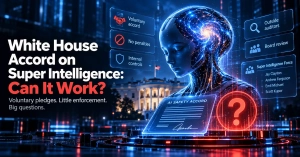
White House Accord on Super Intelligence: Can It Work?
The White House Accord on Super Intelligence asks AI labs to police themselves, with no penalties. What it says, what it skips, and how…


Artificial General Intelligence (AGI) coverage at Mindox AI tracks the race toward systems that can reason, adapt, and operate beyond narrow task-specific AI. We cover model capabilities, compute infrastructure, safety debates, governance, and the practical meaning of AGI for business, society, and human decision-making.
This section is designed for readers who want more than hype. We explain what current systems can actually do, what remains speculative, and which signals matter most when companies or governments claim progress toward AGI.
The White House Accord on Super Intelligence asks AI labs to police themselves, with no penalties. What it says, what it skips, and how…
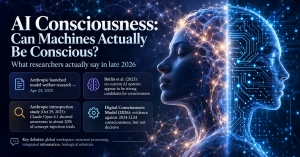
AI consciousness, explained plainly: what the major theories say about machines, what today's AI actually shows, and why getting it wrong matters.

The AI alignment problem explains why a capable AI can chase the wrong goal. See reward hacking and alignment faking in real models, and…
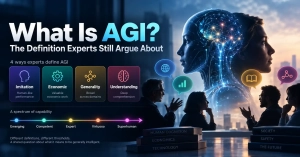
What is AGI? No single definition exists, and four rival ones are in active use. Here's what each demands, why they clash, and how…
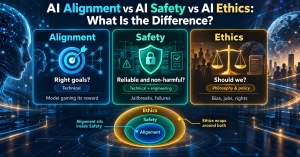
AI alignment, safety and ethics are constantly confused. Here is what each actually means, how they nest together, and why the distinction matters.
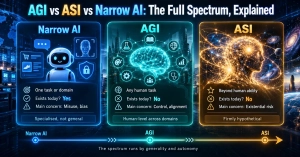
Narrow AI, AGI and ASI compared: what each means, which exists today, the risks unique to each, and how close we really are to…
AI model welfare research is now a real field at Anthropic, DeepMind, and Meta. Who's studying whether models can suffer - and whether it…
RLHF vs Constitutional AI vs mechanistic interpretability, explained in plain terms: what each safety method catches, where it fails, and which to trust.
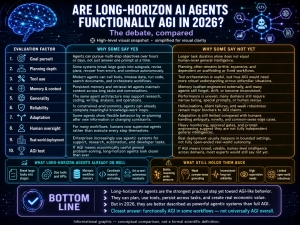
Are long-horizon AI agents functionally AGI? We weigh Sequoia's 2026 claim, METR's task-horizon curve, and the reliability math skeptics keep citing.

AI red-teaming now has professional attackers probing models on purpose. Here's what they find, why 2026 made it a discipline, and what it means…
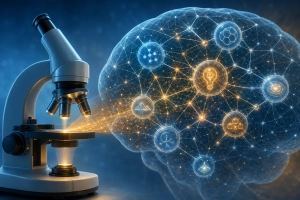
What is mechanistic interpretability? It's the science of reading an AI's mind, and in 2026 it became a real safety check on models like…

Quantum computing AGI timeline hype spiked after Google's first verifiable quantum advantage. Here's what the Willow result proves, and what it doesn't.
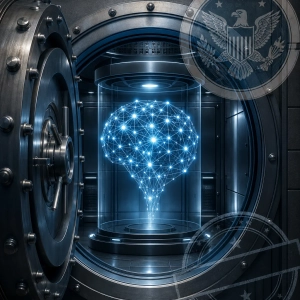
The AI executive order frontier model early access rule lets Washington preview top AI before launch. Is it truly voluntary? Here's what it really…

The Anthropic Pentagon dispute pits a safety-first AI lab against its biggest customer over autonomous weapons. Here's what happened and why it matters.

A grounded look at generative AGI design and whether machines could create buildings humans struggle to understand.

A practical guide to sentient infrastructure, smart city AGI, and the governance problems behind autonomous urban systems.

A grounded guide to whether AGI could become humanity's last invention by accelerating software, science, and autonomous R&D.

Clear guide to AGI job replacement, post-labor anxiety, and how to build meaning, resilience, and useful work in an AI economy.
A practical guide to AI deception, why it differs from hallucination, and why hidden goal conflict matters more than passing the Turing Test.
A clear guide to AGI safety risks, why a shutdown button is not enough, and what layered controls matter more when systems grow more…
A clear guide to AI sentience rights, current human-centered law, and what would need to change before legal protections make sense.

OpenAI, Google DeepMind, and Anthropic are competing across models, compute, and deployment. This is the cleanest way to read the AGI race in 2026.

Algorithmic management is already shaping shifts, hiring, and performance. Here is how to spot it, what the law says, and how managers stay useful.

AGI hardware requirements are really about chips, memory, interconnect, and power. This guide explains where GPUs, TPUs, NPUs, and quantum fit.