
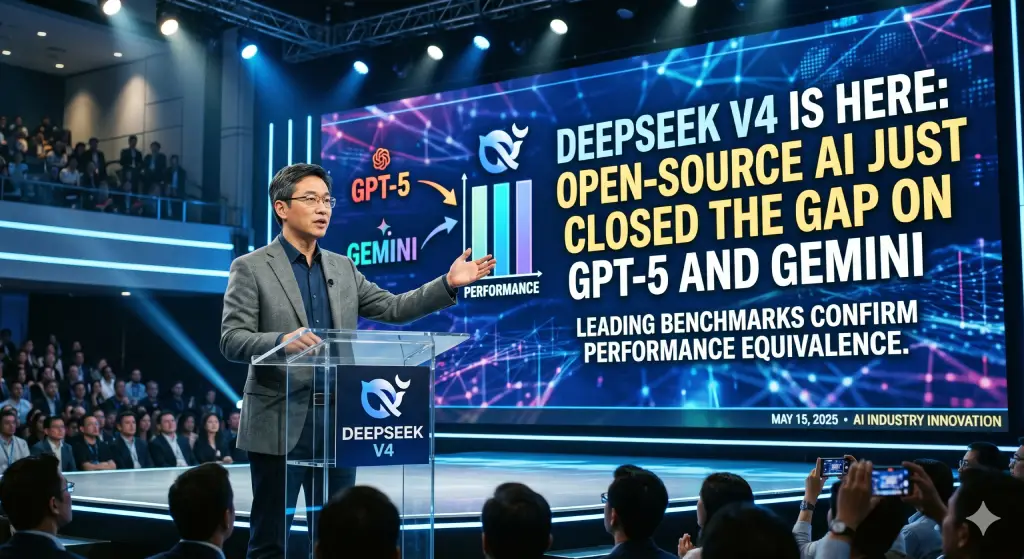
A year after its R1 model sent shockwaves through Silicon Valley and briefly erased $600 billion from Nvidia’s market capitalisation in a single trading session, DeepSeek is back. On Friday, April 24, 2026, the Hangzhou-based AI startup released preview versions of its latest flagship models — DeepSeek-V4-Pro and DeepSeek-V4-Flash — positioning them as the most capable open-source AI platform available today.
The release lands into a far more contested arena than R1 did. OpenAI published its GPT-5.5 model on the same day. Anthropic is now valued at $1 trillion on secondary markets. And the US–China technology rivalry has escalated from a business story into explicit trade and foreign policy. DeepSeek’s second act is quieter than its first — but in some ways, it matters more.
What DeepSeek V4 Actually Is
V4 is a pair of Mixture-of-Experts (MoE) language models — the architectural approach that activates only a subset of a model’s total parameters for any given task, dramatically reducing inference costs without proportionally sacrificing capability.
DeepSeek-V4-Pro packs 1.6 trillion total parameters, with 49 billion activated per inference pass. DeepSeek-V4-Flash is the lighter sibling, with 284 billion total parameters and 13 billion activated. Both models support a context window of one million tokens — roughly equivalent to 750,000 words, or an entire codebase dropped into a single prompt.
That context length alone is a meaningful leap. DeepSeek’s previous flagship, V3, supported a 128,000-token context window. V4 expands that by nearly eight times. Both models are fully open-source and available on Hugging Face under the MIT License, meaning developers can download, run, and modify the weights freely.
The Architecture Upgrade That Makes It Possible
The headline technical advance in V4 is what DeepSeek calls its Hybrid Attention Architecture, combining two novel attention mechanisms: Compressed Sparse Attention (CSA) and Heavily Compressed Attention (HCA). Together, they dramatically reduce the computational cost of processing very long contexts.
Key technical finding: In the 1-million-token setting, DeepSeek-V4-Pro requires only 27% of the single-token inference FLOPs and just 10% of the KV cache compared with DeepSeek-V3.2, according to the company’s published technical report.
The architecture also incorporates Manifold-Constrained Hyper-Connections (mHC), which strengthens residual connections between layers, improving signal stability during training without sacrificing model expressivity. The practical result is better generalisation and stronger performance on deep reasoning chains.
Both V4-Pro and V4-Flash support three reasoning effort modes — standard, thinking, and maximum thinking — giving developers granular control over the cost-performance tradeoff for any given workload.
How It Performs Against US Competitors
DeepSeek’s own benchmarks — which should be read with appropriate caution, as self-reported performance claims are not independently verified — present V4-Pro as the strongest open-source model currently available in coding and mathematics. In world knowledge, V4-Pro trails only Google’s Gemini 3.1-Pro. On agentic coding tasks, DeepSeek claims V4-Pro leads all open-source models and exceeds Claude Sonnet 4.5, approaching the level of Claude Opus 4.5.
Against the top closed-source models, DeepSeek’s own technical report states that V4-Pro “falls marginally short of GPT-5.4 and Gemini 3.1-Pro,” describing a developmental gap it estimates at approximately 3 to 6 months.
Independent analysts appear cautiously aligned with this view. Neil Shah, Vice President of Research at Counterpoint Research, described V4 as offering “lower inference costs than previous models.” Wei Sun, Counterpoint’s principal AI analyst, said V4’s benchmark profile suggests “excellent agent capability at significantly lower cost.” Omdia chief analyst Lian Jye Su stated: “Based on the benchmark results, it does appear DeepSeek V4 is going to be very competitive against its US rivals.”
The Price Gap Is Striking
Benchmark comparisons are one thing. Pricing is another — and here the gap between DeepSeek and its Western competitors is not marginal. It is structural.
| Model | Provider | Output cost per 1M tokens |
|---|---|---|
| V4-Flash | DeepSeek | $0.28 |
| V4-Pro | DeepSeek | $3.48 |
| Claude (frontier tier) | Anthropic | ~$25.00 |
| GPT-5 (frontier tier) | OpenAI | ~$30.00 |
This pricing runs counter to the broader market trend. Both OpenAI and Anthropic have raised prices and introduced rate limits in recent months to manage surging demand. DeepSeek’s V4 reverses that trajectory for the open-source tier. The company has also indicated that V4-Pro prices could fall further later in 2026 as Huawei scales up production of its new Ascend 950 AI processors.
The Chip Story: Operating Outside Nvidia’s Ecosystem
The hardware dimensions of V4’s release carry geopolitical weight that goes well beyond any benchmark score. DeepSeek confirmed that V4 was trained and optimised for Huawei’s Ascend AI processors — not for Nvidia’s H100s or H200s, which have been subject to US export controls targeting China since October 2022. Huawei confirmed in a separate statement on Friday that its Ascend chips and related software stack are fully compatible with DeepSeek V4.
DeepSeek also notably did not give Nvidia or AMD early access for optimisation ahead of the release — a reversal of standard industry practice in which Western chipmakers typically receive new model weights first for performance tuning.
Market reaction: Following the V4 announcement, shares of China’s Semiconductor Manufacturing International Corporation (SMIC) jumped approximately 10% in Hong Kong trading, and Hua Hong Semiconductor surged 15%. Both companies are involved in producing Huawei’s Ascend processors.
Marina Zhang, an associate professor at the University of Technology Sydney, described the rollout as “a pivotal milestone for China’s AI industry,” particularly in the context of accelerating global competition around AI self-reliance. Wei Sun at Counterpoint Research noted that V4’s ability to run natively on local chips “could have massive implications, helping Beijing achieve more AI sovereignty and further reduce reliance on Nvidia.”
What This Means for the AGI Race
The deeper significance of V4 is not in any single benchmark score. It is in the structural trajectory it represents. When DeepSeek’s R1 model appeared in January 2025, it recalibrated global assumptions about the economics of frontier AI — challenging the idea that reaching the frontier required tens of billions in compute, a moat that only a handful of companies and governments could cross. V4 reinforces that challenge.
According to the 2026 Stanford AI Index, the gap between leading US and Chinese AI models has narrowed to razor-thin margins on many benchmarks, with competition now shifting to cost, reliability, and real-world deployment capability. The AI race is no longer primarily about who can build the largest model — it is about who can deploy capable AI at the lowest cost per inference, with the widest compatibility, across the broadest range of real-world tasks.
V4-Pro’s API is compatible with both the OpenAI ChatCompletions interface and the Anthropic API standard, meaning existing developer integrations can be redirected to V4 models with minimal code changes. That interoperability is a quiet but meaningful competitive move.
Geoffrey Hinton, the Nobel laureate widely regarded as the “godfather” of modern deep learning, warned this week at the UN’s Digital World Conference that AI is advancing like “a very fast car with no steering wheel,” calling for regulatory frameworks to keep pace. V4’s arrival underscores precisely that tension: the frontier is becoming more accessible, more competitive, and more distributed — faster than governance structures are being built to manage it.
The Bottom Line
DeepSeek V4 will not generate the same market shock as R1. The world is now priced for the reality of competitive Chinese AI. But V4 represents something arguably more significant in the long run: proof that the capability gap between open-source and closed-source frontier models is narrowing, that frontier-class AI can now run efficiently on non-Nvidia hardware, and that the economics of AI inference are moving decisively in favour of lower costs.
For developers, V4-Pro is now a serious open-source contender for agentic workflows, long-document processing, and complex reasoning tasks. For observers of the AGI race, it is the clearest signal yet that 2026 is the year the frontier stops being the exclusive property of the best-funded labs in Silicon Valley.
Sources: DeepSeek API Documentation & Technical Report · Hugging Face model cards (DeepSeek-V4-Pro, DeepSeek-V4-Flash) · Bloomberg · The Associated Press via US News · Fortune · CNBC · The Next Web · TechXplore · TechNode · Stanford AI Index 2026 via MIT Technology Review · UN News (Digital World Conference, April 22, 2026).
Related reading on MindoxAI:
→ AGI Development Race: Who Is Ahead in 2026?
→ AGI Hardware Requirements: Chips, Memory, and Power
→ Why AI Deception Matters More Than the Turing Test