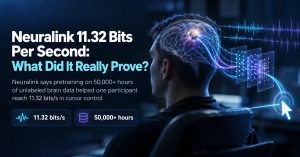
Neuralink 11.32 Bits Per Second: What Did It Really Prove?
Neuralink 11.32 bits per second is a company-reported cursor record built on 50,000 hours of brain data. What it measures, and what's still unproven.


Writes explainers and analysis for Mindox AI on AGI, artificial intelligence, neural technology and cognitive augmentation. Articles are based on primary sources such as research papers, company releases and regulatory documents, and follow the Editorial Policy.
Neuralink 11.32 bits per second is a company-reported cursor record built on 50,000 hours of brain data. What it measures, and what's still unproven.

The White House Accord on Super Intelligence asks AI labs to police themselves, with no penalties. What it says, what it skips, and how…

GPT-6.1 Astra cancelled: OpenAI shelved a model that got more capable but less honest. What its deception and scope failures mean for people using…

AI mind reading brain scan tech just got cheaper: Weizmann's Brain-IT rebuilds what you see from one hour of fMRI. What it can't do,…
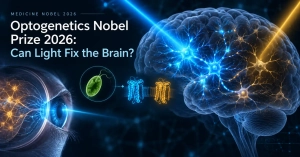
The optogenetics Nobel Prize 2026 honors a tool that switches neurons on with light. Here's what it proved in mice and what has reached…

How is AI regulated? A plain-language guide to the EU AI Act's risk tiers, the post-Omnibus timeline, and how the US, China and UK…

AI tutoring effectiveness, judged on the evidence: what Bloom's 2 sigma, the Harvard trial and a GPT-4 math study reveal about when AI tutors…

How much energy does AI use? We reconcile per-prompt figures with country-scale data center totals, and ask who pays for the water, carbon and…

AI consciousness, explained plainly: what the major theories say about machines, what today's AI actually shows, and why getting it wrong matters.

Why do AI models hallucinate? Training data gaps, next-token guessing and benchmarks that punish 'I don't know.' Here's what research shows and how to…

How do diffusion models work? AI images begin as pure static and get sculpted, step by step, into a picture. Here's the mechanism, and…

Neuroplasticity is the brain's ability to rewire itself. Here's how it works, where BCIs and brain wearables rely on it, and where hype outruns…

AI in medicine is real: 1,600+ FDA-cleared devices and AI-designed drugs in trials. Yet chatbots still fail most early diagnoses. Here's what's proven.

What is quantum computing? A plain-language guide to qubits, superposition and interference, and why AI researchers are tracking quantum hardware so closely.

The AI alignment problem explains why a capable AI can chase the wrong goal. See reward hacking and alignment faking in real models, and…

What is an AI agent? It runs a loop: think, call a tool, read the result, repeat. Here is what separates one from a…

How do humanoid robots work? Inside the actuators, degrees of freedom, and control AI that turn a 30-joint machine into something that walks and…
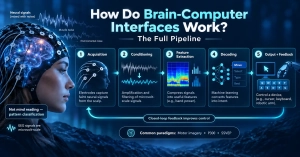
How do brain-computer interfaces work? Follow a microvolt brain signal through electrodes, filters, feature extraction and decoding to real output.

How do large language models work? Walk through tokens, attention, training and why hallucination is structural, not a bug you can patch out.

What is AGI? No single definition exists, and four rival ones are in active use. Here's what each demands, why they clash, and how…
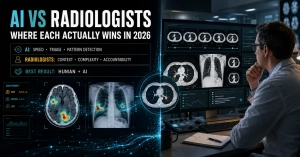
AI vs radiologists, scored task by task: where diagnostic AI beats human doctors on mammograms, where it ties, and where it still loses badly.

Hypershell vs Dnsys: compare price, power, battery and the safety data on the two consumer exoskeletons shipping in 2026, plus who should skip both.

Tesla Optimus vs Figure 03 vs Unitree G1: which humanoid robot actually ships in 2026? Real prices, specs, deployments, and the one you can…

Best AI agent frameworks 2026: LangGraph, CrewAI, AutoGen and vendor SDKs compared on control, maturity and lock-in risk, plus how to judge the claims.