

Midjourney built its name generating pictures that look real without being real. Now, with the Midjourney ultrasound scanner, it wants to point that same instinct at your liver.
Unveiled as “Midjourney Medical” on June 18, 2026, the device promises a full-body scan in about a minute: you step onto a platform, sink into a shallow pool of water, and a ring of underwater sensors fires sound through you from every angle (MobiHealthNews). A compute cluster then reconstructs a picture of what’s inside.
Here’s the tension worth sitting with. Midjourney’s entire craft is producing convincing images, regardless of whether the thing in the image ever existed. Ask that company to picture your insides, and you have to wonder which instinct wins.
What the Midjourney ultrasound scanner actually is
Strip away the launch video and the device is fairly concrete. It uses licensed Butterfly Network ultrasound-on-chip hardware, 40 imaging modules per system, under a deal worth up to $74 million over five years (Radiology Business). Midjourney calls the technique “Ultrasonic CT” and describes it as the first new whole-body imaging method in 50 years.
The consumer front end has a name too: the “Midjourney Spa,” with a first location planned for the Bay Area at the end of 2027 (Futurism). Golden light, warm water, a scan on your way out.
Founder David Holz went big on the claims. He called the scanner “in many ways superior to even MRI machines,” with no radiation and no heavy magnets, and said early imaging could one day help the world “avoid 30% of all deaths and 50% of all healthcare costs” (Forbes).
Those are enormous numbers. Hold onto your skepticism for a moment, because the physics has other ideas.
How Ultrasonic CT works, and why it’s still just ultrasound
The name suggests something new. The physics doesn’t back that up.
At bottom, this is ultrasound. Sound waves get fired through a water medium and reassembled by software. The water immersion isn’t a gimmick, though. It exists to remove the skin-air boundary that ordinary ultrasound can’t cross.
But water only solves one interface. Ultrasound still can’t travel through bone or air. That rules out reliable imaging of the brain, which sits behind the skull, and the lungs, which are full of air. Solid abdominal organs, the liver, kidneys, spleen, and pancreas, are the realistic targets.
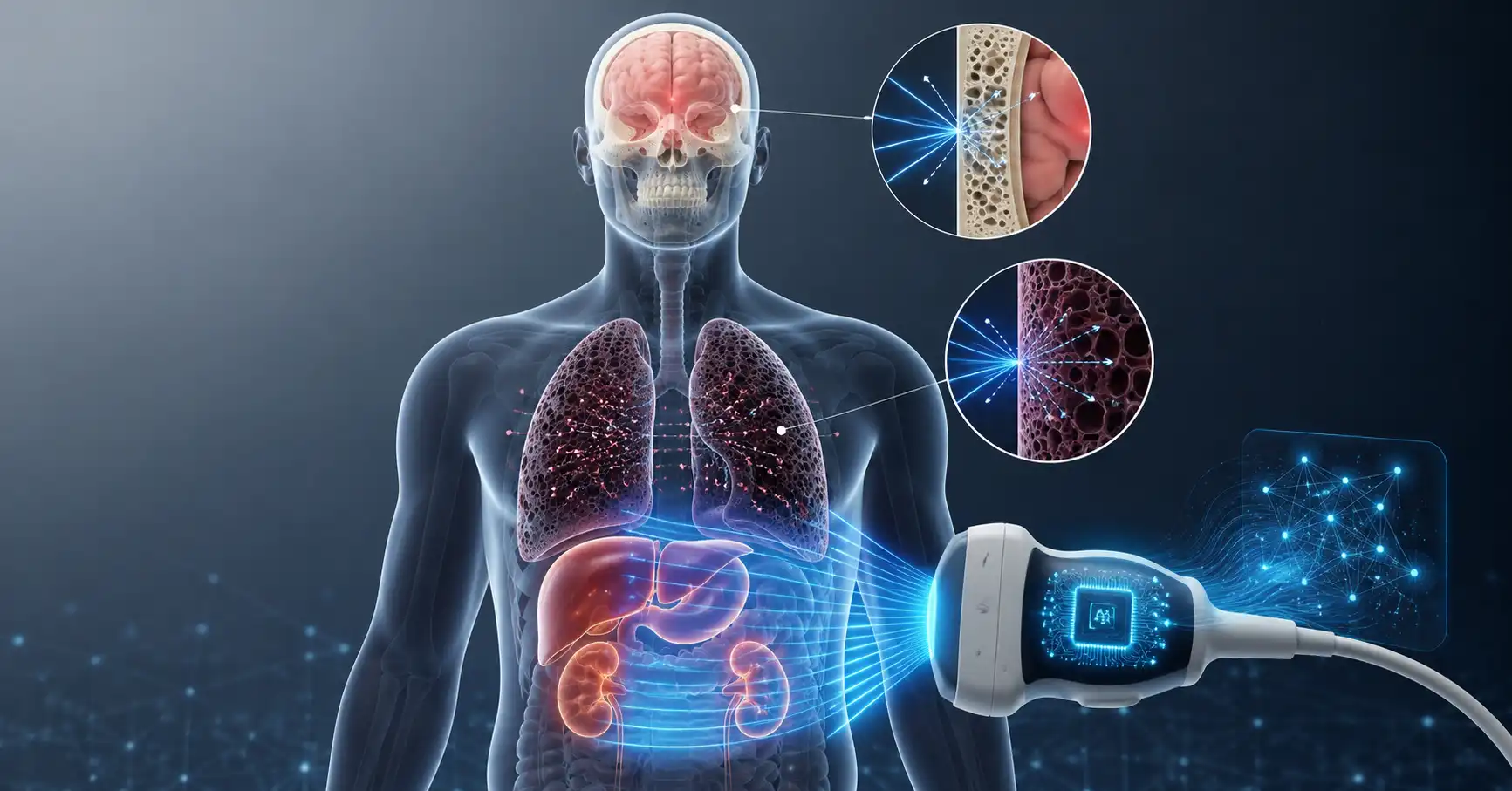
“The device will be limited by the fundamental inability of ultrasound to penetrate through bone, air, and deep soft tissues, rendering many body parts inaccessible,” said Francis Deng, a radiologist at Johns Hopkins, in comments to Futurism.
So the honest framing is narrower than the marketing. Not a whole-body window. A partial one.
The trust problem an AI image generator brings to medicine
This is where Midjourney’s résumé cuts against it.
In February 2024, the journal Frontiers retracted a paper containing Midjourney-generated diagrams, including a now-infamous image of a rat with grossly oversized, anatomically nonsensical anatomy, as Futurism has reported. Critics keep raising it, and not to be cruel. A diffusion model is trained to make outputs that look plausible. Plausible and true are not the same thing.
Laura Heacock, a breast-imaging radiologist at NYU, put the risk to Futurism in one line: “I can AI-upsample a fuzzy photograph but that doesn’t mean what comes out of it actually existed.”
That’s the whole worry compressed into a sentence. If reconstructing a scan involves any AI upsampling or gap-filling, the output can look clean, confident, and medically wrong. A picture that invents a detail is a nuisance in an art tool. In a scan of your pancreas, it’s a different kind of problem. We’ve written before about why AI deception matters more than passing the Turing test, and medical imaging is where that abstract worry gets teeth.
It’s the same underlying question that shadows generative models everywhere: a system trained to be convincing rather than correct carries that habit into whatever job you give it next.
What radiologists and regulators are saying
The gap between pitch and prototype is wide.
Midjourney says the finished scan will take 60 seconds. The current prototype takes roughly 20 minutes, because the system “cannot yet move that much data fast enough,” according to ExpertRadiology’s breakdown. And only about a dozen people have been scanned by it so far. A dozen.
On regulation, Midjourney is being careful. It makes no diagnostic claims at launch, framing the device as body-composition and wellness, and says it will submit results to the FDA over time. No clearance exists today. Butterfly Network went further and cautioned publicly that clearance “may not come on the anticipated timeline, or at all” (Butterfly Network).
Paul Hsieh, a diagnostic radiologist with more than 30 years reading ultrasound, CT, and MRI, was blunt about the clinical limit: “I would not feel confident in determining whether or not there was an early tumor (less than 1 cm in size) in organs such as the liver or kidneys with this system.”
Read those together and a pattern emerges. Big claim, thin evidence, and a wellness label doing the work a clearance hasn’t.
Privacy, overdiagnosis, and the ethics of scanning healthy people
Say the imaging works well enough. There’s still a catch that has nothing to do with resolution.
Scan enough healthy people and you find things. Whole-body MRI screening research shows most asymptomatic people turn up at least one incidental finding, and roughly a third have something significant enough to warrant follow-up (ExpertRadiology). The overwhelming majority prove benign. At population scale, that predictably manufactures anxiety and a wave of low-value tests chasing shadows.
Then there’s the part almost nobody in the trade coverage foregrounds. The scan may not be the product.
Reporting suggests Midjourney’s real objective is a dataset: billions of internal body scans by 2031, roughly 50,000 machines worldwide, to train future disease-detection AI, according to that same Forbes reporting. The current device carries no diagnostic AI at all. So early adopters aren’t just patients. They’re data donors, handing over the most intimate map imaginable, an image of their own organs.
That reframes the consent question entirely. It’s a version of the data-ownership problem we’ve raised around neural tech and who owns the data your body generates, only here the raw material is a picture of your insides. And it fits a broader pattern of AI labs pivoting into new markets during the race to build ever-larger systems, where owning a rare dataset can matter more than owning the product.
What would need to be true for this to work
I’m not writing this off. A cheap, radiation-free way to image the abdomen could help people, especially where MRI is scarce or unaffordable. The idea isn’t the problem.
The proof is. For the Midjourney ultrasound scanner to deserve trust, a few things have to hold. Peer-reviewed accuracy data, not a launch video. A published, verifiable line between what the sensors measured and what the AI reconstructed, so no invented detail slips in as fact. FDA clearance before any diagnostic claim. And clear, revocable consent over where those scans go and who gets to train on them.
None of that exists yet. What exists is a beautiful pool, a bold number, and a company whose greatest skill is making the unreal look convincing.
Curious about the same trust question from the other direction? Read our take on whether you can trust an AI to diagnose you better than a doctor, then decide how much you’d hand over for a 60-second scan.