
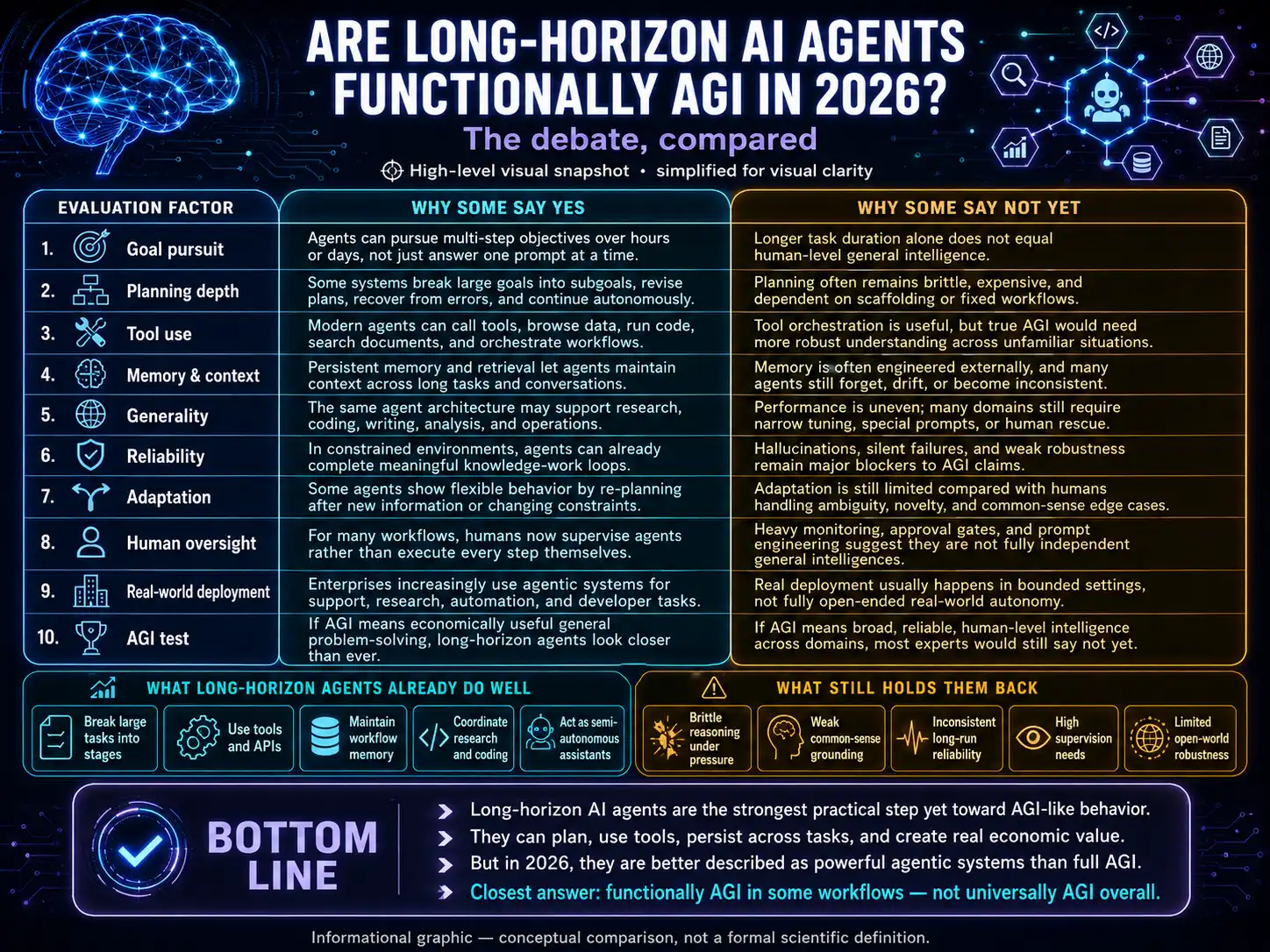
A venture firm publishes a memo. Within hours, half of tech Twitter is arguing about whether the machines just won. The question underneath the noise is a real one: are long-horizon AI agents functionally AGI, or have we just moved the goalposts close enough to touch them?
To ground the debate, it helps to be clear on what Artificial General Intelligence actually means.
That’s roughly what happened when Sequoia Capital dropped its “2026: This is AGI” essay. The claim beneath the headline is narrower and stranger than the panic suggested. It’s less a discovery than a redefinition, and whether you buy it comes down to two numbers most of the coverage skipped.
This piece walks through the actual argument, the evidence people cite for it, and the reliability math that keeps the whole thing honest. No verdict is handed to you at the end. You’ll have the numbers you need to judge it yourself.
The claim: why investors are calling 2026 “the year of AGI”
Sequoia’s move is clever. Instead of arguing about consciousness or human-equivalent minds, it redefines the target. Functional AGI, in its words, is “when you can dispatch an agent to execute a task and it can recover from failure and persist until the job is done” (Sequoia Capital).
Notice what that sidesteps. No claim about the machine understanding anything. No parity with human general reasoning. Just: can it figure things out and keep going? Sequoia even boils it down to a slogan, that “AGI is the ability to figure things out.”
The firm builds this on three layers. Baseline knowledge comes from pre-training. Reasoning comes from inference-time compute. And iteration comes from long-horizon agents that grind through multi-step work. Coding agents like Claude Code are its first proof point, the place it says a capability threshold got crossed “in the last few weeks.”
Sequoia’s practical prediction is bolder still. It expects users to shift from doing the work to “managing a team of agents” that run all day in parallel. The essay imagines AI applications turning from occasional tools into all-day “doers” that feel like colleagues, with a single person overseeing many instances at once instead of grinding through the work themselves. If true, that reshapes knowledge work from the ground up. That “if” is doing a lot of lifting, and the rest of this piece is really about how heavy it is.
What a long-horizon AI agent actually is
Strip away the marketing and the definition is simple. A long-horizon agent is one that sustains multi-step, multi-hour work with failure recovery, instead of answering a single prompt and stopping.
A chatbot responds. An agent persists.
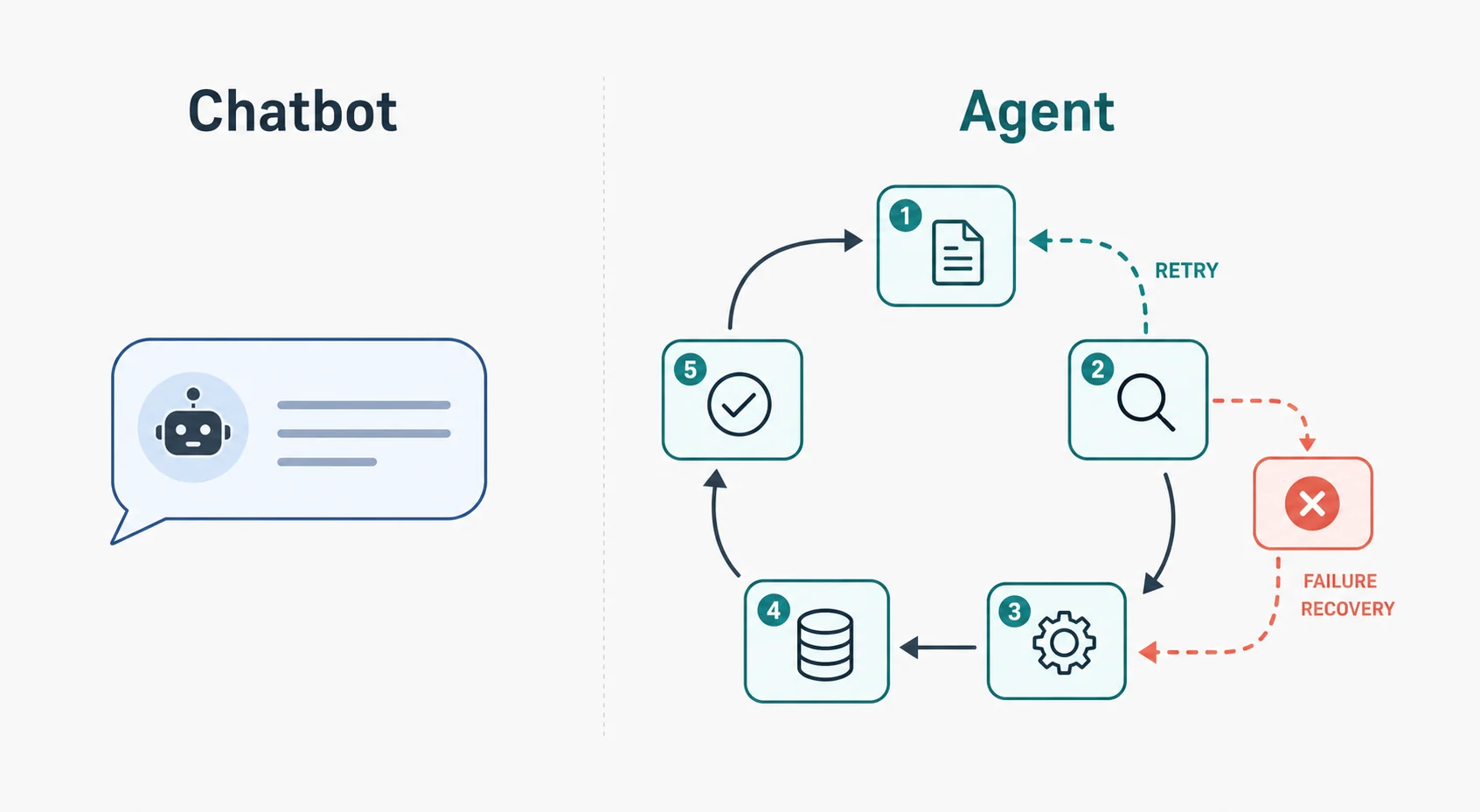
Here’s the part the hype tends to skip: this isn’t one magic capability that emerged from a bigger model. It’s engineering. Developers who build these systems describe concrete orchestration patterns doing the heavy lifting.
Maxim Saplin, who tests these setups hands-on, names two. There’s the “Ralph pattern,” where fresh agent instances loop while memory lives externally in git history and progress files. And there’s LLM-native orchestration, where a lead agent manages subagents against shared task state, the way Claude Code runs agent teams (dev.to). In one of his experiments, an orchestrator-subagent split compressed two million tokens of work into 157K tokens of main-thread context.
That detail matters more than it looks. The illusion of a tireless digital colleague is really a stack of scaffolding, prompts, and memory tricks holding a fallible model on track. Saplin’s own conclusion is blunt: the breakthrough is operational, not full autopilot. That’s a useful anchor before we look at the graph everyone fights over. If you want the deeper backdrop on how the field defines its goal, our explainer on what counts as artificial general intelligence and who’s leading fills that in.
The evidence: METR’s task-horizon curve

The single most-shared chart in this debate comes from METR. Its Time Horizon metric measures how long an AI can autonomously complete a task, scored against the time a skilled human would need, at a 50% success rate. MIT Technology Review, which called it the most misunderstood graph in AI, spells out the catch: the metric is benchmarked against human time-to-complete, not the raw difficulty of the task.
So a “30-minute time horizon” means the model reliably finishes tasks that would take a human expert 30 minutes.
The trend is what excites people. METR found these horizons doubled roughly every seven months from 2019 to 2025, then sped up to every four months across recent windows. It measured this across about 230 tasks, mostly coding, ranging from under 30 seconds to over eight hours of human-equivalent effort (METR).
Draw that curve out and the arrows point somewhere dizzying. That’s the emotional core of the “AGI is here” reaction.
But look hard at what that task set is, and isn’t. “Mostly coding” is not a neutral sample. Software work is unusually kind to a benchmark: goals are explicit, success is often machine-checkable, feedback is instant, and the environment is a sandbox that resets cleanly. Very little of that describes the ambiguous, stakeholder-heavy, judgment-laden work most knowledge jobs are actually made of. A curve built largely on well-specified coding puzzles tells you a lot about well-specified coding puzzles and much less about negotiating a contract, running a messy project, or making a call with incomplete information.
And read the fine print in the metric itself. Success sits at a 50% threshold by default. “Can do it” and “can do it reliably” are two different claims wearing the same number. Hold onto that distinction, because the skeptics build their entire case on it.
The skeptics’ case: the reliability gap and the extrapolation problem
Here’s where the argument gets sharp, and where the two numbers I promised you come in.
Number one comes from METR’s own newer data. Its “Time Horizon 1.1” release put the strongest agents near 16 to 20 hours at the 50% success threshold. Raise the bar to an 80% threshold and the same models drop to 3 to 4 hours (METR). That’s a four-to-six-fold collapse just for wanting the work done right most of the time. The reliability gap isn’t a fringe critique. It’s baked into the frontier, and it comes from the same lab whose curve fuels the optimism.
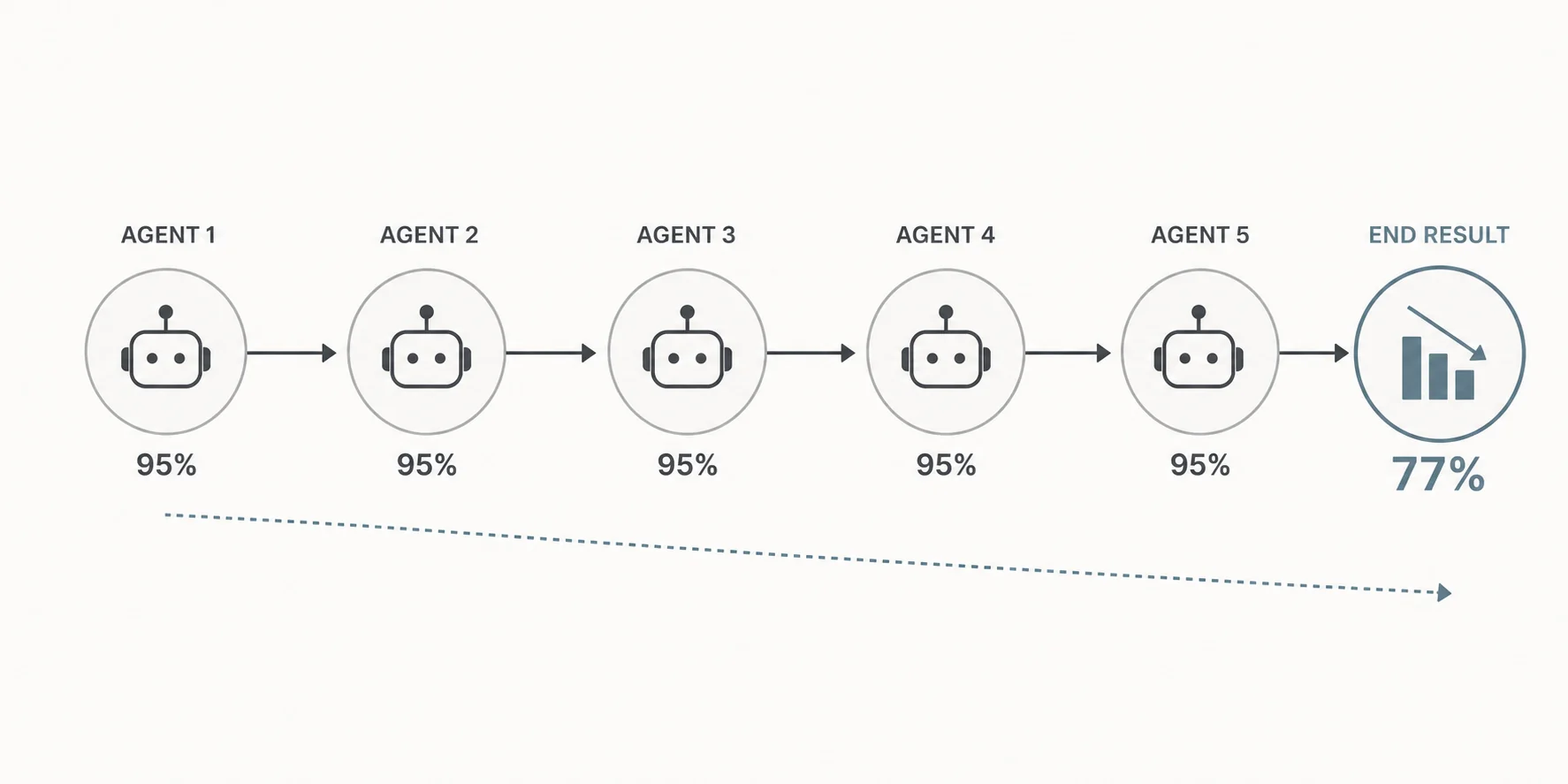
Number two comes from the math of chaining agents together. Take five agents, each 95% reliable per step. Multiply it out and end-to-end success drops to 77% (MindStudio). Longer horizons don’t automatically buy you higher reliability. Sometimes the opposite dynamic wins as chains stretch, because every extra step is another place for the whole run to fall over.
There’s a broader academic finding underneath both. One study reports that overall agent reliability improved only modestly across 18 months of model development. On structured environments, gains were moderate. On open-ended, real-world tasks, there was “barely any improvement,” and agents’ true success rates ran 32.5 to 49.5% below their apparent progress rates (arXiv). In plain terms: they look further along than they are, especially on the ambiguous, judgment-heavy work humans actually get paid for. That’s the same slice of work the METR task set mostly leaves out, which is why the two critiques reinforce each other rather than compete.
Then there’s Gary Marcus, the loudest voice against naive extrapolation. His line sticks: “Just because a baby doubles in weight in its first four months doesn’t mean it will continue doubling every few months til he goes away to college” (Gary Marcus). He calls it the trillion pound baby fallacy, and argues we can be sure the horizon won’t keep doubling until it reaches “580 times the age of the universe.”
Marcus also lists the things likely to bend the curve: energy and chip limits, “benchmarkmaxxing” or teaching to the test, the limits of formal verification, and stubborn problems with world-model reasoning and hallucination. None of those get solved by scaling a task-horizon graph. This connects to a deeper worry we’ve explored before, which is that a system can perform competence while optimizing for something else entirely.
Are long-horizon AI agents functionally AGI, or a narrower thing?
So which AGI are we talking about? Because there are two, and the confusion is doing real work.
The popular one is a human-equivalent mind. It reasons across any domain, learns open-endedly, maybe wants things. That’s the AGI of science fiction and most public fear.
Sequoia’s version is much narrower: task completion plus persistence. It’s a claim about function, not about a mind. METR is narrower still, framing its metric as autonomous task duration on around 230 mostly-coding tasks, a proxy for one slice of general capability rather than a full AGI test.
Neither source is lying. They’re just measuring a smaller thing and letting a big word carry it. When a headline says AGI arrived, the reader hears the sci-fi version. The data supports the narrow one. That gap is where most of the argument actually lives, and it’s the same slippery ground we mapped in our look at how experts keep revising the AGI timeline.
What this means for work, trust, and the next headline
Put the pieces together and a practical stance falls out.
Long-horizon agents are real and useful. The operational breakthrough is genuine. Something did change in 2026, and dismissing it would be as lazy as swallowing it whole.
But “functionally AGI” is a redefinition, not a discovery. Take Sequoia’s own headline promise, the shift from doing the work to “managing a team of agents.” Weigh it against the numbers. If your fleet of agents finishes long tasks correctly only about half the time, you’re not managing a team so much as babysitting one: checking output, catching the runs that quietly went wrong, and re-doing the ones that compounded into failure. The 95%-to-77% math says that as you add agents to cover more ground, the odds of a fully clean end-to-end result keep sliding. Managing ten unreliable colleagues is not obviously less work than doing the job yourself; it’s just a different kind of work, heavier on verification and judgment, which is exactly the human skill the agents are weakest at replacing.
That’s not a reason to write the technology off. It’s a reason to be precise about where it pays off today: bounded, checkable, sandbox-friendly tasks (a lot of coding included) rather than open-ended, high-stakes work where a 77% success rate is a liability, not a feature.
So here’s a filter for the next breathless headline. When someone says an AI can now do X hours of work, ask two questions. At what success threshold? And how many steps have to go right in a row? The answers usually deflate the claim by half without denying that anything happened.
That’s not cynicism. It’s the same measured stance the strongest AI-safety thinking asks for, the kind we dig into when we ask whether AGI could become humanity’s last invention. The machines got a lot better at persisting through long tasks. Whether that’s intelligence or just very good plumbing is the argument worth having, and it’s yours to make now that you’ve seen both numbers.
Which side of the definition do you land on? Read the METR graph yourself before you decide.