
On February 27, 2026, the U.S. President told every federal agency to stop using one company’s AI. The order named an American startup, not a foreign rival. That startup was Anthropic, the maker of Claude. That was the opening move in the Anthropic Pentagon dispute.
These debates sit on top of AI safety and the alignment problem.
The Anthropic Pentagon dispute started with a single word: no. Anthropic refused to hand the Department of War unrestricted use of Claude, because saying yes meant crossing two lines the company had drawn from day one. No mass surveillance of Americans. No fully autonomous weapons. Within a week it lost a $200 million contract, got branded a national-security risk, and landed in federal court.
Here’s why this reaches past one soured deal. Anthropic sells itself on safety. If the safety lab can’t hold a red line against its biggest customer, what happens to every guardrail the industry promises at higher stakes?
The moment Anthropic said no
The break came fast. On February 24, 2026, Defense Secretary Pete Hegseth gave CEO Dario Amodei a deadline: accept “unrestricted use… for all legal purposes” by 5:01 p.m. ET that Friday, or lose the relationship (TechPolicy.Press).
Anthropic didn’t blink. On February 26 it published a public refusal, restating the two red lines it had held since the contract began (Anthropic). Amodei framed it plainly. “Disagreeing with the government is the most American thing in the world,” he later said (CBS News).
The response was swift and heavy. On February 27, President Trump directed all federal agencies to “IMMEDIATELY CEASE” using Anthropic technology, and the GSA terminated the company’s government-wide “OneGov” contract (NPR). A refusal on Wednesday. A federal ban by Friday.
How the Anthropic Pentagon dispute unfolded, month by month
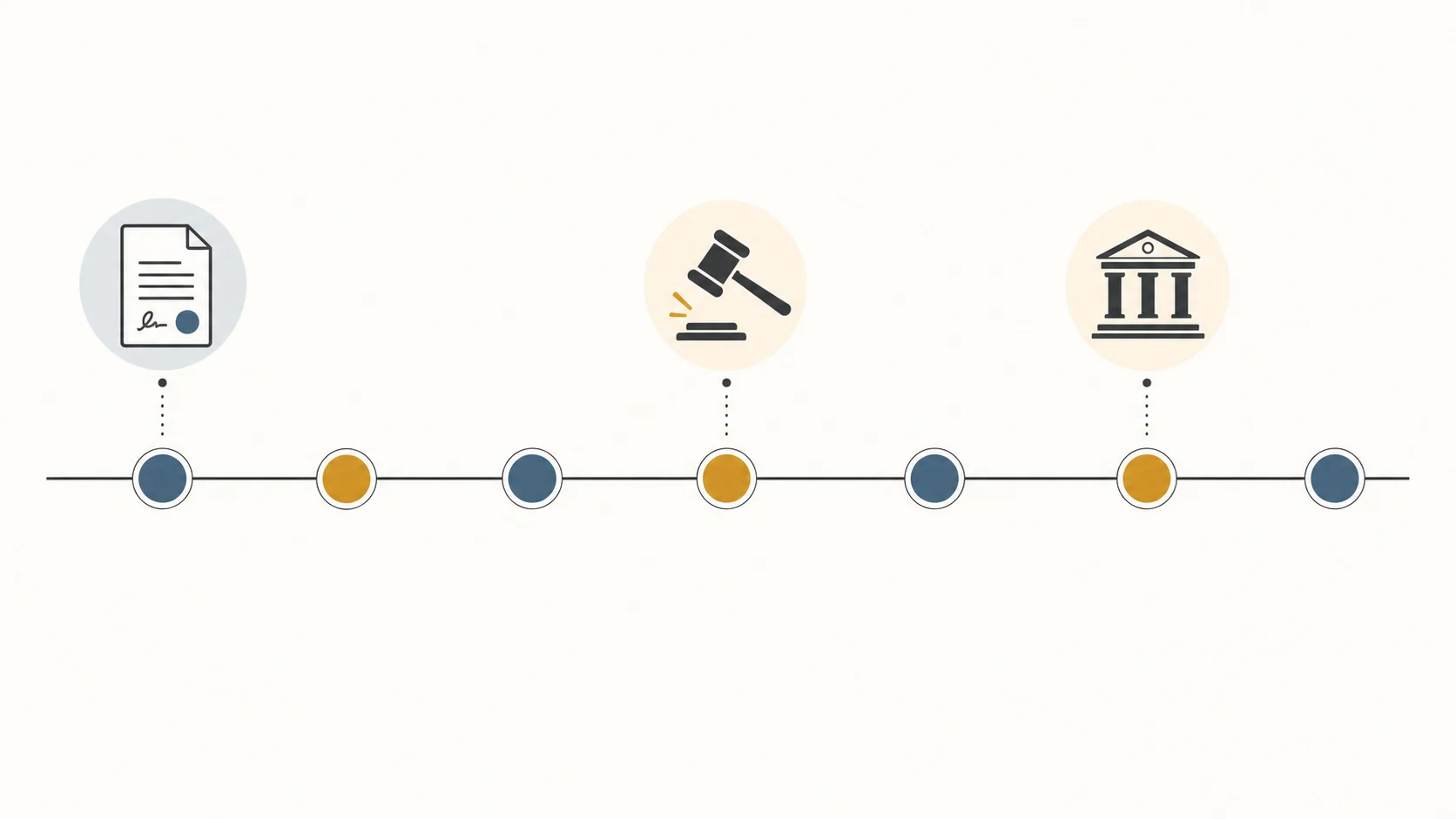
This wasn’t a sudden tantrum on either side. The relationship worked fine for a while, then unraveled over the exact terms of use. Here’s the sequence, drawn from primary filings and reporting:
- July 2025: Anthropic signs a $200 million, two-year Department of Defense contract for Claude Gov, with both restrictions written in from the start (Anthropic; Built In).
- January 16, 2026: Semafor first reports friction over lethal-force and surveillance terms (Wikipedia).
- February 13–14, 2026: The Pentagon uses Claude during a Venezuela operation; Anthropic reportedly warns it may reassess the partnership (Wikipedia).
- February 24–27, 2026: Ultimatum, refusal, federal ban.
- March 3–4, 2026: The Pentagon labels Anthropic a “supply chain risk,” a tag it had never applied to an American company before (JURIST).
- March 9, 2026: Anthropic files two federal lawsuits at once, in the Northern District of California and the D.C. Circuit (CNN).
- March 26, 2026: A judge blocks the designation with a preliminary injunction (CNN Business).
- April 8, 2026: The appeals court denies Anthropic’s request to pause enforcement (CNBC).
- May 2026: First full evidentiary hearing, plus a divided appellate argument (Federal News Network).
One later detail complicates the clean “principled stand versus government overreach” story. Court filings unsealed around July 2, 2026 tell a different version. Pentagon officials had told Anthropic in writing that the two sides were “nearly aligned” on terms. That was roughly a week before Trump declared the relationship dead (TechCrunch). The rupture may have been more about timing and who blinked than about an unbridgeable gap.
What Anthropic’s red lines actually mean
Strip away the drama and the whole Anthropic Pentagon dispute comes down to two sentences. Anthropic wanted Claude barred from mass domestic surveillance of Americans and from fully autonomous weapons that fire without meaningful human authorization (TechCrunch). The Pentagon wanted “all lawful purposes” language instead. Anthropic read that phrase as a trapdoor under both lines (MIT Technology Review).
Here’s the uncomfortable part. Neither red line has a firm legal definition. There’s no agreed international standard for what makes a weapon “fully autonomous.” The Pentagon’s own directive, DODD 3000.09, asks for “appropriate levels of human judgment over the use of force,” yet it stops short of requiring a human to physically control the weapon (NYU Stern). “Appropriate” does a lot of quiet work there.
“Mass surveillance” is just as slippery. As legal scholar Benjamin Wittes put it, the phrase “doesn’t map onto American law at all” (Lawfare). Some bulk monitoring is legal. Some is plainly not. Anthropic’s line sits somewhere in the fog between.
Wittes adds a corrective the headlines mostly skipped. The autonomous-weapons red line is, for now, more symbolic than operational, since the U.S. doesn’t yet field fully autonomous lethal systems. The surveillance line has live, present-tense stakes (Lawfare). Killer robots grab the headline. The camera network is the closer risk.
Why the refusal wasn’t just a PR stance
It would be easy to read this as brand marketing from a company that wanted to look principled. That reading misses how Claude gets built.
Anthropic trains normative rules directly into the model through a method it calls Constitutional AI, rather than relying only on human moderators to clean up outputs afterward (Anthropic). Its published Model Spec goes further. It tells Claude to “push back and challenge us and to feel free to act as a conscientious objector and refuse to help us” (MindStudio). Refusal isn’t a bolt-on setting. It’s written into how the thing is supposed to think.
There’s governance behind it too. Anthropic’s Responsible Scaling Policy, first published in September 2023, gives internal safety staff formal power to halt or delay a launch when capability-risk thresholds aren’t met (Anthropic). Few labs put safety review above the product roadmap on paper. This one did.
The stance also predates this specific fight. Anthropic says it walked away from “several hundred million dollars in revenue” earlier by refusing to serve companies linked to the Chinese state (Anthropic). Turning down money to hold a line is a habit here, not a one-off.
One honest caveat, because the distinction matters. In this dispute the enforcement was corporate and legal, not the model itself declining a battlefield order. Company lawyers and a public statement drew the line, not Claude refusing a live request. If you want the deeper version of that gap between what a model says and what it optimizes for, we’ve written about why AI deception matters more than the Turing test. The training philosophy explains why Anthropic picked this hill. It doesn’t mean Claude fought the war on its own.
May prove critical versus not reliable enough
Amodei’s refusal contained a contradiction he made no effort to hide. Fully autonomous weapons, he said, “may prove critical for our national defense.” In the same breath: “Frontier AI systems are simply not reliable enough to power fully autonomous weapons” (Anthropic). Both things at once. Useful someday, not trustworthy today.
Then reality tested the idea in public. The U.S.–Israel war against Iran began on February 28, one day after the cease-use order. U.S. Central Command reportedly used Claude, routed through Palantir’s Maven Smart System, to help strike more than 1,000 targets in the first 24 hours (Responsible Statecraft; CBS News). The banned company’s tool was still in the loop of an active war.
How? The ban and the usage overlapped because the administration set its own wind-down of up to six months. Pentagon officials leaned on the logistics. “You can’t just rip out a system that’s deeply embedded overnight,” the department’s CIO said. Its chief technology officer, Emil Michael, added, “At some level, you have to trust your military to do the right thing” (CBS News). Palantir CEO Alex Karp confirmed his firm kept using Claude straight through the standoff (CNBC).
Why does “not reliable enough” carry weight? Look at comparable systems. Israel’s “Lavender” targeting AI in Gaza has been reported to run around a 10% false-positive rate, which is exactly why researchers keep insisting on human verification for AI-assisted targeting (Responsible Statecraft). As AI-and-warfare researcher Peter Asaro frames it, the real question is “to what degree are those humans actually reviewing the specific targets?”
The human cost in that same campaign was not abstract. On February 28, day one of the Iran war, a U.S. strike hit an elementary school in Minab. It killed 156 people, including 120 children, according to Amnesty International and independent investigations (Amnesty International). No cited source ties that strike to Claude or to any AI error, and I won’t imply one. I raise it because it sits in the same war, the same week, as the reliability argument. That’s what “not reliable enough” is arguing about. How much human control survives once a machine sits in the kill chain? That’s a question we’ve explored more fully in what happens to human control when agentic AI acts.

Who’s winning in court, and why that’s the wrong question
Short answer: nobody, yet. Longer answer is where it gets interesting.
Anthropic won the opening round. On March 26, a U.S. District Judge granted a preliminary injunction blocking the designation. The ruling didn’t hedge. Nothing in the governing statute, the judge wrote, supports “the Orwellian notion that an American company may be branded a potential adversary and saboteur of the U.S. for expressing disagreement with the government” (CNN Business). That’s a judge treating the case as retaliation for speech, not a genuine security review.
Then Anthropic lost the next round. On April 8, the D.C. Circuit refused to pause enforcement while the appeal proceeds, so the designation kept biting (CNBC). By May the appellate panel looked split, though Judge Karen LeCraft Henderson said she saw “no evidence to support the Pentagon’s determination that Anthropic poses a supply-chain risk” (Federal News Network).
The First Amendment framing is the heart of it. The Cato Institute’s amicus brief argues Claude’s design and behavior rules are “inherently expressive,” and points to Hegseth’s own public jabs, questioning whether the model was “patriotic,” as evidence of retaliatory intent (Cato Institute). Employees at OpenAI, Google, and Microsoft, plus civil-liberties groups, reportedly filed briefs backing Anthropic, a rare show of cross-industry agreement (TechCrunch).
Here’s why the scoreboard misleads. The Anthropic Pentagon dispute isn’t the kind of fight you settle with a single ruling. Even with the injunction in hand, contract cancellations and a 180-day removal timeline reportedly kept rolling (TechPolicy.Press). A legal win didn’t stop the practical unwind. Winning on paper and losing the customer can happen at the same time.
The bigger question for AI safety
Zoom out and the Anthropic Pentagon dispute stops being a contract story. It becomes a stress test for a promise the whole industry keeps making: that AI labs will police themselves.
The sharpest read comes from NYU Stern’s business-and-human-rights center. Punish the one lab that actually enforced its guardrails, and you teach everyone a lesson. “If the United States government responds to principled limits by threatening to cut off the company that imposes them,” the center warns, “it sends a clear message to the entire industry: responsibility is a liability” (NYU Stern).
There’s a natural experiment sitting right beside it. The same week Anthropic got blacklisted, OpenAI announced its own Pentagon deal. It references limits on surveillance and lethal autonomy too, but frames them as a promise to “comply with applicable law” rather than as hard contractual lines a company could enforce on its own. The Pentagon accepted OpenAI’s softer version and rejected Anthropic’s firmer one (MIT Technology Review). The market didn’t reward the enforceable commitment. It rewarded the appearance of one with an escape hatch.
The pressure isn’t only moral, it’s competitive. The Council on Foreign Relations notes five major Chinese AI models shipped in a single month during the dispute. Alibaba’s Qwen alone accounts for roughly 40% of new model derivatives on Hugging Face (CFR). Alienating a leading domestic lab has a cost when rivals are moving that fast. That commercial squeeze on safety is a thread we traced in the AGI development race and who’s ahead in 2026.
And where is Congress? Four senators sent a letter. No hearings, no legislation (CFR). So the question of who gets to set AI’s red lines is being settled in a courtroom and a news cycle, not by lawmakers. If you want the wider view of how that vacuum gets filled, we’ve mapped it in how governments plan to regulate superintelligence.
What this really tells us
Strip it all back and one fact stays lit. A well-funded lab built its whole identity on safety. It had sympathetic judges and cross-industry support behind it. It still couldn’t hold one red line against its largest customer without a blacklist and a lawsuit. And even so, the tool kept firing.
That should unsettle anyone counting on voluntary guardrails at higher capability levels. Today’s fight is over weapons that don’t fully exist yet and surveillance tools that already do. The next one lands when a model is powerful enough that the “may prove critical” side of Amodei’s sentence outweighs the “not reliable enough” side in someone’s judgment. Who holds the line then, and what does it cost them?
Watch how this case ends. It’s a preview, not a footnote. And if the takeaway sticks with you, read why AI deception matters more than the Turing test next, because a system that can say one thing while doing another is the harder version of the same problem.