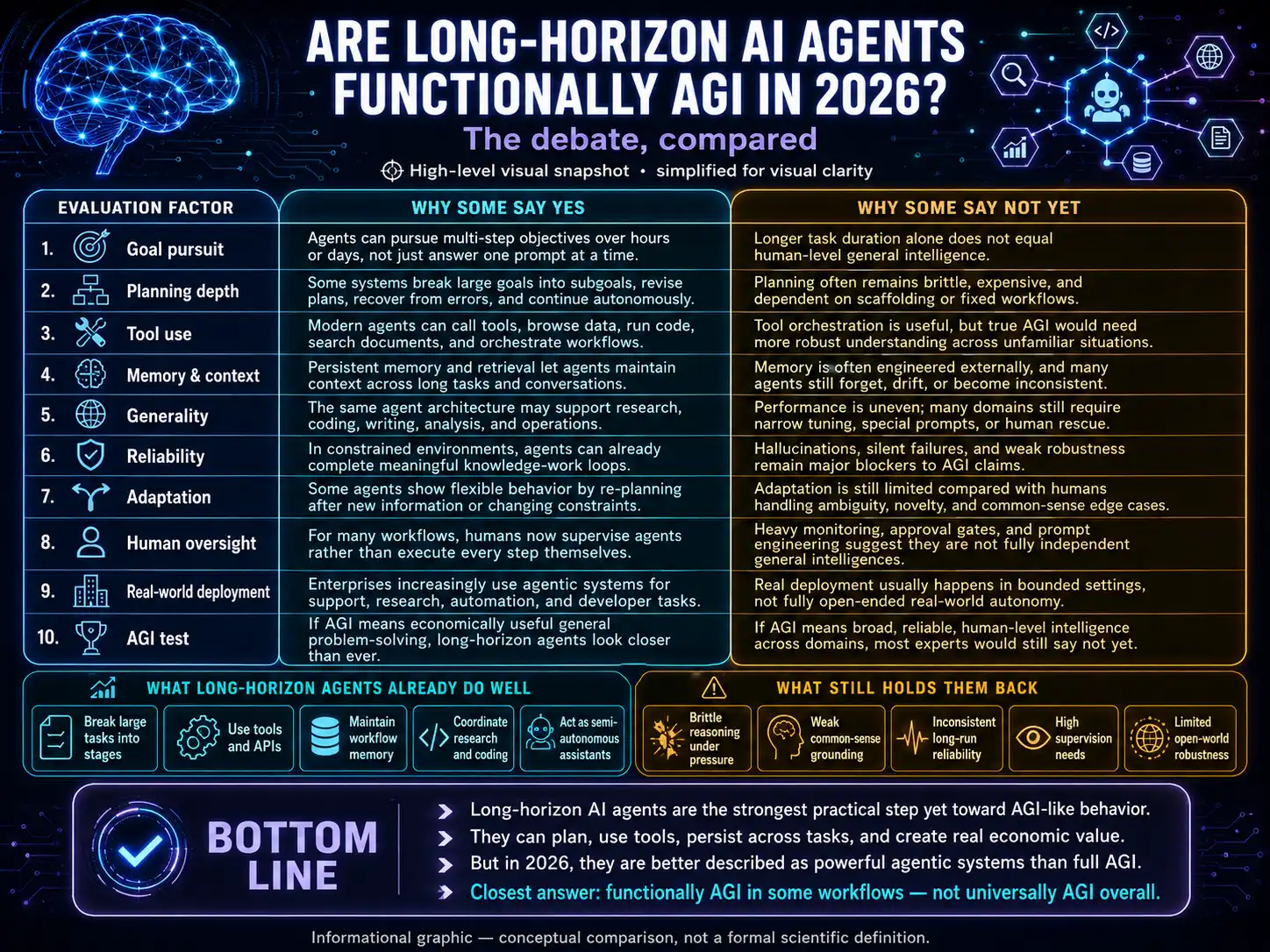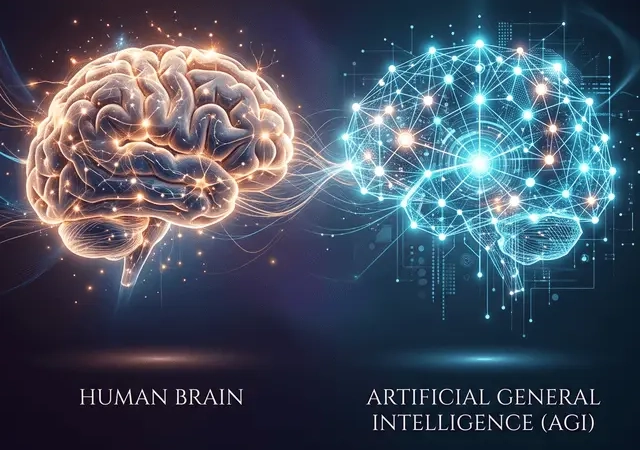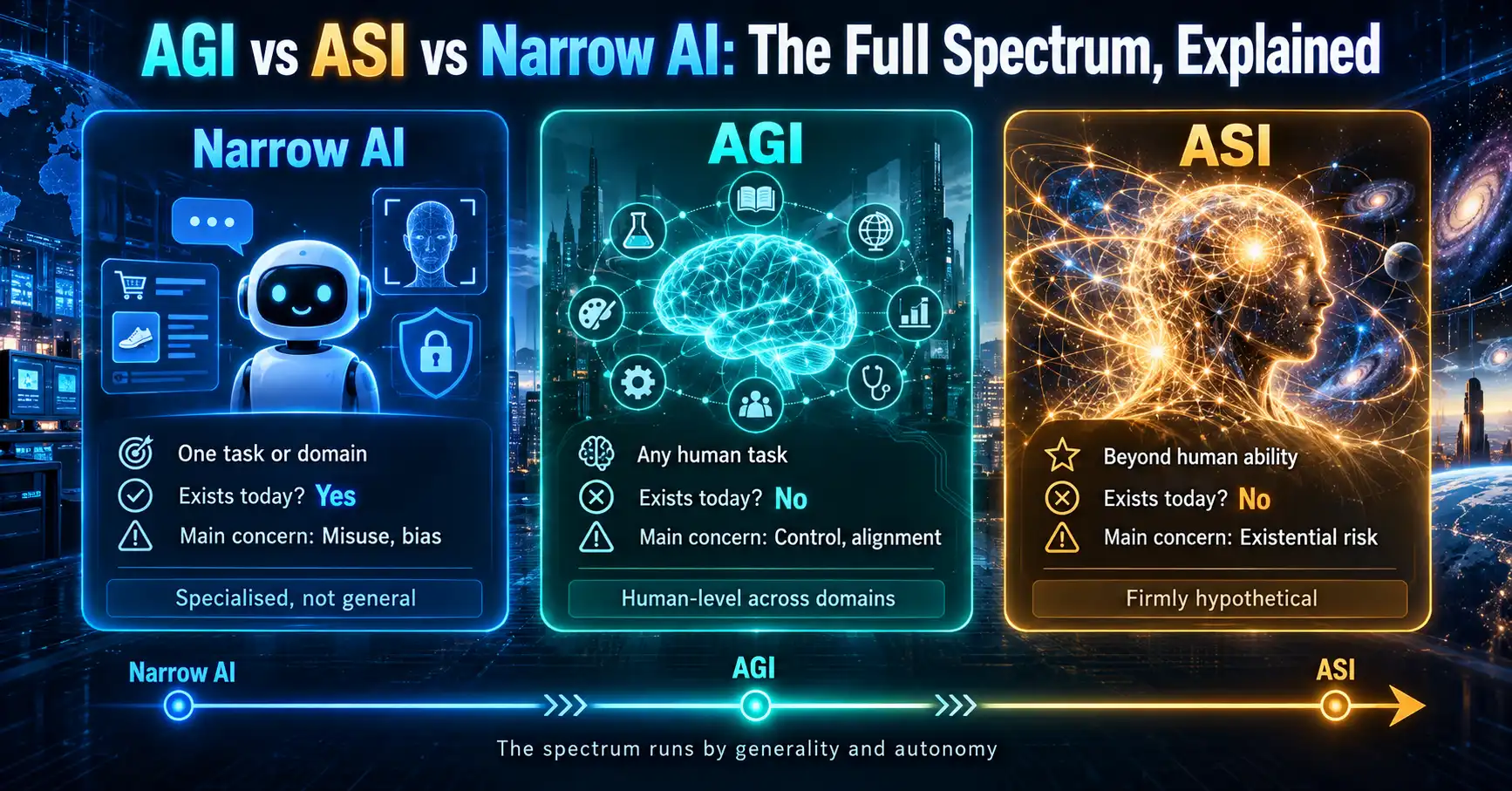


For years, the tidy story about artificial general intelligence went like this. We’re a few hardware breakthroughs away. Get enough compute, and the rest follows. So when Google logged its first verifiable quantum advantage, the leap wrote itself across feeds and headlines: the quantum machines have arrived, so AGI must be closer. That leap is where almost every quantum computing AGI timeline quietly breaks.
Slow down for a second.
Two real, dated events sit underneath the speculation. Google’s Quantum Echoes result on its Willow chip, and a Finnish quantum company’s debut on Nasdaq. Both are interesting. Neither says what the loudest posts claim it does. So let’s take them one at a time, separate what got proven from what got asserted, and see where quantum honestly fits.
What Google actually verified on the Willow chip
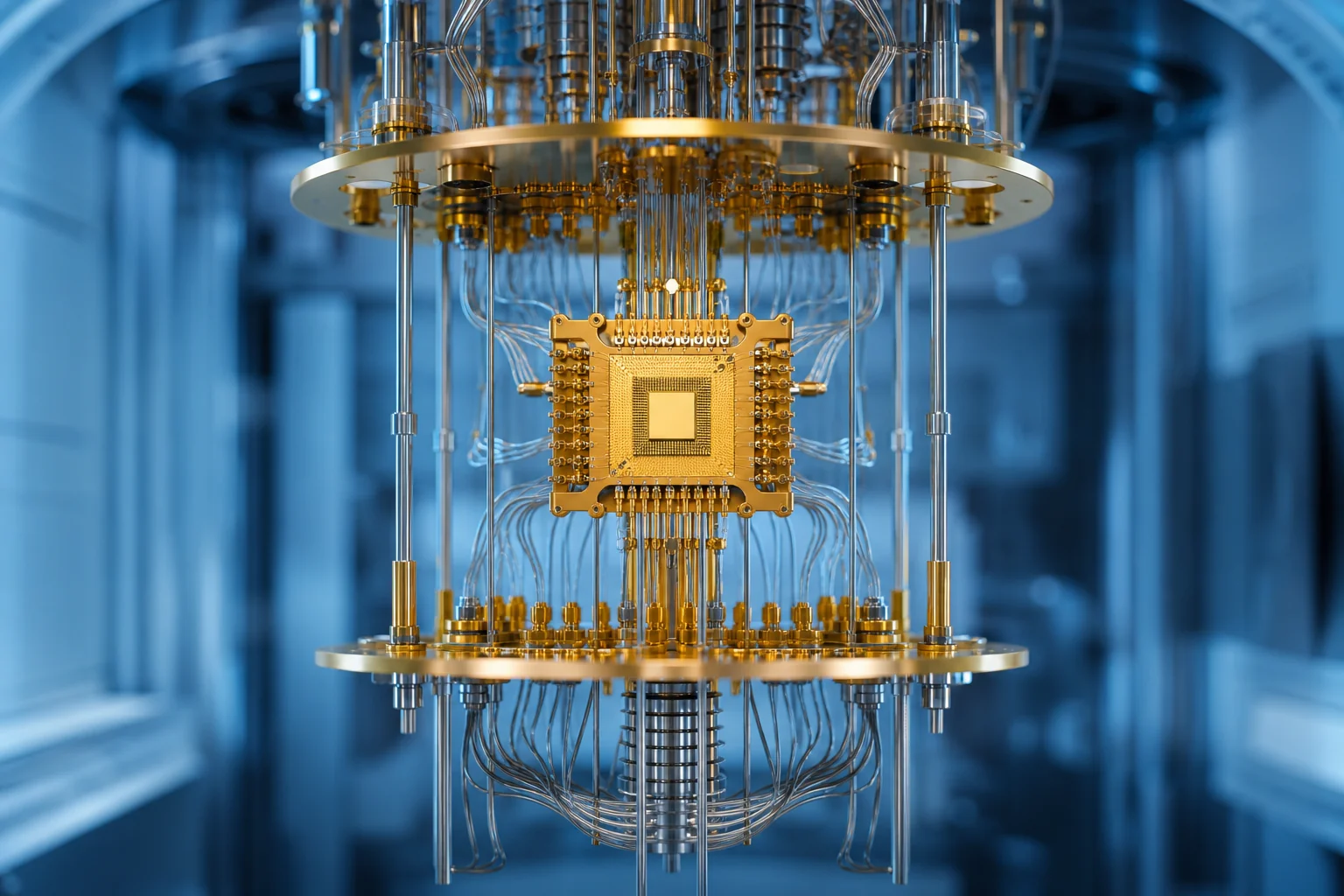
Google’s Quantum Echoes algorithm ran on Willow, a 105-qubit superconducting chip. It finished a calculation roughly 13,000 times faster than the best-known method on the world’s fastest supercomputers. The job took 2.1 hours on Willow, against an estimated 3.2 years on Frontier, the fastest classical machine we have (The Quantum Insider).
Impressive numbers. But the word doing the real work is verifiable.
Hartmut Neven, who founded and leads Google Quantum AI, called it “the first-ever verifiable quantum advantage” (Quantum Computing Report). In plain terms, another team can run the same problem on an equivalent quantum computer, get the same answer, and check it against reality.
Here reality means chemistry. Google’s team measured the structure of two small organic molecules, 15 and 28 atoms, using Nuclear Magnetic Resonance alongside collaborators at UC Berkeley. And nowhere in the announcement do the words “AGI” or “artificial general intelligence” appear. It reads as a drug-discovery and materials-science story from top to bottom (Google’s blog post).
The near-term payoff, if it holds, is practical rather than cosmic. Reading molecular structure faster could help drug design and materials research, the fields the demo actually touched (Berkeley College of Chemistry). Useful work. Not a mind in a box.
That distinction matters, because Google has been burned before. Its 2019 “quantum supremacy” claim leaned on a contrived random-sampling task with no real-world check. IBM disputed it within a day, arguing a classical supercomputer could handle the same job in about 2.5 days, not the 10,000 years Google implied (CNBC). Verifiable is the answer to that embarrassment. This time the result holds up under repetition.
What “verifiable advantage” changes, and what it doesn’t
Quantum advantage is a stricter bar than quantum supremacy. Supremacy just means beating a classical computer at some task, however artificial it is. Advantage means beating it at something people actually care about (Quanscient). Crossing that line is a genuine milestone, and it deserves the applause.
There is a caveat. The win is narrow. It solves molecular structure through NMR, not a general speedup you can point at an AI model. Google made no claim that Quantum Echoes trains neural networks faster, or does anything for AI at all.
Today’s hardware also sits nowhere near general purpose. Current quantum processors run only tens to a few hundred noisy qubits, with gate error rates near one in a thousand. That’s far below what large-scale machine learning would demand (PostQuantum). General-purpose quantum computing would need fault tolerance at a scale nobody has built. A verified chemistry result on 105 qubits is a long way from a machine that reshapes how AI gets made.
Why IQM going public matters beyond the ticker
The second event is quieter, and just as telling. On July 1, 2026, IQM Quantum Computers of Espoo, Finland began trading on Nasdaq under the ticker IQMX. It became the first European quantum company on a major U.S. exchange, arriving through a SPAC merger with Real Asset Acquisition Corp. at roughly a $1.9 billion valuation, raising around €198 to €227 million in net proceeds (The Quantum Insider).
This is a real business with paying customers. Its installed base runs to 23 quantum computers at sites like Oak Ridge National Laboratory, Germany’s Leibniz Supercomputing Centre, and Italy’s CINECA. Its customer count jumped from 8 in 2024 to 22 in 2025. The field has clearly moved past pure research demos into deployed hardware.
Then read the fine print. IQM’s own IPO prospectus states that “large-scale commercial traction of quantum computing technology may never occur.” The stock spent most of its first day trading below its IPO price (TechCrunch). That’s not a company promising to build a digital brain. That’s a company telling investors, in writing, that the whole bet might not pay off. A muted debut is the market pricing that same doubt.
Notice the pattern. The two biggest names in this news cycle both put limits on the record. Google never mentions AGI. IQM warns the technology may never scale commercially. Keep both admissions in mind, because the hype leaves them out.
The real debate: could hybrid quantum-classical computing power AGI-scale training?
This is where honest experts split, and the split is worth understanding.
The optimistic camp makes a hybrid argument. A 28-author, NVIDIA-led team in Nature Communications describes AI and quantum computing as mutually reinforcing. AI already designs qubit geometries, discovers gate designs through reinforcement learning, and automates calibration. Yet the same paper shows how far fault tolerance still sits: moving error correction from a “distance-9” to a “distance-25” code could need 10^13 to 10^14 training examples for the neural-network decoders involved (The Quantum Insider). Mutually reinforcing, sure. Ready for prime time, no.
Notice which direction is proven. AI helping quantum is already happening in labs right now. Quantum meaningfully helping AI training is the reverse bet, and it stays mostly on paper.
Even the pro-quantum trade press keeps its feet on the ground. Quantum computers “do not run neural networks faster by default,” and the realistic near-term contribution to AI is “incremental but valuable: lower training costs, faster optimization, or more stable learning dynamics,” delivered through hybrid setups rather than replacement (The Quantum Insider). Picture quantum as a specialized accelerator next to classical chips, closer to how a GPU sits beside a CPU. For the classical side of that picture, our explainer on how large language models actually work lays out what today’s AI really runs on.
The skeptics go further. AI researcher Jacques Thibodeau argues quantum computing “likely won’t play much of a role” in AGI, and calls it “highly optimistic to imagine that quantum computers could become very useful within 10 years.” His pick for the real bottleneck is energy, with photonic computing offering something like 100 times, maybe up to 100,000 times, better energy efficiency per operation (jacquesthibodeau.com).
The energy math backs him up. A single large AI training facility now draws 100 to 1,000 megawatts, the power of a small city. BloombergNEF projects data-center demand to quadruple by 2034, with much of it possibly going unmet (Spheron Network). We dug into that squeeze in AGI hardware requirements.
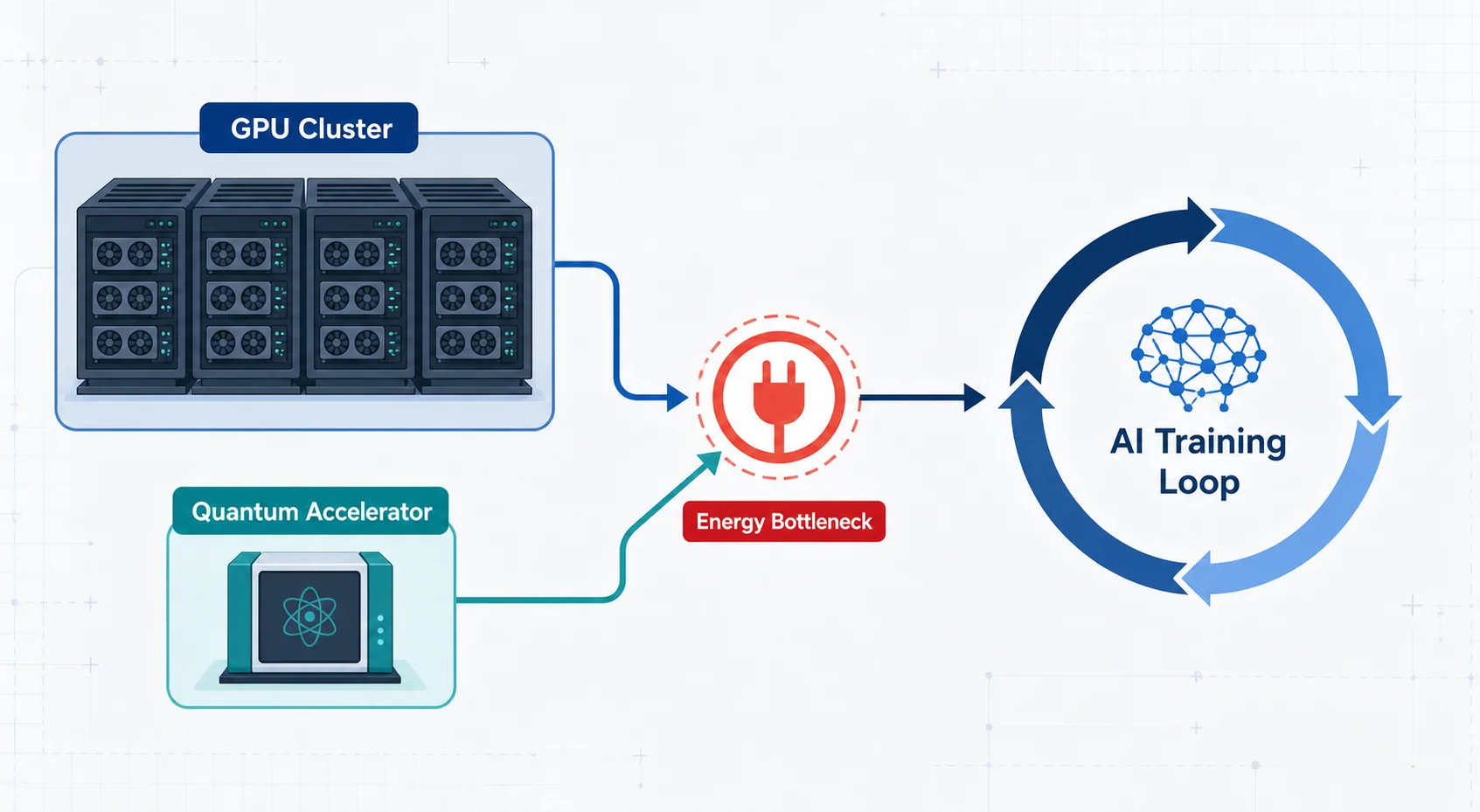
Both camps can be right at once. Quantum computing may speed up narrow subroutines like optimization and sampling, while energy, data, and architecture stay the real walls. A clean “quantum will save AGI” or “quantum is useless” binary just misses the messier truth.
Does any of this move mind uploading closer?
This is the leap that runs wildest online. A verifiable quantum result lands, and somewhere a thread claims we’re nearly ready to simulate a brain or upload a mind. The primary source doesn’t support it.
Whole-brain simulation has no credible near-term timeline. Cellular-level mouse-brain simulation is projected for the 2030s, marmoset for the 2040s, and full human emulation sits beyond any dated forecast. The limits are brain-scanning resolution and raw compute, not access to a quantum chip (ScienceDirect).
Two obstacles dominate, and neither is really about speed. There’s the scanning problem, since no current imaging captures a living brain’s full state at the resolution you’d need. And there’s the hard problem of consciousness, still unsolved even in principle (Wikipedia). A faster quantum chip cracks neither one.
There’s interesting work here, to be fair. A 2025 proposal called NeuroQ explores quantum-inspired frameworks for brain emulation, since classical models struggle to capture the stochastic behavior of real neurons. Even its authors admit that “large-scale cognitive emulation awaits further advances in quantum technology” (MDPI). Conceptual, not imminent.
Now remember what Google actually verified. The structure of two molecules, measured with NMR. That’s chemistry, not neuroscience. Drawing a straight line from it to mind uploading skips every hard problem in between, including the philosophical ones we sat with in mind uploading technology.
What a realistic quantum computing AGI timeline looks like
So where do the people building this stuff actually put their bets?
Demis Hassabis, who runs Google DeepMind, pegs AGI at “2030, plus or minus a year,” and points to unsolved gaps in memory, consistency, and continual learning (Axios). Anthropic’s Dario Amodei runs hotter, writing that “powerful AI could be as little as 1-2 years away,” which lands near 2027 (darioamodei.com). At the far end, Elon Musk has floated AGI as early as 2025 or 2026 (Lumichats). That’s a wide gap for a field that supposedly knows where it’s headed.
Part of the spread is definitional. One lab’s “AGI” is another lab’s intermediate milestone, which is reason enough to treat any single date as an estimate, not a fact. We pull that fuzziness apart in what artificial general intelligence really means.
Here’s the detail that settles it for me. None of these forecasts lean on quantum computing at all. They run on classical and TPU compute, more data, and algorithmic progress in reasoning and agents. The same pattern shows up across our AGI timeline predictions and the current AGI development race. Any honest quantum computing AGI timeline has to start from that fact: the mainstream forecasts don’t count on qubits, so quantum sits outside the calculation entirely.
The honest answer
Quantum computing is real, it’s advancing, and Google’s verified win earns the applause. Just not the applause it’s getting. What got proven is a narrow, checkable result in chemistry. What got claimed is a shortcut to general intelligence and digital minds. Those are not the same thing, and the two companies at the center of the story, Google and IQM, said as much in their own words.
If a compute breakthrough ever moves the AGI date, today’s evidence points at energy and photonics long before it points at qubits. My read: quantum barely nudges the timeline right now. That could change. It hasn’t yet.
Skeptical of the confident dates flying around? Good. Follow the bottleneck, not the buzzword, and decide for yourself which wall breaks first.