

If you have spent any time reading about sequence models, you have run into the same three acronyms over and over: RNN, LSTM, GRU. They get mentioned together, compared in passing, and rarely explained in a way that actually tells you which one to reach for. So let us settle it.
The short version: an RNN is the original design for handling sequences, but it struggles to remember things that happened many steps ago. LSTMs fix that with a gated memory cell. GRUs are a stripped-down take on the LSTM that trains faster and, in practice, performs almost as well. That is the whole story in three sentences, the rest of this piece is about when each one earns its keep.
The quick comparison
| RNN | LSTM | GRU | |
|---|---|---|---|
| Memory | Hidden state only | Cell state + hidden state | Single merged state |
| Gates | None | Three (input, forget, output) | Two (reset, update) |
| Long dependencies | Weak | Strong | Strong |
| Training speed | Fast but unstable | Slowest | Faster than LSTM |
| Reach for it when | Learning the basics | Context runs long | You want speed |
RNN: the honest starting point
A plain recurrent neural network reads a sequence one element at a time and passes a hidden state forward, like taking notes as you go. That is a clever idea, and for short sequences it works fine. The problem shows up with distance. By the time the network has processed thirty or forty steps, the signal from the early inputs has been multiplied through so many layers that it either fades to nothing or blows up. Researchers call this the vanishing (and exploding) gradient problem, and it is the reason plain RNNs quietly disappeared from serious NLP work.
None of that makes the RNN useless. It is still the cleanest way to understand what a sequence model is, and for short, tidy sequences it remains perfectly serviceable.
LSTM: giving the network a real memory
The Long Short-Term Memory network, introduced back in 1997, tackled the forgetting problem head-on. Instead of one hidden state doing all the work, an LSTM maintains a separate cell state (think of it as a conveyor belt running through the whole sequence) and three gates that decide what to write to it, what to erase, and what to read out.
That extra machinery is why LSTMs can hold onto a detail from the start of a paragraph and use it at the end. It is also why they are slower to train: every step now involves several small neural networks instead of one. For years, if you needed to model long-range structure in text, speech, or time series, the LSTM was the default, and it earned that reputation.
GRU: the lighter alternative that usually holds up
The Gated Recurrent Unit arrived in 2014 as a deliberate simplification. It merges the cell state and hidden state into one, and it uses two gates instead of three. Fewer parameters means faster training and less data needed to fit. And in a surprising number of benchmarks, the GRU matches or beats the LSTM anyway.
There is no universal winner between the two. The rule of thumb that actually holds up in practice: if your sequences are very long or your dataset is large, the LSTM’s extra gate can pay off. If you are compute-constrained, working with smaller data, or just want to iterate quickly, start with a GRU. Honestly, many teams try both and keep whichever validates better, the difference is often small enough that it comes down to your specific data.
What the research says
The vanishing gradient problem is documented, not folklore. In 1994, Bengio, Simard and Frasconi showed that training recurrent networks to capture long-term dependencies with gradient descent is difficult. The LSTM, introduced by Hochreiter and Schmidhuber in 1997, was designed to get around that. The GRU came later, proposed by Cho and colleagues in 2014 as part of an encoder-decoder model for machine translation.
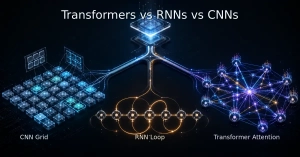
Direct comparisons give a measured answer. In 2014, Chung and colleagues evaluated gated units on polyphonic music and speech signal modeling. They found that gated units were better than traditional tanh units, and that the GRU was comparable to the LSTM. In 2015, Greff and colleagues ran what they describe as the largest study of its kind on LSTMs: eight variants across speech recognition, handwriting recognition and polyphonic music modeling, in 5,400 experimental runs. None of the variants improved significantly on the standard LSTM, and the forget gate and output activation function were its most critical components. Together these studies support the rule of thumb above: start simple, and do not expect a large gain from swapping one gated unit for another. For how these networks compare with attention-based models, see our guide to transformers, RNNs and CNNs.
So which should you use?
Here is how I would decide it without overthinking:
- Learning how sequence models work? Build a plain RNN first. You will understand the other two far better once you have felt the forgetting problem yourself.
- Shipping something where long context matters: long documents, extended time series? Start with an LSTM.
- Limited compute, smaller dataset, or you value fast iteration? Start with a GRU and only move to an LSTM if the numbers ask for it.
One more thing worth saying plainly: for large-scale language work, all three have largely been replaced by transformers, which sidestep the sequential bottleneck entirely by processing a whole sequence at once. That does not make RNNs, LSTMs, and GRUs obsolete (they are still lighter, faster to run, and a better fit for many smaller on-device and time-series tasks) but it helps to know where the field went. If you want the wider map, our ANN vs CNN vs RNN vs GNN cheat sheet lays out how all these architectures relate.
Key takeaways
- Plain RNNs struggle with long dependencies because gradients shrink or grow over many steps.
- LSTMs and GRUs both fix this with gates, and studies find the GRU comparable to the LSTM.
- Large studies of LSTM variants found no variant that clearly beat the standard design.
Sources
- Bengio, Simard and Frasconi, “Learning long-term dependencies with gradient descent is difficult”, IEEE Transactions on Neural Networks, 1994.
- Hochreiter and Schmidhuber, “Long Short-Term Memory”, Neural Computation, 1997.
- Cho et al., “Learning Phrase Representations using RNN Encoder-Decoder for Statistical Machine Translation”, 2014.
- Chung et al., “Empirical Evaluation of Gated Recurrent Neural Networks on Sequence Modeling”, 2014.
- Greff et al., “LSTM: A Search Space Odyssey”, 2015.
How we checked this: we compared the figures and findings above with each paper’s published abstract and record. Results are specific to the tasks and datasets those papers used.