

Three of the most capable machines ever built shipped inside 24 days of each other. Google put out Gemini 3 on November 18, 2025. Anthropic answered with Claude Opus 4.5 six days later. OpenAI landed GPT-5.2 on December 11. Any comparison of GPT-5.2 vs Gemini 3 vs Claude Opus 4.5 has to start with that timing, because the timing is the story.
Here is the uncomfortable part. On most headline tests, the distance between first place and second place is now smaller than a rounding error you’d shrug at in a school exam. Under one percentage point, in several cases.
So what does “best” even mean when the lead changes hands every few weeks and depends on which variant of which model somebody happened to test?
That’s the question worth your time. Not the leaderboard.
The race that keeps resetting itself
The release cadence wasn’t a coincidence. Days after Gemini 3 arrived, Sam Altman declared an internal “code red” at OpenAI, on December 2–3, 2025. Reporting at the time described him warning staff about temporary economic headwinds and pausing side projects (ads, a shopping assistant, the Pulse feature) to pour engineering back into ChatGPT. Salesforce CEO Marc Benioff had publicly switched to Google’s product. Nine days after that memo, GPT-5.2 shipped.
Read that sequence again. A flagship model from the best-funded lab in the field arrived as a defensive move, on a clock set by a competitor.
The benchmark numbers tell the same story from a different angle. Independent aggregation published the day GPT-5.2 launched put Claude Opus 4.5 at 80.9% on SWE-bench Verified and GPT-5.2 Thinking at 80.0% (R&D World). Nine tenths of a point. On competition math, GPT-5.2 hit a clean 100% on AIME 2025 with no tools, Gemini 3 Pro managed 95.0%, and Opus 4.5 sat around 94%. On GPQA Diamond, Gemini 3 Deep Think took 93.8% and GPT-5.2 Pro 93.2%.
Those same figures come with a caveat the source states plainly: they’re vendor-reported and pending independent verification.
We’ve watched this pattern before, most recently when an open-source challenger closed the distance on the paid flagships. Our look at DeepSeek V4 covered the same dynamic from below.
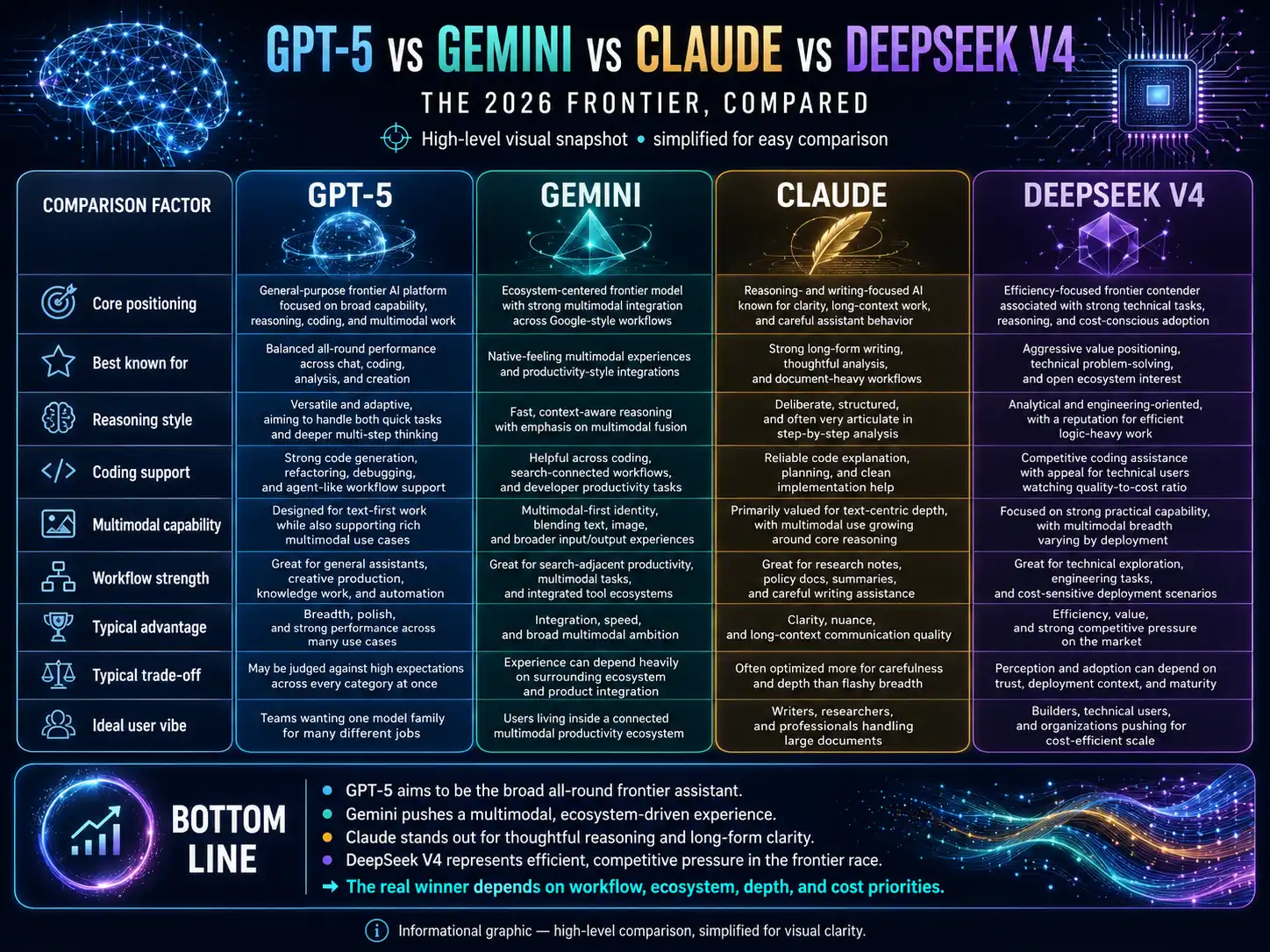
GPT-5.2 vs Gemini 3 vs Claude Opus 4.5: how each one actually thinks
Strip away the scoreboard and each model has a personality shaped by what its lab chose to optimize.
GPT-5.2 got smarter and worse at writing. That isn’t a critic’s opinion. It’s OpenAI’s. At a developer town hall on January 26, 2026, Altman said the company “just screwed that up.” He promised future 5.x versions would write better than GPT-4.5 did. He explained the trade too: OpenAI decided “to put most of our effort in 5.2 into making it super good at intelligence, reasoning, coding, engineering, that kind of thing” (Search Engine Journal). Users had already noticed. They called the output unwieldy and hard to read next to GPT-4.5.
A CEO conceding a regression five weeks after launch is rare enough to be worth sitting with. It tells you something honest about how these systems get built. Capability is a budget, and somebody decides where it goes.
Claude Opus 4.5 got the long-haul budget. Anthropic called it the best model in the world for coding, agents and computer use. The supporting numbers point at sustained execution rather than clever one-shot answers: a 29% improvement over Sonnet 4.5 on Vending-Bench, which tests long-horizon agentic consistency, and a 10.6% gain on Aider Polyglot (Anthropic). Staying coherent across a long, structured task is exactly the skill that also produces readable long-form prose.
Gemini 3 got the knowledge budget. It leads the hardest reasoning tests. Humanity’s Last Exam at 41.0% in Deep Think mode. GPQA Diamond at 93.8%. Claude Opus 4.5 sits at 25.2% on Humanity’s Last Exam and 87% on GPQA. That’s the widest genuine gap anywhere here, and it’s a gap in raw analytical horsepower rather than conversational polish.
One warning about all of the above. Swap the aggregator and the ranking moves. One independent comparison has Gemini 3 Pro at 91.9% on GPQA against GPT-5 Pro’s 88.4%. Another puts GPT-5.2 Pro ahead at 93.2%. Both can be right, because “Pro” and “Thinking” and “Deep Think” are different products wearing the same brand name.
Want a sense of why these differences exist at the architecture level rather than the marketing level? Our explainer on how large language models actually work is the better starting point.
Where the gap is still real: code
For engineers, the ranking matters more, and it’s clearer. Claude Opus 4.5 was the first model to break 80% on SWE-bench Verified. It also leads on 7 of 8 languages in SWE-bench Multilingual. Anthropic cut its price hard at launch too, to $5 per million input tokens and $25 per million output, down from Opus 4.1’s $15 and $75.
That’s a genuine edge for agentic engineering work. It’s also the narrowest slice of what most readers here do all day.
Context and memory: the one difference you’ll feel
Skip the benchmarks for a moment. This is the axis where the three models differ by amounts a normal person can notice.
- Gemini 3: 1,000,000 tokens of input, up to 64,000 tokens of output
- GPT-5.2: 400,000 tokens of input, 128,000 tokens of output
- Claude Opus 4.5: 200,000 tokens, the smallest of the three
A million tokens is a different category of tool. Drop in an entire book, a year of email threads, a full research archive. Gemini 3 holds all of it at once. Nothing else here comes close.
The 200K-versus-400K difference between Opus 4.5 and GPT-5.2 is far less interesting in practice. Most real conversations run a few thousand tokens. You will hit neither ceiling on a Tuesday afternoon.
Output tells a different story. GPT-5.2 writes twice as much in one go as Gemini 3 can, 128K against 64K. Whether you want that from a model with an admitted prose problem is another matter.
What you actually pay
The subscription picture refuses to be tidy.
ChatGPT Plus is $20 a month. Claude Pro is $20 a month. Dead heat. Google splits its lineup instead: an entry AI Plus tier around $5–8, AI Pro at $19.99, and an AI Ultra tier running $99.99 to $199.99. Only Ultra unlocks Deep Think and the highest usage caps. Google cut Ultra from $250 and added the cheaper $99.99 option at I/O 2026.
So Gemini is simultaneously the cheapest way in and by far the most expensive way to the top. On the API side, Gemini 3 Pro runs $2 per million input and $12 output. GPT-5.2 runs $1.75 and $14. Claude Opus 4.5 charges the steepest output rate of the three at $25.
One detail is buried in Google’s tiering. The Gemini scores that beat everyone else, the Deep Think numbers, live behind the plan that costs five to ten times what a ChatGPT Plus or Claude Pro subscription does. The version most people will actually use isn’t the version on the chart.
The comparison table
| Specification | GPT-5.2 | Gemini 3 | Claude Opus 4.5 |
|---|---|---|---|
| Released | Dec 11, 2025 | Nov 18, 2025 | Nov 24, 2025 |
| Context window | 400K in / 128K out | 1M in / 64K out | 200K |
| Consumer plan | ChatGPT Plus, $20/mo | ~$5–8 entry, $19.99 Pro, $99.99–$199.99 Ultra | Claude Pro, $20/mo |
| API, per M tokens | $1.75 in / $14 out | $2 in / $12 out | $5 in / $25 out |
| Strongest showing | AIME 2025, 100% | HLE 41.0%, GPQA 93.8% | SWE-bench Verified, 80.9% |
| Known weak spot | Writing quality, conceded by OpenAI | Best mode locked to the priciest tier | Smallest context, dearest output tokens |
| Reasonable pick for | Math and technical problems | Huge documents, deep research | Long-form writing, sustained tasks |
Read down the columns and the honest verdict writes itself. One independent comparison put it flatly: no single frontier model dominates across all dimensions.
So which one deserves your trust?
If you write for a living, use Claude. Its own maker optimized it for staying coherent over long stretches. The rival lab publicly admitted its model got worse at prose. That’s about as clear a signal as this industry ever hands out.
If you feed a machine enormous documents, Gemini 3 wins on the only spec that isn’t a rounding error. Just check which tier you’re actually on before you trust the headline scores.
If you want the strongest technical reasoner and don’t mind editing the output, GPT-5.2 earns its place.
But I’d push back on the premise of the question. A lead of 0.9 points, on vendor-reported numbers, on a benchmark that a newer test will replace within a year, is not a reason to switch anything. These labs aren’t sprinting toward a finish line. They’re circling each other, and every lap costs a fortune.
What survives the next release cycle is the boring stuff. The size of the window. The price on your card. Which lab’s incentives happen to favour the thing you need this month. Everything else expires. Bookmark this comparison if you like, but assume the numbers in it have a shelf life measured in weeks.
Curious where this pressure actually leads? Our piece on the AGI development race picks up the same question at a larger scale, and asks who is ahead when nobody stays ahead for long. Tell us in the comments which of the three you’ve settled on, and whether it stuck.