

You probably helped build the AI you use every day. Not on purpose. If you’ve ever posted a blog, pushed code to a public repo, published a novel, or written a technical answer online, there’s a good chance your words sit somewhere inside the training data of a large model. So it’s fair to ask: is AI training on copyrighted work fair use, or did the industry quietly take something that wasn’t theirs to take?
That question stopped being abstract in 2025. A federal judge answered part of it, and now a federal appeals court is about to answer more. The headlines make it sound like the whole future of AI hangs on one case. It doesn’t. But the real story is stranger, and honestly more interesting, than the headlines suggest.
Here’s the short version. The narrow legal ruling everyone’s waiting on is smaller than it looks. Meanwhile the money moving to real writers is already enormous, and it’s happening regardless of how that ruling lands.
What actually happened in Thomson Reuters v. Ross Intelligence
Start with the case that kicked this off, because most coverage buries it under legal jargon.
Ross Intelligence was a startup that built an AI-powered legal research tool. It wanted to compete with Westlaw, the giant legal database owned by Thomson Reuters. To train its system, Ross used memos that contained Westlaw’s copyrighted “headnotes”, the short editorial summaries Westlaw writes for court opinions (CourtListener docket).
On February 11, 2025, Judge Stephanos Bibas granted partial summary judgment for Thomson Reuters. He found that Ross had infringed 2,243 headnotes and that its fair-use defense failed. It was the first ruling of its kind on AI training and copyright (Davis Wright Tremaine).
The judge’s reasoning matters. He decided the headnotes cleared copyright’s low creativity bar because they “introduce creativity by distilling, synthesizing, or explaining part of an opinion.” And he found Ross “took the headnotes to make it easier to develop a competing legal research tool” (Patently-O).
Read that again. The problem wasn’t just that Ross copied. It’s that Ross copied to build a rival product. That detail runs through everything that follows.
Not everyone agreed with the decision. The Authors Alliance called it unpersuasive, arguing the judge undervalued the genuine technical transformation that happens inside machine learning (Authors Alliance).
A one-minute primer on fair use
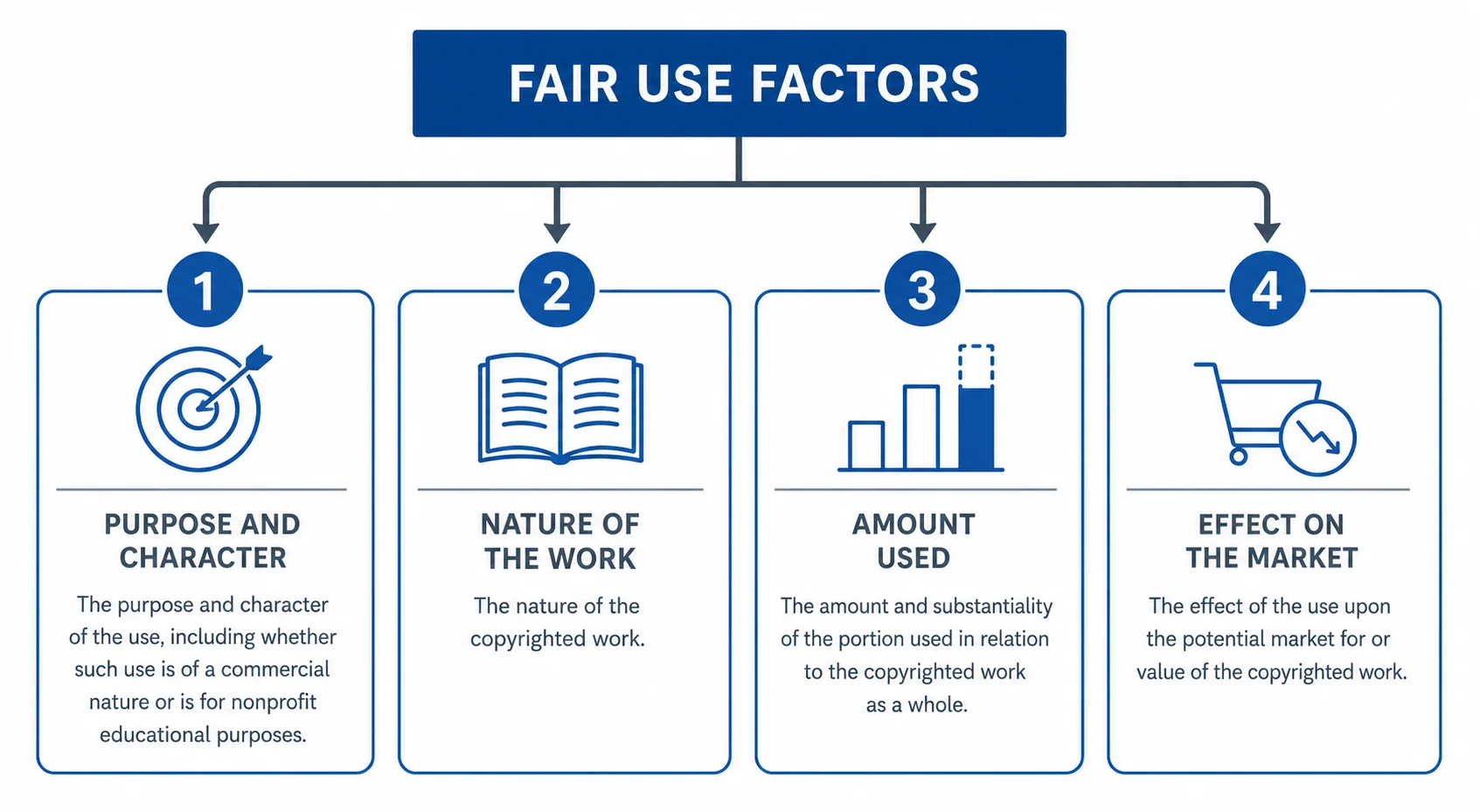
Fair use is the exception that lets you use copyrighted material without permission in limited cases. Courts weigh four factors. Two are doing most of the work in AI cases.
- Factor one: transformative use. Did you turn the original into something new with a different purpose? Or did you just repackage it?
- Factor four: market harm. Does your use compete with the original and eat into its market?
The whole “is AI training on copyrighted work fair use” fight lives inside those two questions. Training pulls patterns out of text, which sounds transformative. But if the trained system then competes with the people whose work fed it, factor four starts to bite.
Why the Third Circuit appeal is the first real test
Ross appealed. And that’s where this gets historic.
On June 11, 2026, the Third Circuit Court of Appeals heard oral argument in the case, No. 25-2153. It was the first time a federal appeals court has weighed whether training an AI on copyrighted material can be fair use (ChatGPT Is Eating the World). A district court ruling binds one court. An appeals court ruling binds a whole circuit and gets cited everywhere.
The three-judge panel (Judges L. Felipe Restrepo, Tamika R. Montgomery-Reeves, and Emil J. Bove) zeroed in on exactly the two factors I flagged: transformativeness and market harm (LawNext).
The judges pressed hard. Judge Bove asked why Ross’s system was transformative “as opposed to just a different type of legal search engine.” Judge Restrepo pointed out that Ross was a direct competitor to Westlaw, even when Ross framed its copying as internal technology. Judge Montgomery-Reeves asked whether the product was really aimed at serving as a commercial substitute for Westlaw.
Those questions lean toward “this competes, so it’s not fair use.” But oral argument isn’t a verdict. The parties were ordered to file the argument transcript by June 25, 2026, and no ruling had come down as of this writing. We’re all still waiting.
Is AI training on copyrighted work fair use? What a loss for Ross would mean
Say the Third Circuit affirms. Say it rules, clearly, that Ross’s training wasn’t fair use. What breaks?
Less than you’d think, and more than you’d hope. Both things are true.
One detail the headlines skip: Ross’s tool was not generative. It retrieved and ranked existing legal opinions. It didn’t write new sentences. Multiple legal analysts stress that this means the ruling doesn’t directly resolve fair use for generative models like ChatGPT or Gemini (Perkins Coie).
Even Thomson Reuters’ own lawyer drew that line at argument. Counsel described Ross’s product as “a legal research system for finding court opinions in response to legal topics,” deliberately distinguishing it from gen-AI systems that produce new text. When the winning side tells the court “our case is narrower than the AI panic suggests,” pay attention.
IPWatchdog groups this case with two other 2025 decisions as part of a developing, still-unsettled body of law. No single ruling controls the whole industry yet (IPWatchdog).
So a loss for Ross wouldn’t flip a switch that makes every chatbot illegal. What it would do is hand every author, artist, and studio suing an AI company a powerful appellate precedent to cite, especially the part about competing products and market harm. It tilts the field.
The money is already moving, no matter how the appeal ends
This is the part I wish more people knew.
While everyone debates a search tool about legal headnotes, the generative-AI industry has already started paying creators real money. A lot of it.
In September 2025, Anthropic agreed to pay at least $1.5 billion plus interest to settle Bartz v. Anthropic, a class action by authors whose pirated books, pulled from shadow libraries, trained Claude. It’s the largest publicly reported copyright recovery in U.S. history (Fieldfisher).
Put a number on it per person. The settlement covers roughly 482,000 to 500,000 works, which lands near $3,000 per book. The claims deadline was March 30, 2026, and about 120,000 authors and rightsholders had filed by then (Kluwer Copyright Blog). Anthropic also agreed to destroy the unlawfully obtained files.
Three thousand dollars for a book that got vacuumed into a model without a phone call first. That’s the going rate a court accepted.
And Bartz isn’t alone. As of June 2026, more than 70 AI copyright suits are active or recently resolved, with claimed damages across active cases topping $50 billion (Sustainable Tech Partner). A few from that pile:
- Universal Music, Concord, and ABKCO sued Anthropic for $3.1 billion in January 2026, alleging Claude trained on pirated music-publishing content.
- The New York Times filed against Microsoft in June 2026 over training on its articles.
- A group of writers, including Pulitzer winner John Carreyrou, sued six AI companies (Anthropic, Google, OpenAI, Meta, xAI, and Perplexity) over pirated books.
Those plaintiffs aren’t an abstraction. They have names. Which reframes the whole question. “Is AI training fair use” isn’t only a pending legal abstraction. It’s already a live, measurable transfer of money to individual creators.
What’s still undecided
I want to be honest about the open questions, because overclaiming here is exactly the trap the legal blogs fall into from the other direction.
Nobody has ruled cleanly on generative models and fair use at the appellate level. The Third Circuit could affirm on narrow grounds tied to Ross being a direct competitor, leaving gen-AI companies room to argue their case is different. The settlements, big as they are, set a price, not a precedent. A settlement means nobody won on the law.
The deepest fault line is the one lawyers call transformative use versus substitution. AI companies argue that training reads text the way a person does. A model studies patterns, keeps none of the original prose, and outputs something new. That sounds like the textbook definition of transformative. Rightsholders counter that a product competing for the same readers, listeners, or subscribers substitutes for the original in the market, no matter how clever the math inside. Judge Bibas leaned toward substitution because Ross aimed squarely at Westlaw’s customers. Whether that logic survives contact with a generative model is the question no court has answered head-on. Two systems can both “train on copyrighted work” and land on opposite sides of that line, depending on how much they compete with the source.
There’s also a hint of where the Third Circuit’s head is at. The same panel had recently decided a related fair-use case, American Society for Testing v. UpCodes, giving that circuit a second fair-use precedent in short order (ChatGPT Is Eating the World). That doesn’t tell us how Ross comes out, the facts differ, but it means these judges are actively wrestling with the boundaries of fair use, not treating it as settled. Add the “dueling questions presented” the parties filed, each trying to frame the core issue in its own favor, and you get a panel that clearly sees how much rides on the wording of whatever it writes.
If you want the regulatory backdrop to all this, we’ve written about how governments are trying to plan for superintelligence and AI regulation. Copyright is one front in a much wider fight over who controls these systems.
Where this leaves the rest of us
So, is AI training on copyrighted work fair use? The most honest answer in 2026: partly decided, mostly contested, and already expensive.
The narrow ruling everyone’s watching involves a dead startup and some legal headnotes. It may never touch your favorite chatbot directly. But the deeper current is unmistakable. Courts grow more willing to ask whether a model competes with the people it learned from, and companies grow more willing to write nine- and ten-figure checks rather than find out the hard way.
I think that’s the real headline. The era of scraping the open web as if it were free raw material is ending, not because one court declared it over, but because the bill finally started arriving. If you write or code, your work now carries a market value inside these systems that a court has put a dollar figure on. That’s worth understanding, and worth watching.
If this question grabs you, read our take on why AI deception matters more than passing the Turing test and the thornier one of whether a sentient AI would need rights. The copyright fight is really the same fight in a business suit: what do we owe the minds, human or machine, that build the tools we lean on every day?