
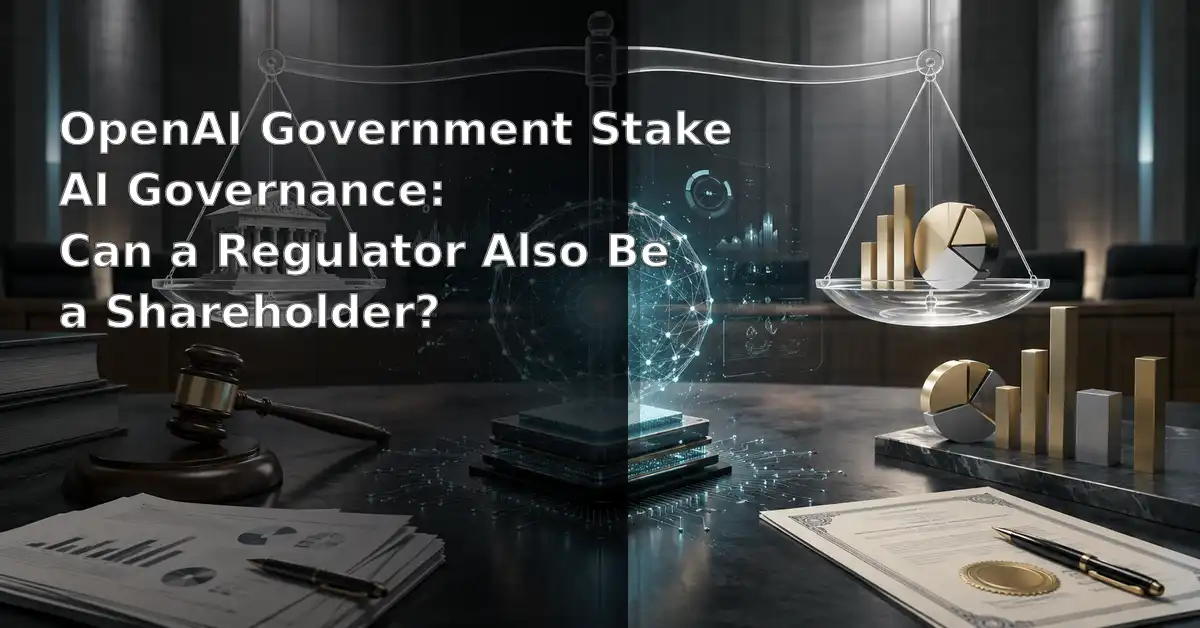
Governments have taxed the powerful for centuries. What they rarely do is buy a piece of them. That is the quiet novelty buried inside the OpenAI government stake AI governance debate now unfolding in Washington: OpenAI has floated handing the US government a 5% equity slice of itself, and the question underneath the headline is not “how much is it worth” but “what happens to accountability when the referee owns shares in one of the teams.”
The number is eye-catching. That 5% is reported at around $42.6 billion against OpenAI’s roughly $852 billion valuation, according to Yahoo Finance. Against a separately reported $730 billion IPO-track valuation, aimed at a September 2026 listing, the same slice works out closer to $36.5 billion. Either way, it would be one of the largest voluntary equity transfers a private company has ever offered a state. But the money is the easy part to grasp. The governance part is where it gets strange.
What OpenAI actually proposed
Strip away the speculation and the core move is simple. OpenAI offered to give the federal government a 5% ownership position in the company. Sam Altman has reportedly discussed it directly with President Trump, Commerce Secretary Howard Lutnick, and Treasury Secretary Scott Bessent. The thread traces back to at least April 2026, when a white paper proposed donating shares into a “Public Wealth Fund.”
Altman’s pitch is populist in flavor. Giving the public a financial interest in AI companies, he argues, lets Americans “share in the industry’s economic gains.” And he has not framed it as an OpenAI-only favor. He has floated extending the same roughly 5% model to other major US developers, including Anthropic, Google, and Meta, through a shared sovereign wealth fund vehicle rather than a one-off deal.
The vehicle has a real-world template. It is modeled on the Alaska Permanent Fund, which has paid oil-revenue dividends to Alaskans every year since 1982 and held about $91.2 billion in assets as of May 31, 2026, per a Forbes analysis by James Broughel. Swap oil for AI, and you get the mental model: a national resource throws off returns, and citizens collect a check. Broughel estimates a 5% OpenAI stake could generate roughly $2 billion a year in distributions, against the roughly $1,000 per resident Alaska’s fund paid out last year.
Why now: political pressure and the public wealth fund idea
Timing is not an accident here. The Trump administration has separately signaled interest in the government benefiting financially from the AI sector’s growth, so OpenAI’s offer lands on receptive ground.
It also is not the only version of the idea in play. Senator Bernie Sanders introduced the American AI Sovereign Wealth Fund Act, and it is far more aggressive. Rather than a voluntary 5%, Sanders proposes a one-time 50% stock tax on AI companies with more than $200 million in annual AI-related receipts. That would seed a fund projected at roughly $7 trillion, governed by a seven-member Independent Commission for Democratic AI, distributing 5% of the fund’s value each year, about $1,000 per American. His rationale is blunt: “AI firms have built trillion-dollar businesses on top of a vast reservoir of human intellectual property” without compensating the people whose work supplied it.
Put the two side by side and the picture sharpens. The same underlying instinct, public equity in AI, shows up as a voluntary 5% gift on one end and a mandatory 50% levy with an independent commission on the other. The idea has momentum well beyond OpenAI’s own framing. What is unsettled is how much coercion and control the public should attach to it.
OpenAI government stake AI governance: can a regulator also be a shareholder?
Here is the knot at the center of everything. The government writes the rules for frontier AI. It also enforces export controls, awards procurement contracts, and decides national-security carve-outs. Now imagine it holds equity in one of the companies subject to all of that.
The sharpest version of the worry comes from a FourWeekMBA analysis: once the state owns a slice, “any federal AI procurement decision, any export control carve-out, any national security AI contract carries an implicit conflict of interest that benefits OpenAI.” Competitors, the analysis notes, “are now competing against a company that has partially nationalized its own regulatory risk.” Or, more bluntly: “A government that profits from OpenAI’s success has a structural incentive to let it operate, expand, and beat foreign rivals. It turns the regulator into a co-investor.”

There is a serious counter-view, and it is worth taking seriously. Broughel argues the conflict can be structurally defused if the stake is a “passive, non-voting position,” with no board seat and no policy lever, modeled on the US government’s existing Intel arrangement. Designed that way, transparent and congressionally overseen, it becomes public finance and a stabilizing force on the federal budget, not ownership-driven regulatory capture. The distinction is the whole ballgame: a silent financial claim behaves very differently from an active ownership seat with votes to cast.
If you have followed how governments already grapple with these questions, our piece on AGI regulation and how governments plan for superintelligence sets up the rules-based world this equity idea is quietly trying to route around.
What this means for AI safety enforcement
It is tempting to leap straight to the nightmare: the government owns OpenAI, so it stops enforcing safety rules. Be careful here, because the evidence does not go that far yet.
No on-record statement currently ties the stake proposal to any specific relaxation of safety enforcement. The documented tension is narrower and more concrete, sitting in procurement and export-control conflicts rather than in a quiet gutting of safety audits. That is an important honesty check for a story moving this fast.
What the safeguard debate does tell you is that people can see the lever forming. Broughel’s proposed structure, passive, non-voting, disciplined by the price system, and overseen by Congress, is explicitly designed to stop the equity stake from becoming a tool the executive branch could use to soften enforcement later. The risk is real enough that thoughtful supporters are already trying to engineer it out. That is different from claiming it has already happened. The same care applies to enforcement questions we cover in why an AGI kill switch is harder than it sounds, where the mechanism matters far more than the intention behind it.
How this differs from AI regulation like the EU AI Act
This is the distinction almost every news write-up skips, and it is the one that actually clarifies the stakes. Equity is not regulation. They are two different machines.
The EU AI Act is rules-based. It sorts systems into a four-tier risk classification, unacceptable, high, limited-transparency, and minimal risk, and attaches binding compliance obligations scaled to that risk level, enforced through prohibitions and audits. Prohibited practices took effect on February 2, 2025, governance and general-purpose-model rules became applicable on August 2, 2025, and full application of the remaining provisions is dated August 2, 2026. Nowhere in that architecture does the state own a share of anything. It sets behavior and checks compliance.
OpenAI’s proposal is the opposite kind of lever. It imposes no behavioral obligations on the company. It gives the state a financial claim on outcomes. A rules regime tells a company what it may and may not do; an equity stake simply lets the government profit when the company profits. Conflating the two is how the debate goes fuzzy. You can have equity without rules, rules without equity, both, or neither, and each combination governs AI in a different way. Our breakdown of the US executive order on frontier-model early access shows the rules-based lever the US already reaches for, which makes the equity move look less like a substitute and more like a second, parallel track.
What would have to be true for this to happen
For all the noise, this is a proposal, not a done deal. A government-equity arrangement of this kind would most likely require an act of Congress. And it is unconfirmed whether Anthropic, Google, or Meta would join a shared vehicle, which matters a lot, because a fund holding only OpenAI is a very different animal from one holding the whole frontier.
Watch three things. First, whether Congress treats this as public finance or as industrial policy, because that framing decides how passive the stake stays. Second, whether the structure locks in non-voting terms before the money moves, since the safeguards only work if they precede the equity. Third, whether Sanders’ mandatory bill and OpenAI’s voluntary offer converge or collide, because one already-introduced piece of legislation plus one corporate offer is how a norm gets set. The question worth sitting with is not whether the public should share in AI’s wealth. It is whether a state can hold the shares and still be trusted to hold the line.