
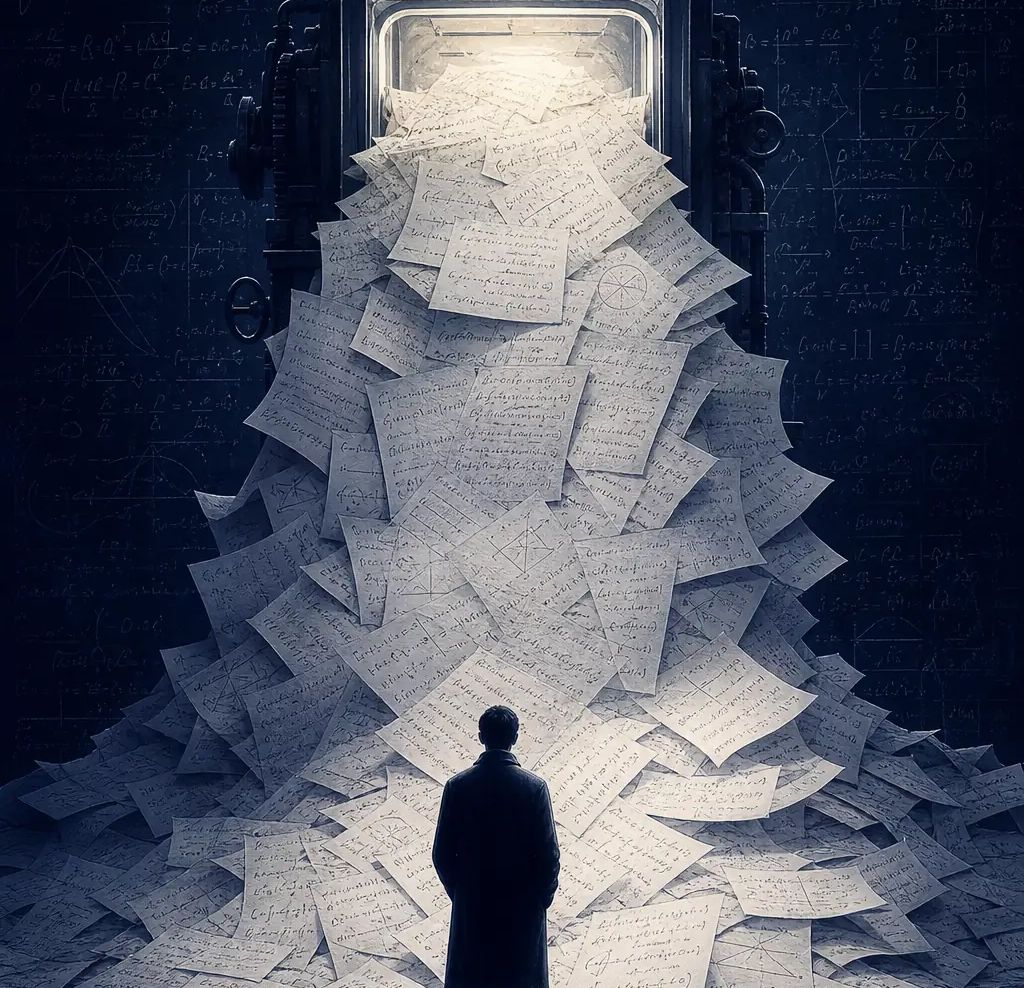
Terence Tao spent his ICM 2026 public lecture describing a problem most fields would love to have. Mathematics has more proofs than it can absorb. He named the shift a move from proof scarcity to proof abundance, and he did not sound relieved about it.
The talk was called “Mathematics in the age of AI.” It ran on July 24, 2026, in Philadelphia. Tao is a Fields Medalist at UCLA and one of the few working mathematicians the general public can actually name.
Here’s why it matters outside mathematics. Tao described a failure mode that every knowledge field will hit once machines produce output faster than people can digest it. Math just got there first, and it happens to have unusually clear rules about what counts as done.
What Tao actually told the room
The International Congress of Mathematicians has convened every four years since 1897. The 2026 edition gave AI a headline public-lecture slot for the first time.
Tao used it to argue that mathematics is in a second crisis of its foundations. The first one, roughly 1900 to 1930, came from Russell’s paradox and Gödel’s incompleteness theorems, and it was about truth. This one is about values and practice.
“We are entering a similarly turbulent period — a crisis in the foundations of mathematical values and practices. But once we thoroughly examine and codify these foundations, our community will emerge stronger and more resilient than before.”
He then did something careful. He split the subject into two questions and refused to mix them.
The first is the AI Capability Conjecture: can machines genuinely do research-level mathematics? The second is the Goals and Values Question: what is mathematics for, once they can? Tao said his talk was not about the first. He assumed a reasonably strong version of it as a working hypothesis, then spent the rest of his slides on the second.
That’s a bolder move than it looks. Most coverage of AI and math argues endlessly about capability. Tao skipped ahead to the part nobody has planned for.
What “proof scarcity to proof abundance” actually means
His own wording, from the slide deck he published the same day, is blunt:
“If the Working Hypothesis holds, then without suitable policy and cultural changes, significant ‘impedance mismatches’ (or ‘proof indigestion’) will emerge… In short, we will transition from an era of proof scarcity to an era of proof abundance.”
Think about what scarcity built. Peer review, publication cadence, priority disputes, tenure cases, the prestige of being first. All of it assumes proofs are rare and slow. A single hard result could carry a career.
That assumption is cracking. The First Proof project ran its Second Batch on May 28, 2026, testing four AI harnesses, including OpenAI’s ChatGPT 5.5 Pro, against ten novel research-level problems. Expert referees graded the output for correctness and exposition. At least one team solved seven of the ten at publication-level quality. Compute cost ran between $10 and $1,000 per problem.
Ten problems is a small sample. The direction is what unsettles people.
It’s already showing up in the wild. The crowdsourced site erdosproblems.com now hosts dozens of AI-generated proof submissions, many of them probably correct and none of them checked. In several cases the humans who submitted them said outright that they weren’t qualified to vouch for the work.
Tao put the endgame as a question:
“But what if an AI tool generates a lengthy proof that nobody — not even the original humans prompting the AI — understands? … Could we have a verified proof of a major result that no human understands enough to explain it?”
We’ve circled this problem before in a different domain, when AI starts designing buildings humans struggle to read. Correct and comprehensible are not the same property.
The five stages, and where the machines stop
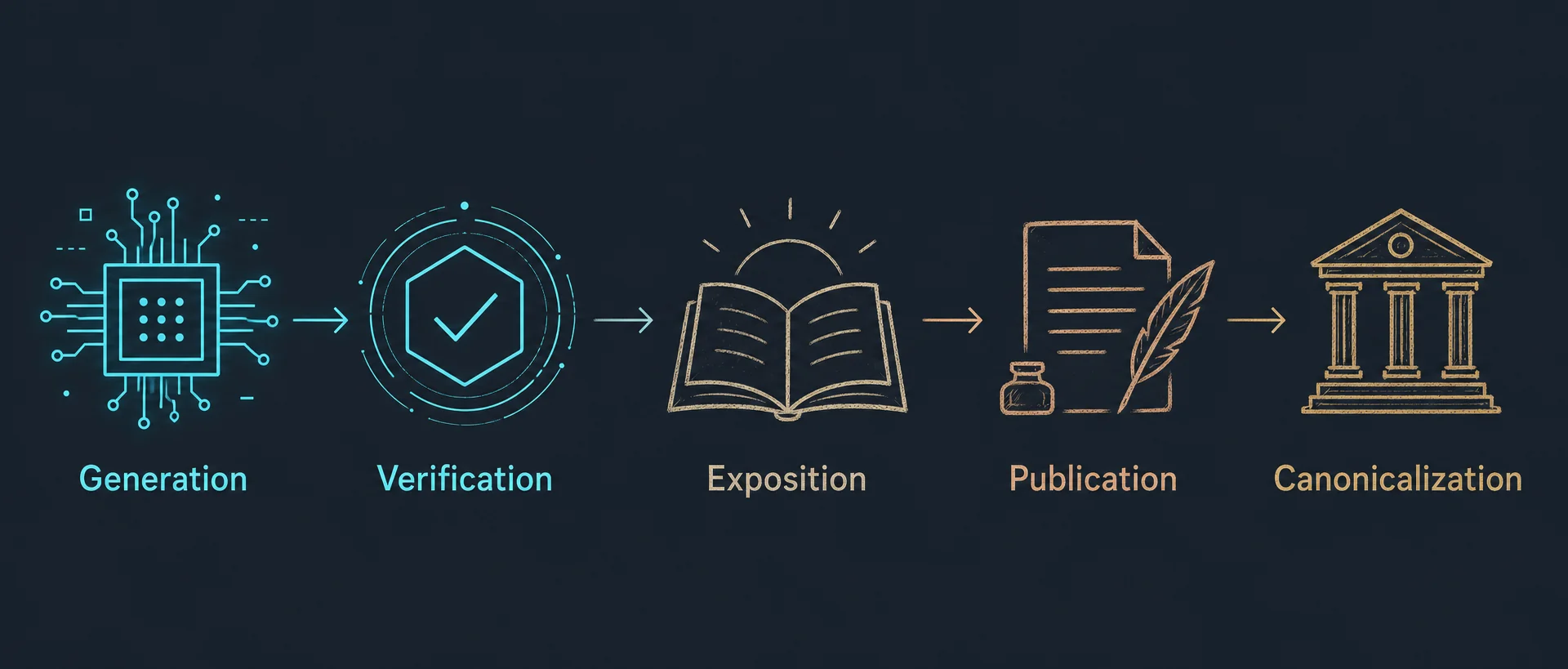
The spine of the talk is a pipeline. Any result has to travel through five stages before mathematics really owns it:
- Generation — somebody produces a proof.
- Verification — somebody confirms it’s correct.
- Exposition — somebody writes it up so others can follow it.
- Publication — the community accepts it, via editors and referees who vouch for it.
- Canonicalization — the field absorbs it into standard theory, courses, textbooks.
AI is strong at stage one. It’s getting strong at stage two, because formal proof assistants like Lean, Rocq, and HOL can check a proof mechanically, without a human reading every line.
Stage three is where it wobbles. Tao describes AI’s record on exposition as very mixed. The grammar and formatting come out near-flawless. But the writing dwells at length on trivialities, glides past the genuinely novel steps, and often fails to connect a result to the literature around it.
He adds a stranger observation. Over-polished machine prose strips out the natural friction that tells a reader where the hard ideas live. Human write-ups are lumpy in informative ways. The places where an author struggles are usually the places worth slowing down for, and a flawless surface hides them.
Stages four and five are, in Tao’s words, the ones least amenable to optimization by AI tools. They run on slow human consensus. Referees choose to stake their names on a result. A field gradually decides a theorem is now just part of how it thinks. Tao calls canonicalization the slowest stage of all, and the most valuable part of the entire process.
More proofs is not more understanding
This is the sentence Tao borrowed from William Thurston’s 1994 essay, and it’s the hinge of the whole talk:
“We are not trying to meet some abstract production quota of definitions, theorems and proofs. The measure of our success is whether what we do enables people to understand and think more clearly and effectively about math.”
Read that against a benchmark score and the mismatch is obvious. Machines optimize output. The field claims to want understanding. Nobody noticed the gap while proofs were scarce, because output and understanding rose together.
Tao’s proposed fix is cultural, not technical. Lower the prestige attached to being first to a proof. Raise it for the digestion work: exposition, refereeing, shepherding results into the canon. His rule of thumb is refreshingly concrete.
“My suggested rule of thumb: if the authors cannot convincingly demonstrate that they can give a clear, expert-level talk on their results, that is correct and properly attributed, then the result should not be published.”
In other words, you may use the machine. You may not hide behind it.
The field is already codifying some of this. The Leiden Declaration on Artificial Intelligence and Mathematics, published June 2, 2026 and endorsed by the International Mathematical Union, asks for mandatory disclosure of AI tool use, keeps human authors fully responsible for correctness and citations, and bars crediting an AI system as an author. Tao calls it an excellent starting point.
Proof indigestion is coming for your field too
Tao doesn’t stop at problem-solving. He says the same analysis needs running on teaching, mentoring, hiring, grant review, and public outreach. In some of those, he argues, mathematicians should emphasize the human part of the work and tightly restrict AI tools. In others they should take the initiative on using them.
Swap “proof” for whatever your job produces and the pipeline still holds. Code gets generated faster than anyone reviews it. Reports get written faster than anyone reads them closely. Research summaries pile up unread. Generation is cheap now, verification is getting cheaper, and everything downstream still runs at human speed.
That’s the part worth sitting with. The bottleneck was never producing the artifact. It was a person understanding it well enough to be responsible for it.
Which is the same worry that runs under the question of whether large language models understand language at all, and under the practical trade-off in cognitive offloading to AI. Fluent output is easy to mistake for comprehension, in the machine and in ourselves.
What’s still genuinely unsettled
Tao is careful about the capability question, and you should be too.
He notes that most public evidence for AI’s mathematical ability is highly subject to reporting bias and non-scientific incentives. Labs publicize wins. Nobody publicizes the eight failed attempts before the good one. That’s exactly why he brackets capability as a hypothesis rather than a settled fact.
The broader record is still striking. Quanta Magazine reports that AI models solved five of six International Mathematical Olympiad problems in summer 2025, the moment many researchers now treat as the tipping point. Google DeepMind’s AlphaEvolve was pointed at 67 open math problems and beat the best known result on 23 of them, matching prior results on 36 more. Toronto mathematician Daniel Litt’s read: “It’s very likely that this technology is bigger than the computer.”
Tao’s own caution cuts the other way too. “AI without validation is too unreliable to be of use in any serious application,” he told Quanta. Both things hold at once.
And First Proof plans further batches. Seven out of ten, at $10 to $1,000 a problem, describes May 2026 and nothing else. If you want a sense of how fast these curves move, our roundup of AGI timeline predictions is a useful reality check on how badly experts date this stuff.
The question worth carrying around
I keep coming back to Tao’s rule of thumb, because it’s portable. Can you stand up and explain the thing you shipped, without the tool in the room?
If yes, the machine made you faster. If no, you didn’t produce work. You produced an artifact that nobody in the chain is accountable for, and abundance of those is not wealth.
Mathematics is going to argue about this for years, in public, with unusually precise language. That makes it the best preview the rest of us are going to get. Watch what they decide to reward, then ask what your own field rewards.
What would your version of Tao’s rule of thumb look like? That’s the conversation to start now, while it’s still yours to shape.