
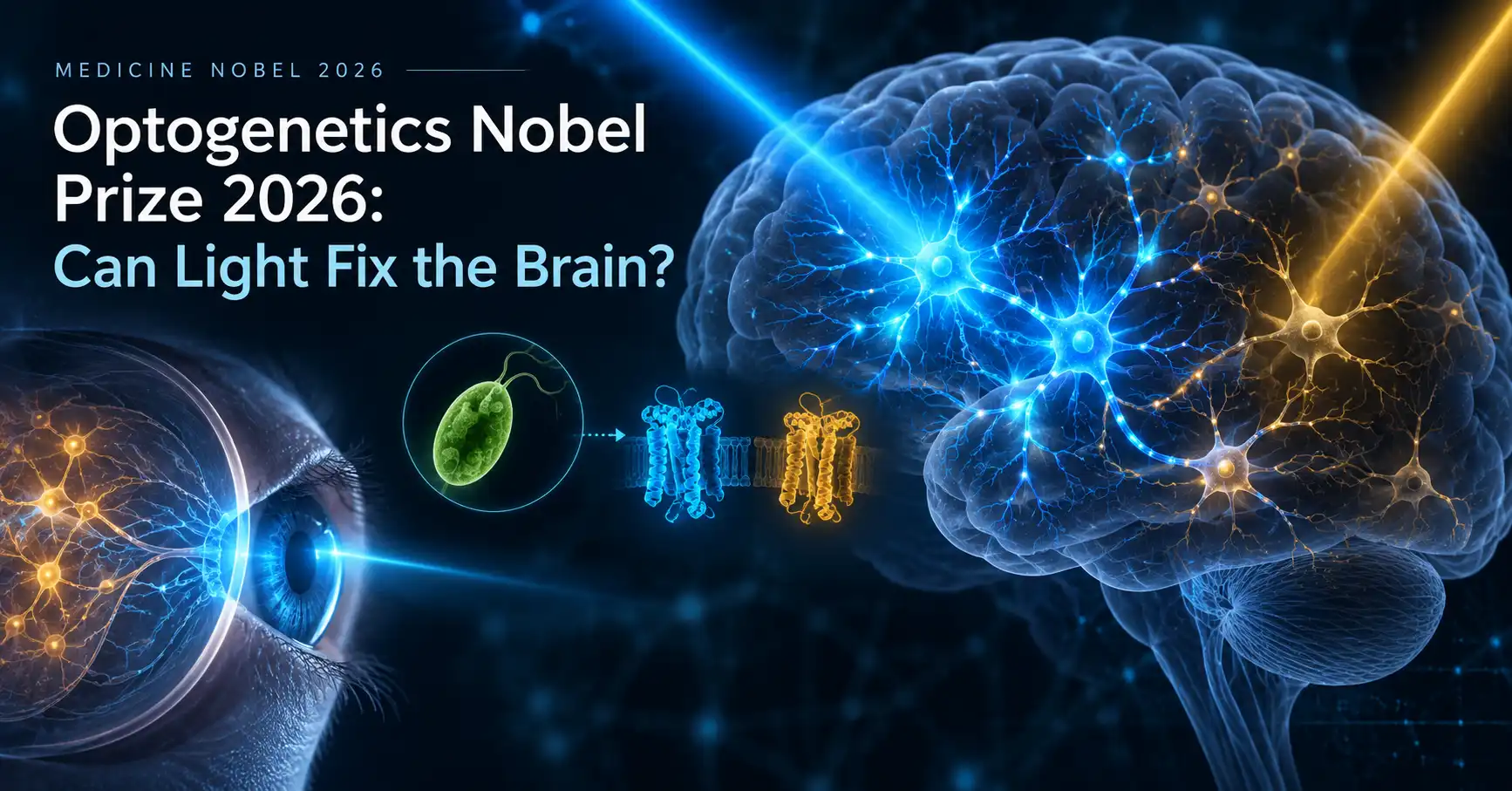
A pulse of blue light reaches a few brain cells carrying a borrowed algae gene, and they fire. Swap in a different light-sensitive protein and the same trick silences them. That idea is what the optogenetics Nobel Prize 2026 rewarded. The Nobel Assembly at Karolinska Institutet announced it in Stockholm on Monday, October 5.
The tension underneath is a human one. If scientists can switch chosen brain cells on and off, what does that mean for someone with Parkinson’s or a failing retina? And how much of it works in people today?
The honest answer splits in two. As a way to study the brain, optogenetics has already changed neuroscience. As a treatment, it’s still knocking on the door. And the first door isn’t the brain at all.
It’s the eye.
Optogenetics Nobel Prize 2026: Who Won, and for What?
The 2026 Nobel Prize in Physiology or Medicine went to three optogenetics pioneers:
- Karl Deisseroth, 54, Stanford University
- Peter Hegemann, 71, Humboldt University of Berlin
- Georg Nagel, 73, University of Würzburg
The citation honors them “for their discoveries concerning light-gated ion channels and optogenetics.” They’ll share 12 million Swedish kronor, about $1.2 million, in equal parts (Al Jazeera). The ceremony takes place in Stockholm on December 10.
The credit splits cleanly. Hegemann and Nagel found the light switch in a single-celled alga. Deisseroth worked out how to install it in nerve cells.
- Early 1990s. Hegemann studied how the alga Chlamydomonas reacts to light within half a millisecond. He proposed that one protein both captures light and acts as an ion channel.
- Early 2000s. Nagel tested the idea by injecting the alga’s genes into frog eggs, which led to channelrhodopsin-2. The pair then made human and hamster cells fire electrical impulses under light.
- 2005. Deisseroth got it working in rat nerve cells. The name “optogenetics” followed in 2006.
- 2007. Deisseroth showed the approach working in the brains of living mice.
How Does Optogenetics Work, in Plain English?
Deisseroth’s own explanation is the cleanest. Researchers make cells light-sensitive by “introducing a gene from algae,” he told NPR. Then “we can use light to create electricity in exactly the cells we give the gene to.”
In practice, the method has moving parts:
- An opsin. This light-sensitive protein does the switching. Channelrhodopsin opens ion channels under blue light and turns a neuron on. A relative called halorhodopsin silences it.
- A delivery vehicle. Scientists package the opsin gene inside an engineered virus, a viral vector, which carries it into target cells.
- A light source. Tethered optical fibers, wireless micro-LEDs or implants bring light to those cells.
Researchers can pulse that light with millisecond precision. “Optogenetics is fast. Optogenetics is precise, just like the brain,” Deisseroth said.
Notice what that list implies. Optogenetics isn’t a drug, and it isn’t a gadget. It’s a gene therapy paired with hardware. That one fact shapes almost everything about where it can go next.
Why Did a Lab Tool Win a Medicine Prize?
For most of its history, neuroscience could watch the brain but struggled to prove cause and effect. A region lights up on a scan during fear. Does it cause the fear, or just tag along?
Optogenetics lets you test that directly. Thomas Perlmann, secretary-general of the Nobel Assembly, put it plainly: “This method makes it possible to switch on, or off, the activity of individual nerve cells in a living brain.”
Labs have used it to study how specific cell types drive learning, fear, addiction and movement. The Nobel Assembly says it has revealed circuits tied to specific memories. Committee member Anna Wedell went further: “For the first time we can actually start to understand how the brain processes information.”
Most coverage of the 2026 Nobel Prize for optogenetics skipped the next part. Deisseroth argues the biggest medical payoff may come from what the tool reveals, not from shining light into patients. Optogenetics “tells you what matters,” he told NPR, and “once you understand the cells that matter, you can design any kind of treatment.” That might mean a drug, or a sharper target for an electrode.
I find that the most convincing case for the prize. A map earns its value long before anyone builds the road.
Is Optogenetics a Brain-Computer Interface?
Winning the 2026 Nobel Prize doesn’t make optogenetics a BCI. The laureate says so himself.
An electrode implant needs one thing: hardware in the right place. (Our guide to how brain-computer interfaces work walks through that pipeline.) Optogenetics needs two. A viral vector has to deliver a gene to the target cells, and then light has to reach them.
So you gain precision, but the invasiveness changes shape. It’s no longer “implant only.” It’s implant plus gene therapy.
Light brings its own physics problem. It travels only a few hundred microns into brain tissue before it scatters, and tethered fibers can damage tissue. That has long limited how deep the method can reach.
Deep brain stimulation (DBS), an approved treatment since 1997, makes a useful comparison. Its implanted device sends electrical pulses that stimulate cells broadly. In 2009, Deisseroth compared the brain to an orchestra without sections: “Treatments like DBS are unrefined, in that they stimulate all of the cells or instruments.”
That same year, his Stanford team tested this in animals with Parkinson’s-like symptoms. Rapid flashes of blue light on targeted neurons eased the symptoms. Slow flashes made them worse. Other cell types did nothing. Cell type mattered, and so did rhythm.
Could light one day replace electricity in a BCI? Deisseroth told AFP it’s “an interesting thing, but one that probably will take a little time to build” (Kuwait Times). He named the obstacle too: “the brain is so complicated with billions of cells that are next to each other and do completely different things.”
What Has Actually Reached Patients?
Very little, and almost all of it in the eye. As of early October 2026, the first optogenetic therapy sits under FDA review.
The eye: one patient, then 27
In May 2021, a Nature Medicine case report described one blind man with retinitis pigmentosa. Researchers delivered the gene for ChrimsonR, an opsin that responds to amber light, to cells in his retina. He then wore camera goggles that projected the scene onto his retina in amber. Training began about five months after the injection, and improvement showed up roughly seven months later.
The gains were real but modest:
- He touched a large notebook in 36 of 39 trials (92%).
- He picked out a small staple box 36% of the time.
- He counted glass tumblers correctly 63% of the time.
Without the goggles, he couldn’t do any of it. The authors called it “proof-of-concept.” GenSight Biologics appears among the institutions behind the work.
Now the news most Nobel-day copy missed. On September 9, 2026, the FDA accepted Nanoscope’s application for MCO-010, now named Mogenry (Optometry Times). It’s a one-time eye injection for adults with retinitis pigmentosa and severe vision loss. It puts a light-sensitive gene into bipolar cells, so ordinary light should be enough. No goggles.
The evidence comes from RESTORE, a randomized, sham-controlled Phase 2b trial of 27 patients (18 treated, 9 sham). The high-dose group beat sham on best-corrected visual acuity by 0.337 logMAR at week 52, and by 0.539 at week 76. The company reported no treatment-related serious adverse events over two years. Eye inflammation (about 44%) and raised eye pressure (about 39%) were common but mild to moderate.
Two caveats matter. The company supplied the data, and 27 people make a small trial. The FDA’s decision window falls in the first half of 2027.
It’s a different bet from brain implants such as Neuralink’s Blindsight. Optogenetics works with cells the patient still has.
The ear: still in animals
Hearing researchers hope light could stimulate the auditory nerve more precisely than today’s electrical cochlear implants. In an April 2026 review, Göttingen’s Tobias Moser described the field moving “toward first-in-human applications.” Every result so far, though, comes from animals. A 2022 Göttingen plan aimed to start a first clinical trial in 2026. As of that review, nobody had reported one.
The brain: mostly indirect, for now
AP named two of the most advanced efforts: MapLight’s autism therapy (Deisseroth co-founded MapLight) and Nanoscope’s retinal treatment. It described both as “still some way from reaching patients.”
Deisseroth told AFP that late-stage trials for autism and schizophrenia look promising. Read that carefully. He calls this “indirect” optogenetics: drugs found by mapping circuits with light, not light switching neurons inside people.
Manuel Valero of Hospital del Mar in Barcelona said optogenetics “allowed us to push the boundaries between science and science fiction.” He also said the field still hasn’t delivered on its promise for human brain disease.
What Are the Limits and Ethical Questions?
The 2026 Nobel Prize for optogenetics doesn’t shrink its ethical problems. They grow out of the very feature that makes it work: it changes the genes in your cells.
A 2022 paper by Harris and Gilbert in Graefe’s Archive for Clinical and Experimental Ophthalmology spelled out the risks for eye trials:
- It’s permanent. Nobody can undo the treatment, and an attempt at reversal could cause “severe harm,” such as scar tissue.
- Leaving is murky. Participants may not be able to withdraw, or to switch to a better treatment later.
- Support can vanish. If a trial ends early, people may lose trial-provided gear like high-intensity goggles.
- Durability is unknown. Expression levels vary, and repeat dosing raises immune-response risk.
The authors also argue that public health systems should distribute a proven therapy, so access stays fair. That’s the same worry we raised about brain chips and the class divide.
Then comes a question no study answers yet, because nobody has built the device. Optogenetics is, by design, a way to write signals into chosen cells. If it ever moves from the retina to the cortex, the issues in the ethics of writing signals into the brain stop being hypothetical. Who consents to a permanent edit? Who holds the switch?
So What Did Stockholm Actually Reward?
Not a cure. Not a brain-computer interface, either.
The 2026 Nobel Prize for optogenetics rewarded a question that finally got answered: which cells actually do what. That’s a scientist’s prize, and I think it’s the right call. The patient’s version, if it comes, starts much smaller. It looks like a man finding a notebook through amber goggles.
Watch the FDA’s Mogenry decision in the first half of 2027. It will say more about where optogenetics goes next than any speech in Stockholm this December.