
A man who hadn’t felt his own hand in three years reached out, and his sister’s fingers were suddenly there. Warm. Real. He called it a “burst of energy.”
That moment is the reason the double neural bypass matters, and it’s the part most of the news coverage rushed past. The device Keith Thomas received didn’t just help him move a paralyzed arm. It gave him back the feeling of being touched. And the feeling stayed even after the machine was switched off.
For years, brain-computer interfaces have been control tools. You think, the system reads the thought, a cursor moves or a robot arm grips. Useful, but one-directional. This is different. For the first time in a peer-reviewed study, a single system restored both doing and feeling. And that raises a question the strength stats can’t answer. What happens when a machine gives someone their body back, not just command of it?
What happened to Keith Thomas
Keith Thomas, 45, of Massapequa, New York, dove into a pool in July 2020 and hit the water wrong. The injury was complete: C4 sensory, C5 motor. He was paralyzed from the chest down, with no movement and no sensation in his arms (Feinstein Institutes).
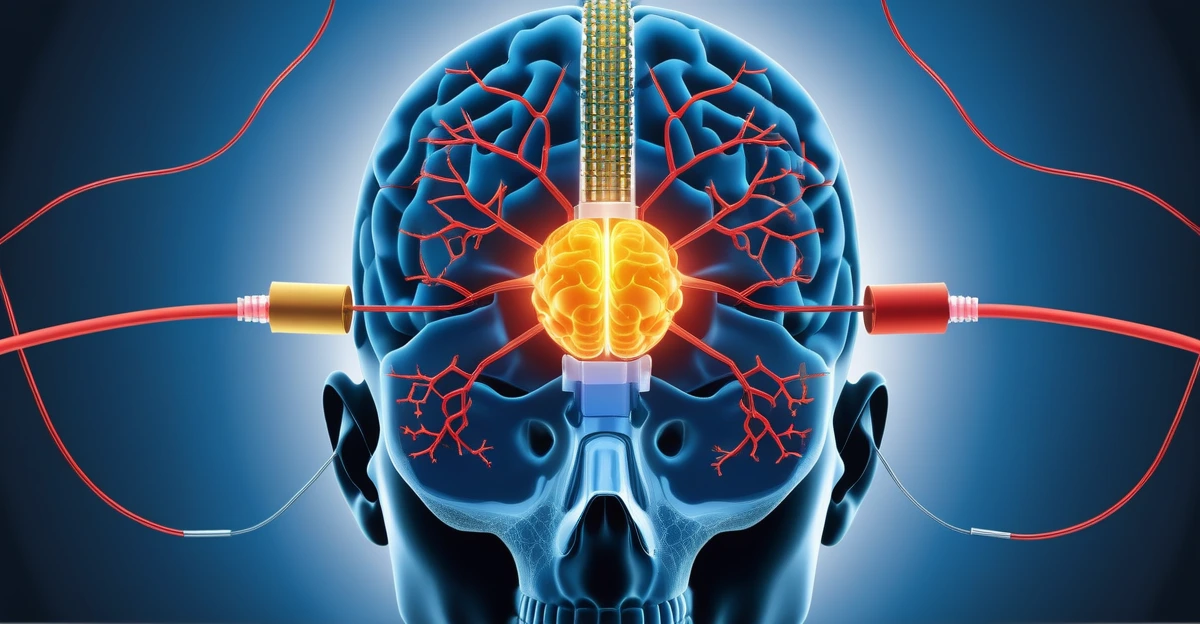
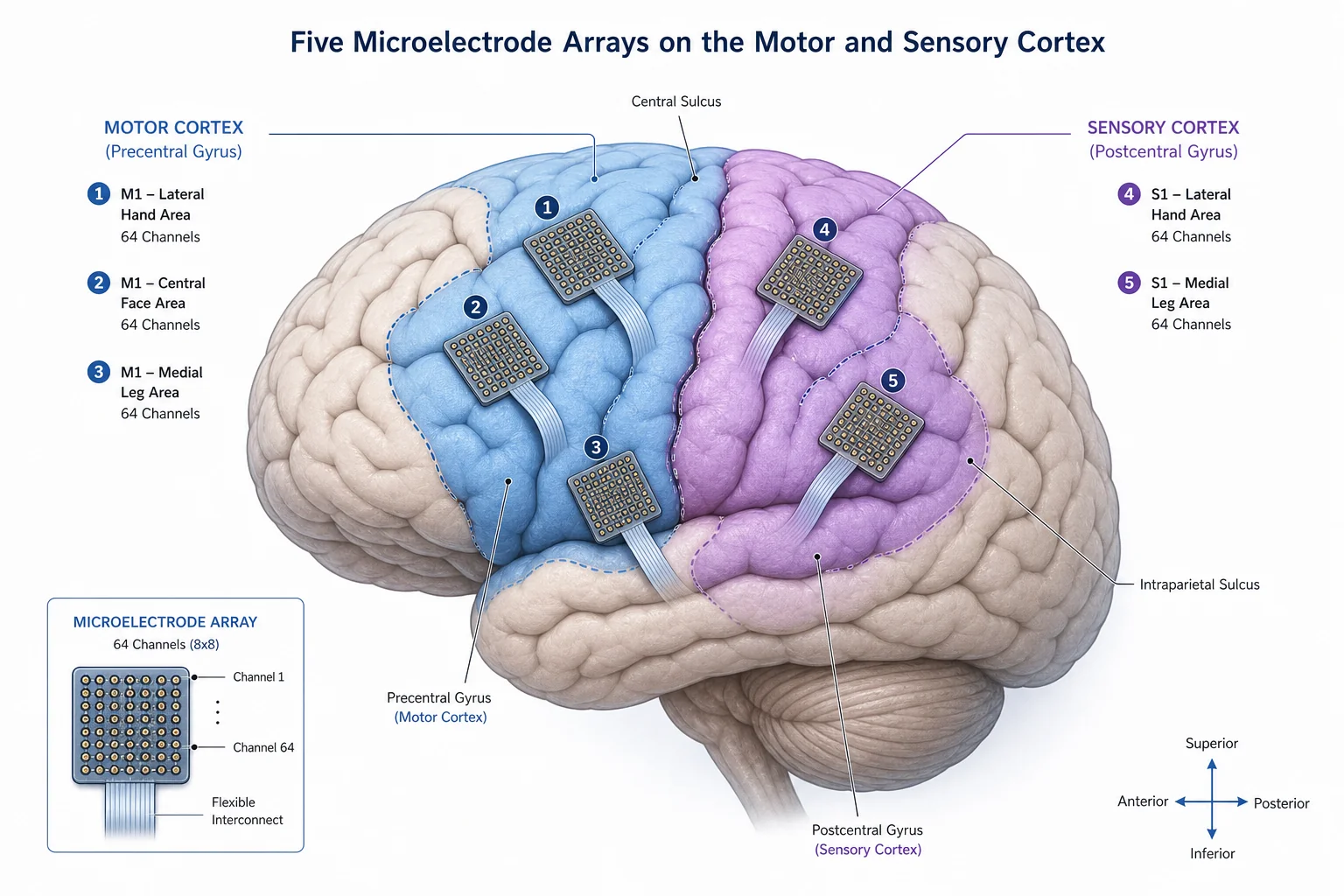
He met the research team in October 2021 and enrolled in the trial. Then came the hard part. On March 8, 2023, neurosurgeons Ashesh Mehta and Netanel Ben-Shalom opened his skull for a 15-hour operation at North Shore University Hospital. They placed five microchips, each smaller than the tip of your pinky: two in the motor cortex, three in the sensory cortex, 224 electrodes in total.
A month later, sensation started flickering back in his fingertips. A year after that, he could grasp, lift, and drink from a cup using thought alone.
From control to feeling: why sensation changes the question
Here’s the framing shift worth sitting with. Motor-only implants answer a mechanical problem: how do I make my hand close? Restoring touch answers something else entirely. It’s about whether you can feel the person holding your hand.
Thomas put it plainly. The return of touch was “overwhelming,” he said. “I can feel the touch of someone holding my hand.”
Mindox has covered the two dominant flavors of brain implant so far. There’s the motor kind, like China’s world-first brain-computer chip, which decodes intent to drive movement. And there’s the sensory kind, like Neuralink’s Blindsight, aimed at restoring sight. The double neural bypass is the first system to do both at once, in one person. And that combination is closer to embodiment than to remote control.
How the double neural bypass actually works
The system runs on two branches, working in tandem.
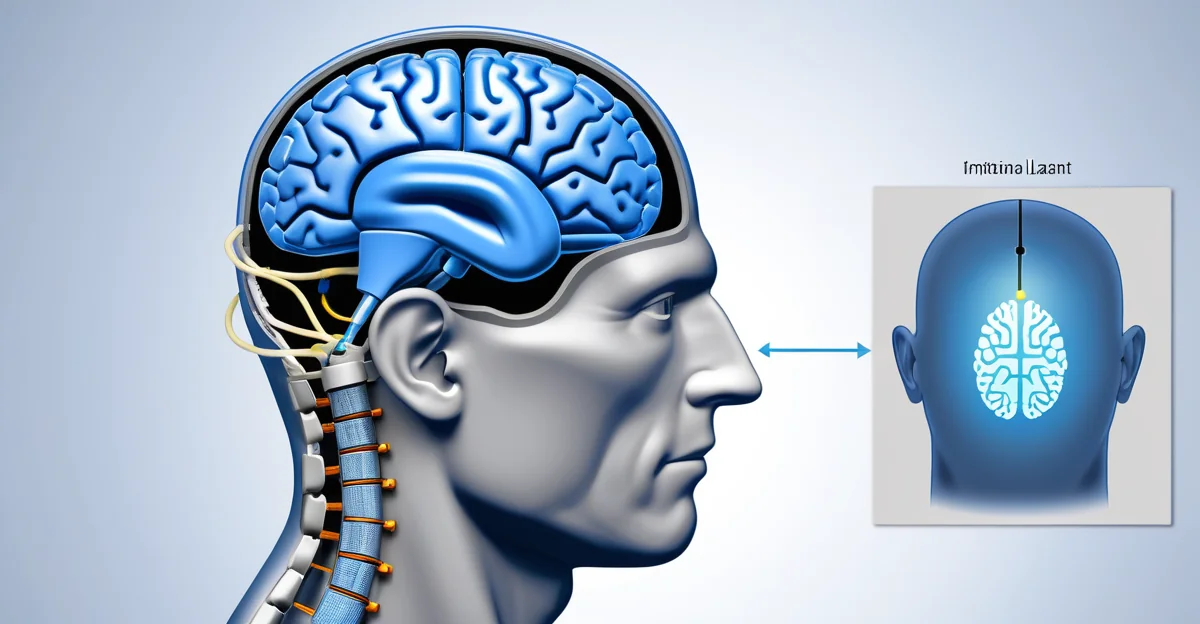
Brain-to-body. Chips in the motor cortex record the intent to move. A machine-learning decoder reads that intent and fires electrode patches that stimulate the spine and forearm muscles. At the same time, sensors on the fingertips relay pressure and touch data back up to the sensory cortex. The decoder held up to 84.6% accuracy over five months with no retraining, running on 128 recording channels in the motor cortex and 96 in the sensory cortex (BioSpace).
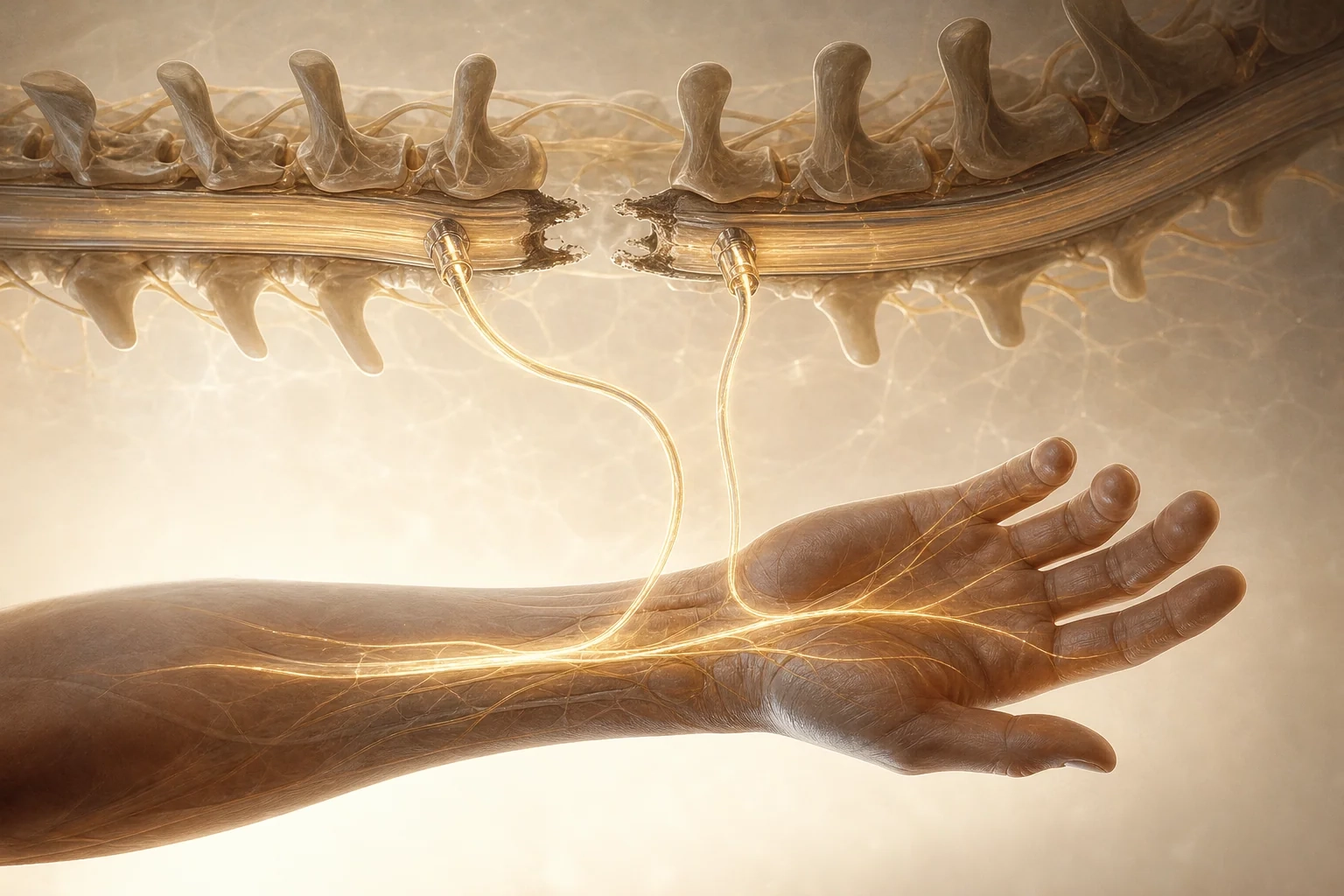
Brain-to-spinal-cord. Flexible electrode patches stimulate the sensory roots below the injury. Researchers call it “thought-driven therapy”, the patient’s own intention drives the stimulation that helps rebuild connections.
Then there’s the piece that does the real work on touch: cortical mirroring. After roughly 25 weeks of it, Thomas regained tactile sensation in his wrist, an area that had been completely numb since the accident. That’s not the assistive decoding. That’s the therapy that rewires.
The stats, briefly
Over 35 weeks of arm-strength training, his right-arm strength rose 86% and his left rose 62%. He grasped hollow eggshells without crushing them 87% of the time. The work was published in Nature Medicine, made its July 2026 cover, and landed his case on TIME’s Best Inventions Hall of Fame.
The detail that actually matters: the gains stayed
This is the load-bearing fact. Earlier single-neural-bypass systems (motor-only, decode and stimulate) only worked while the patient was wired to a lab computer. Unplug it, and the ability vanished.
The double bypass broke that pattern. Thomas’s restored touch persisted more than two years after the study period ended, with the system off. His body had rewired around the damage.
Think about what that means. The machine wasn’t a permanent crutch anymore. It was more like a physical therapist that eventually works itself out of a job. Function that survives the device is a fundamentally different claim than function that depends on it.
What’s confirmed, and what isn’t
Let’s be honest about the size of this. It’s one patient. n=1.
What’s solid: a peer-reviewed, Nature-Medicine-cover study documented real strength gains, restored discriminative touch, and persistence lasting months to years. That’s not a press release; it cleared review.
What’s not: whether any of it generalizes. STAT News reported that outside experts “applauded the results, but questioned if the findings would translate more broadly” (STAT News). Different injuries, different bodies, different levels of damage, none of that is proven yet. The Feinstein team knows it, which is why their next step is exactly that: multi-participant trials across varying injury severities, plus early work on stroke recovery. That plan is itself an admission that one result isn’t a rule.
How it differs from Neuralink and the rest
Quick map of the field, because the differences are the whole point:
- Neuralink Telepathy: already in patients, restores motor control and communication. No touch.
- Neuralink Blindsight: sensory-only, aimed at vision, still pre-human-trial with FDA breakthrough-device status.
- Motor-only bypasses: decode-and-stimulate systems that need the lab computer running to do anything.
- Double neural bypass: motor decoding plus true touch restoration in the same patient, with sensory gains that outlive the device being powered on.
That last line is what sets it apart. Not the electrode count. The persistence.
What it means if feeling becomes the benchmark
For a long time the question for a paralyzed patient was: can we get you moving again? A good question. A hard one. But movement without sensation is a strange kind of restoration, a hand you can close but can’t feel closing.
If the double neural bypass holds up in larger trials, the bar shifts. The goal stops being function and starts being felt experience. Restoring the body as something you inhabit, not just operate.
That opens harder questions the trial can’t touch. Who gets access to a 15-hour surgery and years of specialized therapy? These procedures are rare, resource-heavy, and expensive, the same tension we’ve traced with brain chips and the class divide. And every advance in writing signals into the nervous system carries the questions we raised in the ethics of writing signals into the brain: what else can be written, and by whom?
For now, keep the frame honest. One man can feel his sister’s hand again, and the feeling didn’t leave when the machine did. That’s not a cure for paralysis. It’s a proof of concept for something bigger. That a brain interface might restore not just what a body does, but what it feels. Whether that scales to the next hundred patients is the story worth watching.