
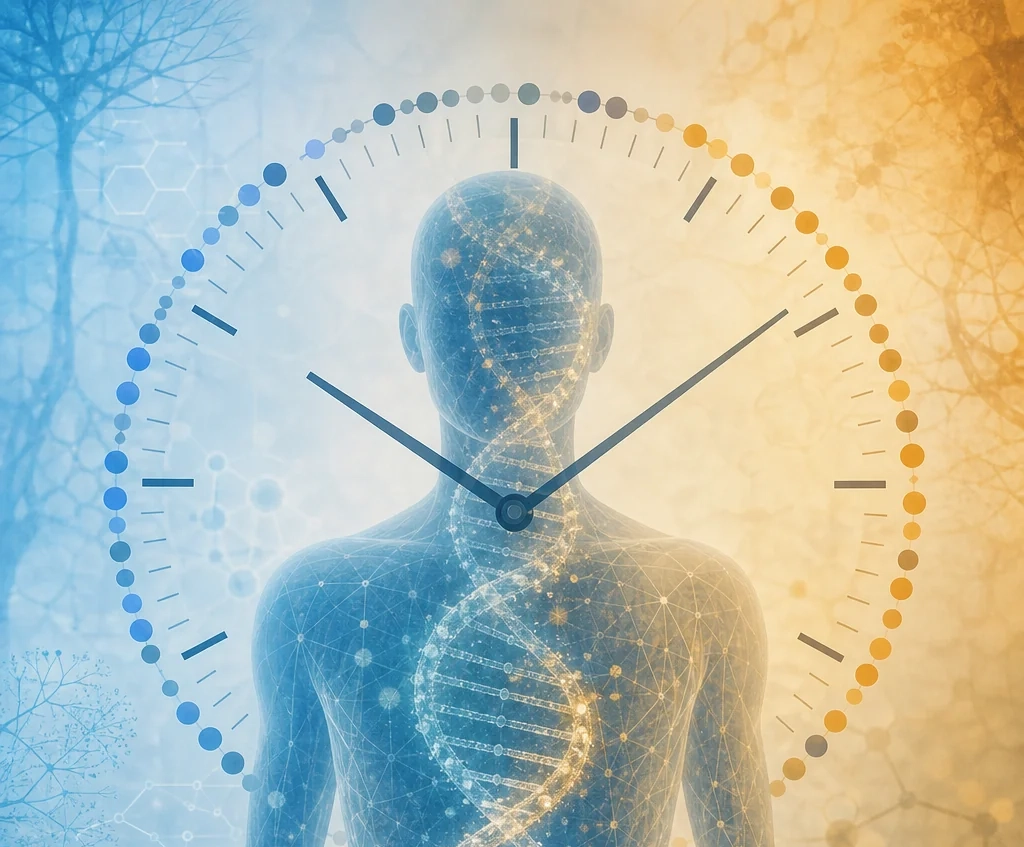
Your birth certificate says one thing. A cheek swab, run through a machine-learning model, might say something else entirely.
That gap is the whole premise behind AI biological age clocks, and in 2026 it stopped being a fringe idea. These are algorithms trained to read the wear on your cells and hand you a number: not the years since you were born, but how old your body actually seems. Sometimes that number is kinder than your age. Sometimes it’s a warning.
The pitch is seductive. Who wouldn’t want a truer measure of how they’re really doing? But the closer you look at these clocks, the more one uncomfortable question pushes forward. If an AI can assign you an age your calendar can’t, who else gets to see it, and what will they do with it?
What AI biological age clocks actually measure
Strip away the marketing and the mechanism is surprisingly specific. These clocks read DNA methylation, a chemical tag that lands on your DNA and shifts as you age. It doesn’t rewrite your genes. It just accumulates, like mineral deposits in a pipe, in patterns that track time.
Machine learning does the rest. Feed a model the methylation status at particular sites on the genome, called CpG sites, and it learns to map those patterns onto an age. The first clock to pull this off across many tissue types was built by Steve Horvath in 2013. It used 353 CpG sites and worked whether the sample came from blood, liver, or lung, which was a genuine first for the field.
So the “AI” here isn’t a chatbot guessing your age from a selfie. It’s a statistical model trained on thousands of biological samples, finding correlations no human could eyeball. That distinction matters when we get to what these numbers can and can’t tell you.
Biological age vs chronological age, and why the difference is the point
Chronological age is trivial. It’s subtraction.
Biological age tries to answer something harder: how worn are you, really? Two people can share a birth year and sit a decade apart biologically. One ran marathons and slept eight hours a night. The other smoked through a stressful job and skipped every checkup. The clock is meant to catch that divergence, the thing your ID card can’t.
This is exactly the territory longevity researchers care about, and it’s why the concept sits so close to how longevity tech tries to extend healthspan, not just life. The goal was never to add years for their own sake. It was to measure whether an intervention actually slows the underlying decay.
From Horvath’s clock to GrimAge and DunedinPACE
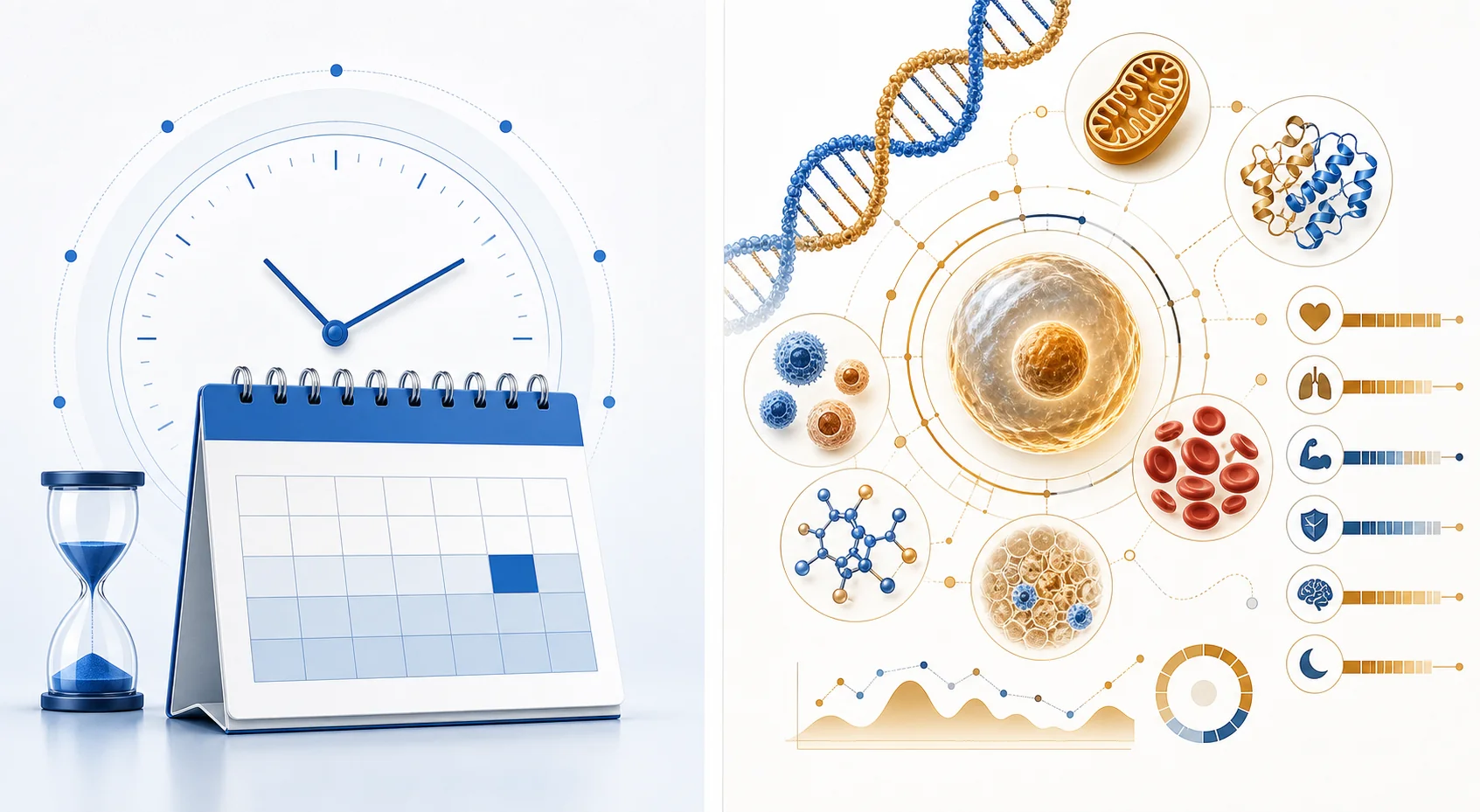
The field didn’t stand still after 2013. It split into generations, and each one changed the question the clock was answering.
First-generation clocks, like Horvath and Hannum, were trained to predict chronological age. Clever, but a bit circular. If a clock’s job is to guess the number you already know, what’s it really for?
Second-generation clocks flipped the target. PhenoAge and GrimAge were trained on health and mortality outcomes instead of birthdays. That’s why GrimAge outperforms the older clocks at what people actually want to know. It’s currently the single strongest methylation-based predictor of mortality, cardiovascular events, cancer, and the countdown to a first major chronic disease.
Then came a third idea. DunedinPACE, published in 2022, stopped taking a snapshot and started clocking a rate. Instead of “how old are you,” it asks “how fast are you aging right now.” Researchers built it by tracking 19 markers of organ-system health in the same New Zealand birth cohort across four time points spanning two decades, then compressed all that into a single blood draw. If GrimAge is an odometer, DunedinPACE is a speedometer.
The two don’t always agree, and that’s not a footnote. The correlation between DunedinPACE and Horvath-clock aging was weak. It got stronger against GrimAge, but the clocks are clearly measuring related-but-different things. DunedinPACE tends to track cognitive decline best and reacts fastest to interventions. GrimAge only budges for longer, larger ones.
The accuracy problem: population truth, personal guess
Here’s where the shine comes off. And it comes off hard.
In December 2025, a peer-reviewed critique in npj Aging asked a blunt question in its title: do we actually need aging clocks? The findings sting. Different clock models predicted different, sometimes contradictory age acceleration for the same people in the CALERIE caloric-restriction trial. Same participants. Same blood. Different verdicts, depending on which clock you trusted.
Worse, the paper flagged that nearly all published clocks hand you a single number with no confidence interval attached. Your result reads like “you are 47.” What the math can actually support is closer to “you are somewhere in a range we haven’t shown you.” The authors put it plainly: these clocks are “unreliable for personal predictions, outside of population-level studies”.
Consumer tests make this messier still. Prices run from $30 to over $1,000, and the results wobble with the method. A saliva sample and a blood sample can hand the same person substantially different ages. Test on a different day and the number can move again, because the epigenetic signal is dynamic, not fixed. Researchers keep repeating the same caution: these tools “aren’t designed to make claims about the health of individuals.” They belong in a lab, not on a bathroom shelf as a personal verdict.
So the clocks are real science. They’re also, for you personally, a blurry photograph presented as a sharp one.
Why 2026 feels like an inflection point
If the tools aren’t ready, why does this year feel different? Because the institutions are moving anyway.
As of 2026, biological age testing sits unregulated in the US as a diagnostic device, roughly in the same bucket as a genetic-ancestry kit. No epigenetic clock has earned formal FDA qualification as a validated surrogate endpoint for anti-aging trials. And yet multiple clinical trials have already started folding aging clocks in as primary or secondary endpoints, even without clear evidence they reliably track intervention-driven change.
Read that twice. The field is racing toward regulatory-grade use of a measurement its own literature says isn’t statistically ready. That’s the tension worth sitting with. Momentum and maturity aren’t the same thing, and right now the momentum is well ahead.
Who gets to know your biological age
This is the part longevity coverage usually skips, and it’s the part that should keep you up.
Say the clocks improve. Say they get precise enough to matter for one person. The moment a number can predict your mortality risk better than your birthday, it becomes something other people want. Insurers already went looking. Back in 2019, an ethics analysis documented that insurers had begun exploring epigenetic-age testing to sort people into risk groups. One researcher’s read on GrimAge’s predictive power was almost cartoonishly confident: it’s “really more likely that planet Earth will be hit by an asteroid tomorrow than that this predictor doesn’t work.” The same analysis still concluded that insurance use of these clocks looked premature.
Now the legal gap. The US Genetic Information Nondiscrimination Act, passed in 2008, blocks health insurers and employers from using genetic information. Life insurers are explicitly not covered. So the one industry most eager to price your mortality faces the fewest guardrails.
And there’s a deeper unfairness baked in. Epigenetic clocks tend to read accelerated aging in marginalized communities, tied to trauma, discrimination, and early-life hardship. If a life insurer priced premiums off that signal, it would charge people more for structural harms they never chose. This is the same fault line running through will brain chips deepen the human class divide?, just with a blood draw instead of an implant.
There’s a privacy dimension too. A biological age isn’t a diagnosis, so it slips through many of the protections we’ve built for health data, a gap that rhymes with the questions raised in neuroprivacy: what governments can really subpoena. Once your “real age” exists as a data point, it can be requested, shared, and acted on in ways you never signed off on.

What’s confirmed, and what’s still a hope
Let me separate the two, because the industry rarely bothers.
Confirmed: DNA methylation tracks aging. GrimAge predicts population-level mortality and disease better than a birthday does. DunedinPACE measures a pace of aging that responds to interventions. These are solid, published, repeatedly validated.
Still a hope: that any of this delivers a trustworthy number for you, one person, on one day. That two clocks will agree on your body. That a result won’t swing on whether you spat or bled. That regulators and insurers will wait for the uncertainty math to be solved before they act on your score.
The honest framing is that these tools optimize for something real while their personal precision lags behind, a mismatch that echoes the caution in cognitive enhancement ethics: a practical framework. Powerful at the population scale. Shaky at the scale of you.
So should you take one? If you’re curious and you treat the result as a loose signal, fine. Read it like weather, not fate. What you shouldn’t do is let a single number rewrite how you feel about your own body, or assume the people who might one day request that number will read it as carefully as you did. The clocks are getting good. Whether we’re ready for what a good one makes possible is the question nobody has answered yet.