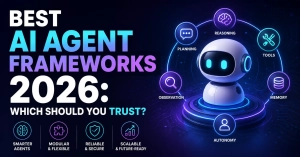
Best AI Agent Frameworks 2026: Which Should You Trust?
Best AI agent frameworks 2026: LangGraph, CrewAI, AutoGen and vendor SDKs compared on control, maturity and lock-in risk, plus how to judge the claims.

Welcome to the heart of Mindox AI-our official blog. In an era where technology moves faster than we can blink, staying informed isn’t just an advantage; it’s a necessity. This section serves as your ultimate guide to understanding how Artificial Intelligence, machine learning, and automation are reshaping our daily lives and global industries. We dive deep into the latest tech breakthroughs, offering you a front-row seat to the digital transformation happening right now.
Our goal is to demystify complex concepts and present them in a way that is easy to grasp, whether you are a seasoned tech professional or a curious beginner. We explore everything from the ethical implications of AI to practical tips on how you can use smart tools to boost your productivity. We don’t just report the news; we analyze what it means for the future of humanity.
Best AI agent frameworks 2026: LangGraph, CrewAI, AutoGen and vendor SDKs compared on control, maturity and lock-in risk, plus how to judge the claims.
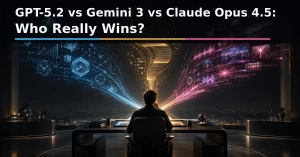
GPT-5.2 vs Gemini 3 vs Claude Opus 4.5: three flagships in 24 days, benchmark gaps under a point. Here is what actually separates them…
Nootropics, neurofeedback and focus BCIs compared: how each tries to sharpen the mind, what the evidence really says, and which is worth your time.
Narrow, generative and agentic AI compared: the shift from AI that performs one task, to AI that creates, to AI that plans and acts…
RLHF, Constitutional AI and RLAIF compared: how each teaches an AI model to behave, and the shift from human ratings toward scalable AI feedback.
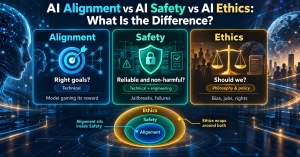
AI alignment, safety and ethics are constantly confused. Here is what each actually means, how they nest together, and why the distinction matters.
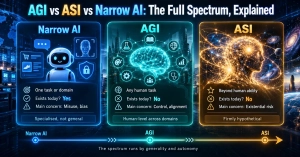
Narrow AI, AGI and ASI compared: what each means, which exists today, the risks unique to each, and how close we really are to…
EEG, fMRI and ECoG compared: which brain-reading method is fast, which is precise, which needs surgery, and how each powers todays neural interfaces.
Invasive brain implants offer precise signal but need surgery; non-invasive BCIs are safe but noisier. Here is the real trade-off and which fits when.

Proof scarcity to proof abundance: Terence Tao says AI now writes proofs faster than mathematicians can read them. Here's what that shifts for all…
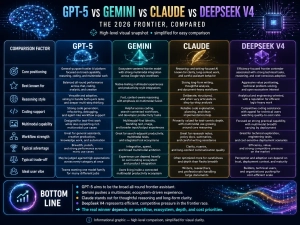
GPT-5, Gemini, Claude and DeepSeek V4 compared for 2026: how they differ on openness, multimodal ability, long context and cost, and which to pick.
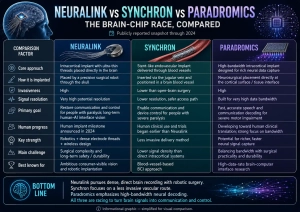
Neuralink, Synchron and Paradromics compared: cortical threads vs a vein-based stent vs speech-focused electrodes, and the bandwidth-versus-safety trade-off.

GANs, VAEs and diffusion models explained: how each generates images, why diffusion now dominates tools like Midjourney, and where GANs still fit.

Double neural bypass restored movement and touch to a paralyzed man, and the gains outlasted the machine. Here's why that changes what BCIs are…

AI model welfare research is now a real field at Anthropic, DeepMind, and Meta. Who's studying whether models can suffer - and whether it…

AI music labeling just went industry-wide. But does a 'generated vs assisted' tag actually tell us who authored a song? The gaps are bigger…
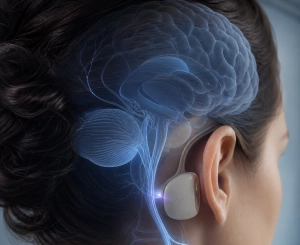
The first FDA-cleared neuromodulation wearable for PTSD just arrived. Here's how Modius Spero works and what it means for cognitive-health tech.

AI biological age clocks promise a truer age than your birthday. Here's what they actually measure, where they fail, and who might read your…
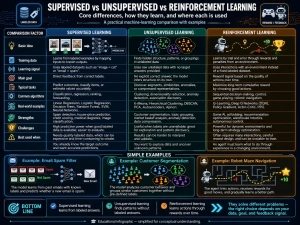
The three types of machine learning made simple: supervised learns from labels, unsupervised finds structure, reinforcement learns from rewards.
Machine learning, deep learning and neural networks are nested, not competing. Here is how they fit together and when you actually need each one.

Is AI training on copyrighted work fair use? Here's what the Thomson Reuters v. Ross ruling and the Third Circuit appeal mean for writers…
Neuralink vs Synchron vs Paradromics: a clear, human-first comparison of electrode counts, safety, patients, and the regulatory race in brain-computer interfaces.
RLHF vs Constitutional AI vs mechanistic interpretability, explained in plain terms: what each safety method catches, where it fails, and which to trust.
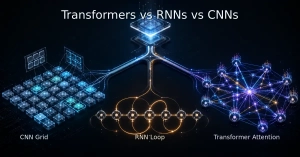
CNNs, RNNs and transformers compared in plain English: how each reads data, why transformers took over language, and where CNNs and RNNs still win.