

Most people hear “post-labor economy” and imagine one of two extremes: either a utopia where no one needs to work, or a collapse where machines take everything and human beings become economically irrelevant. Neither picture is especially useful. The better question is more practical. If AI systems become good enough to do more of the work that currently gives people income, status, and routine, how do you build a life that still feels meaningful? That is the payoff here. This article looks at what current labor data actually says, why the meaning problem is larger than the wage problem, and what people can do now before the labor market gets rougher.
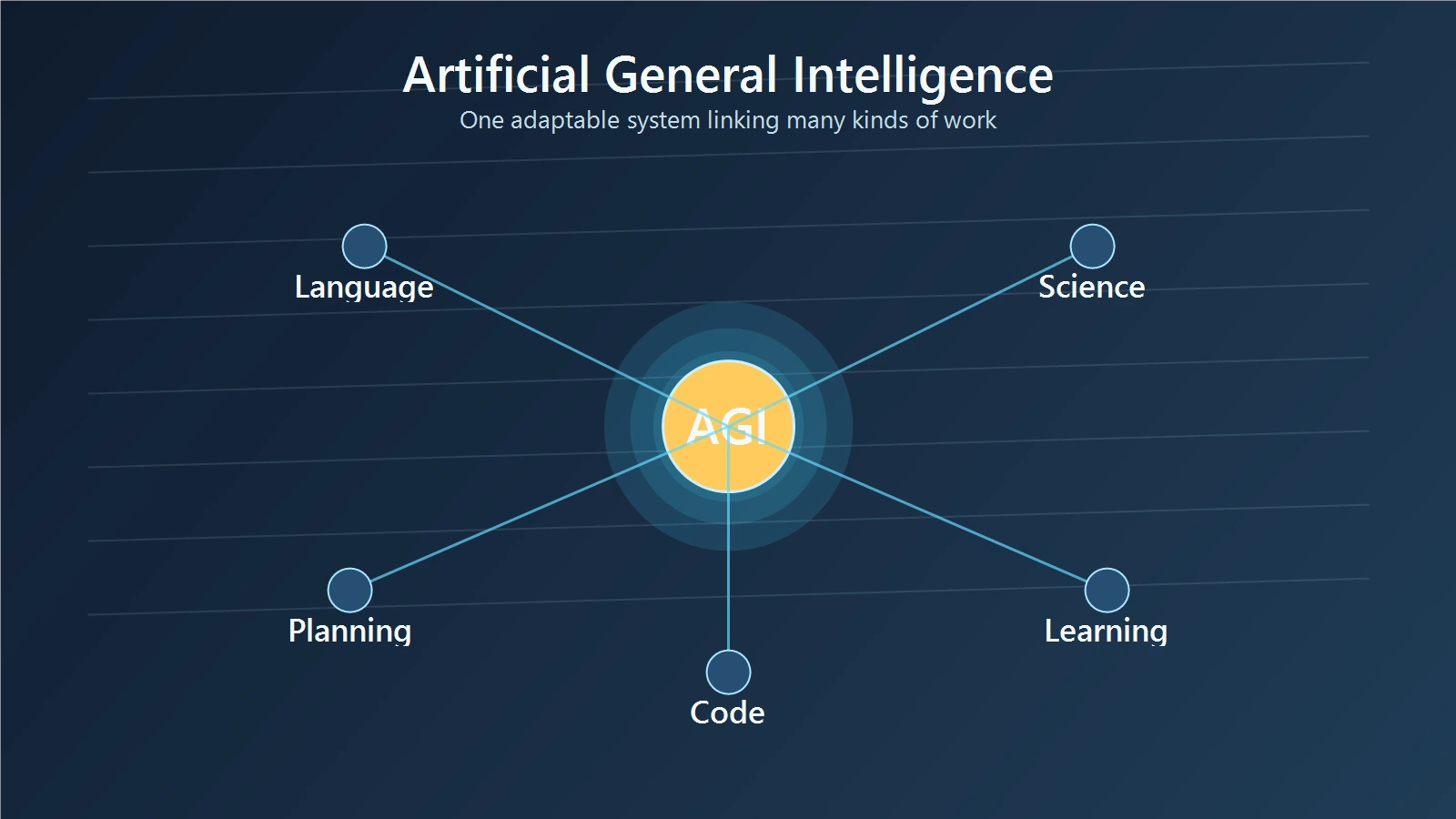
This discussion assumes a working idea of what Artificial General Intelligence is.
A post-labor economy does not mean zero jobs next year
Start with definitions, because this conversation gets distorted fast.
A post-labor economy does not necessarily mean nobody works. It means paid employment stops being the main way large numbers of people secure identity, status, and material stability. There are several ways that could happen. Jobs could fragment into smaller projects. Full-time roles could shrink while AI handles more routine cognitive work. Some people could move into hybrid human-plus-AI roles, while others get pushed into unstable transitions.
A comparison helps. Agriculture used to employ a huge share of the population. Industrialization did not eliminate labor. It changed where labor lived and how societies organized around it. AI could do something similar for cognitive work. The mistake is assuming the transition would feel smooth just because history eventually found new roles.

What the data says right now
Current evidence supports neither complacency nor apocalypse.
Anthropic’s Economic Index has shown that AI use today is concentrated in tasks related to software, writing, analysis, and other knowledge work, with a mix of augmentation and automation rather than clean replacement (Anthropic). That matters because it suggests AI is already reshaping how work is done before it fully replaces whole occupations.
The International Labour Organization reaches a similar conclusion from another angle. Its analysis of generative AI exposure argues that the largest immediate effect is more likely to be job transformation than complete destruction, but it also warns that clerical and administrative tasks are especially exposed (ILO). In plain language, some workers will not wake up to find all work gone. They will wake up to find that more and more of their old role has become cheaper to automate.
The World Economic Forum’s Future of Jobs Report 2025 adds a third useful perspective. It finds that employers expect both creation and displacement at scale, with technology shifts, economic pressure, and demographic changes all reshaping job design (World Economic Forum). That matters because the labor-market shock is unlikely to be one clean AI event. It will be a stacked transition.
Why the meaning problem is larger than the wage problem
Money is only part of what work does.
Jobs organize time. They create milestones. They produce social contact, skill growth, and the feeling that effort leads somewhere. When people say they are afraid of AGI job replacement, they are often talking about income on the surface and identity underneath.
Think about the difference between getting paid and feeling useful. A worker can technically preserve income through severance, benefits, or even a generous policy like UBI, yet still feel unmoored if they lose structure, mastery, and recognition. That is why post-labor debates often sound emotionally larger than spreadsheets suggest. Work has become a social operating system.
A concrete comparison helps. Retiring by choice after decades of work feels different from being made unnecessary at thirty-two because a system can produce the same output in half the time. In both cases, the person may have enough money for the month. The deeper difference is control. One path feels earned and chosen. The other can feel like a verdict.

What meaning could look like when labor changes
The practical response is not to wait for certainty. It is to build meaning on more than one pillar.
The first pillar is contribution. Ask where humans remain especially valuable even when AI gets stronger. That could mean care work, leadership, trust-heavy client work, teaching, negotiation, field operations, or original synthesis across disciplines. These are not magically safe forever, but they tend to depend on context, accountability, and social legitimacy in ways that pure output metrics miss.
The second pillar is mastery. Do not define yourself by a single tool-dependent task. Define yourself by a capability stack. For example, a marketer who only writes campaign copy is more exposed than a marketer who can set strategy, interview customers, judge positioning, and run experiments. The specific output may get cheaper. Judgment does not disappear as quickly.
The third pillar is community. In a volatile labor market, belonging becomes a serious asset. Professional networks, peer groups, local communities, and collaborative projects do more than create opportunity. They protect people from interpreting every market shock as a personal failure.
The fourth pillar is self-authorship. A post-work future, even a partial one, rewards people who can build a portfolio identity instead of a single-job identity. One person may combine part-time consulting, community leadership, learning, and caregiving. Another may mix technical oversight with creative work and local service. The point is not to romanticize precarity. It is to reduce the fragility that comes from tying self-worth to one title.
What individuals can do now
You do not need to predict AGI timelines to make better moves this year.
Start by auditing your job at the task level. Which parts are repetitive, template-driven, and easy to measure? Those are the places where automation pressure is strongest. Which parts depend on trust, context, cross-functional judgment, or accountability? Those are the parts to deepen.
Then build two tracks at once. Track one is defensiveness: learn the AI tools already changing your field so you are not displaced by people who use them better. Track two is expansion: develop skills that keep you valuable when basic production becomes cheap. That may mean domain expertise, relationship management, systems thinking, or live problem-solving.
A simple comparison makes the point. Competing with AI on speed alone is a bad game. Competing on direction, judgment, and ownership is a better one.
What a healthy post-work culture would reward
If labor becomes less central, society still needs status systems. The question is which ones.
A healthy post-work culture would reward contribution that markets often undervalue when they focus too narrowly on short-term output. That includes caregiving, mentoring, community building, local leadership, and forms of creative or civic work that hold social fabric together. None of this requires pretending money stops mattering. It means recognizing that a society cannot let its only prestige ladder run through full-time paid employment if technology keeps making that ladder narrower.
Think of it as a shift from resume identity to contribution identity. In one system, the first question is, “What is your job title?” In the other, it is, “What do you reliably add to the people around you?” That is not soft idealism. It is practical resilience for a world where labor markets may become more volatile than human needs.

What employers and policymakers should prepare
Companies and governments should stop treating this as a future cultural debate and start treating it as transition design.
Employers need clearer role redesign paths, not just efficiency targets. If AI strips routine work from an occupation, workers need a route into higher-value tasks before performance reviews punish them for the transition. Governments, meanwhile, need to think beyond emergency unemployment support. Portable benefits, reskilling systems, career transition support, and experiments around working time and income floors all become more relevant in a world where task replacement moves faster than institutions.
UBI is part of this conversation, but it should not be treated like a magic switch. Income support may reduce financial shock. It does not automatically restore purpose, belonging, or progression. A durable post-labor response has to deal with human meaning as seriously as it deals with cash flow.
Final Thoughts
The post-labor economy is not a switch that flips one morning. It is a gradual but serious possibility created by overlapping changes in automation, role redesign, and institutional lag. That is why the conversation matters now, not after AGI headlines become louder.
The real challenge is not only how to protect wages. It is how to protect dignity in a world where output becomes cheaper. People will still need reasons to grow, contribute, and matter. The sooner individuals, employers, and governments treat meaning as infrastructure instead of a side effect of employment, the better prepared they will be for an economy where the old link between work and worth is no longer guaranteed.