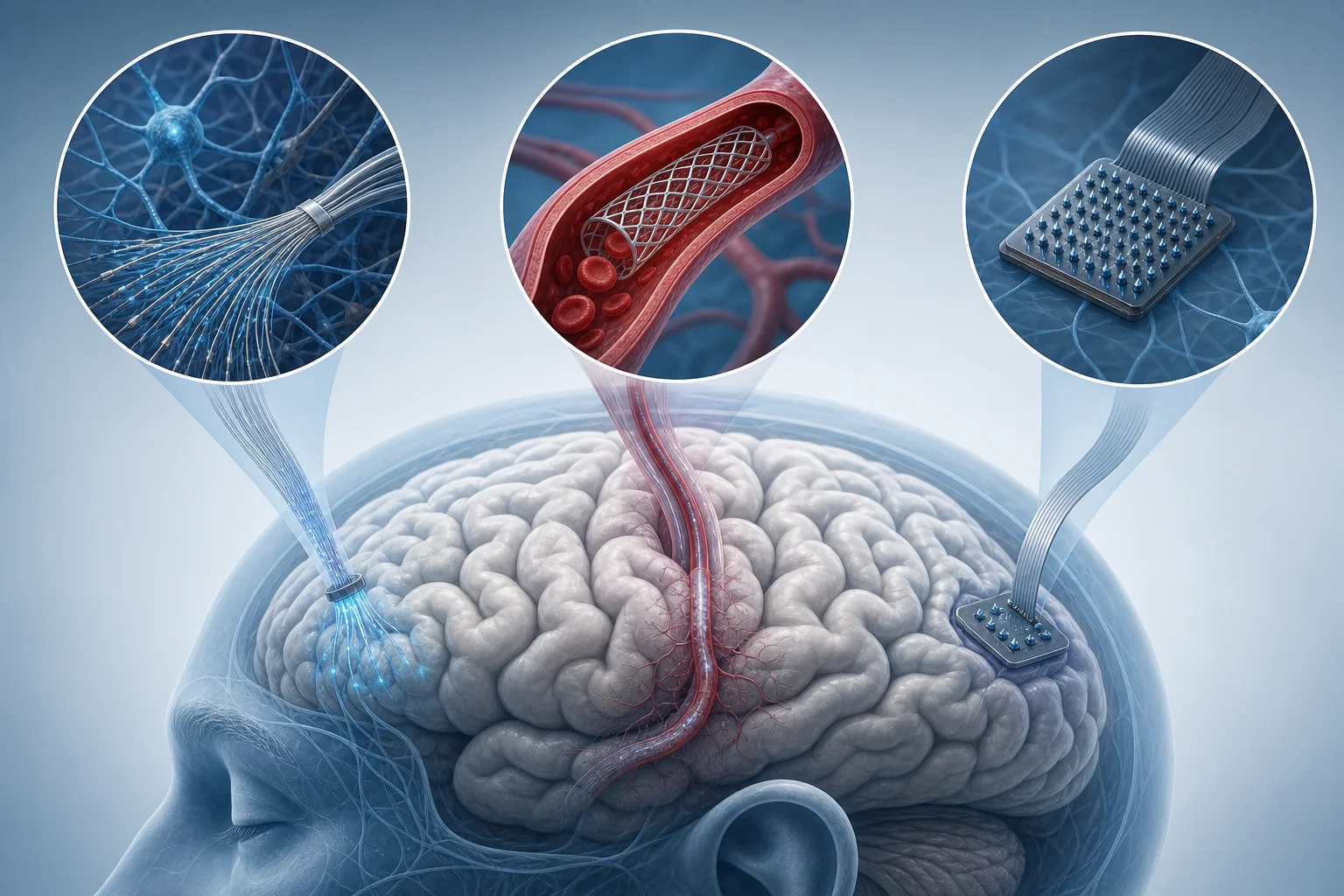

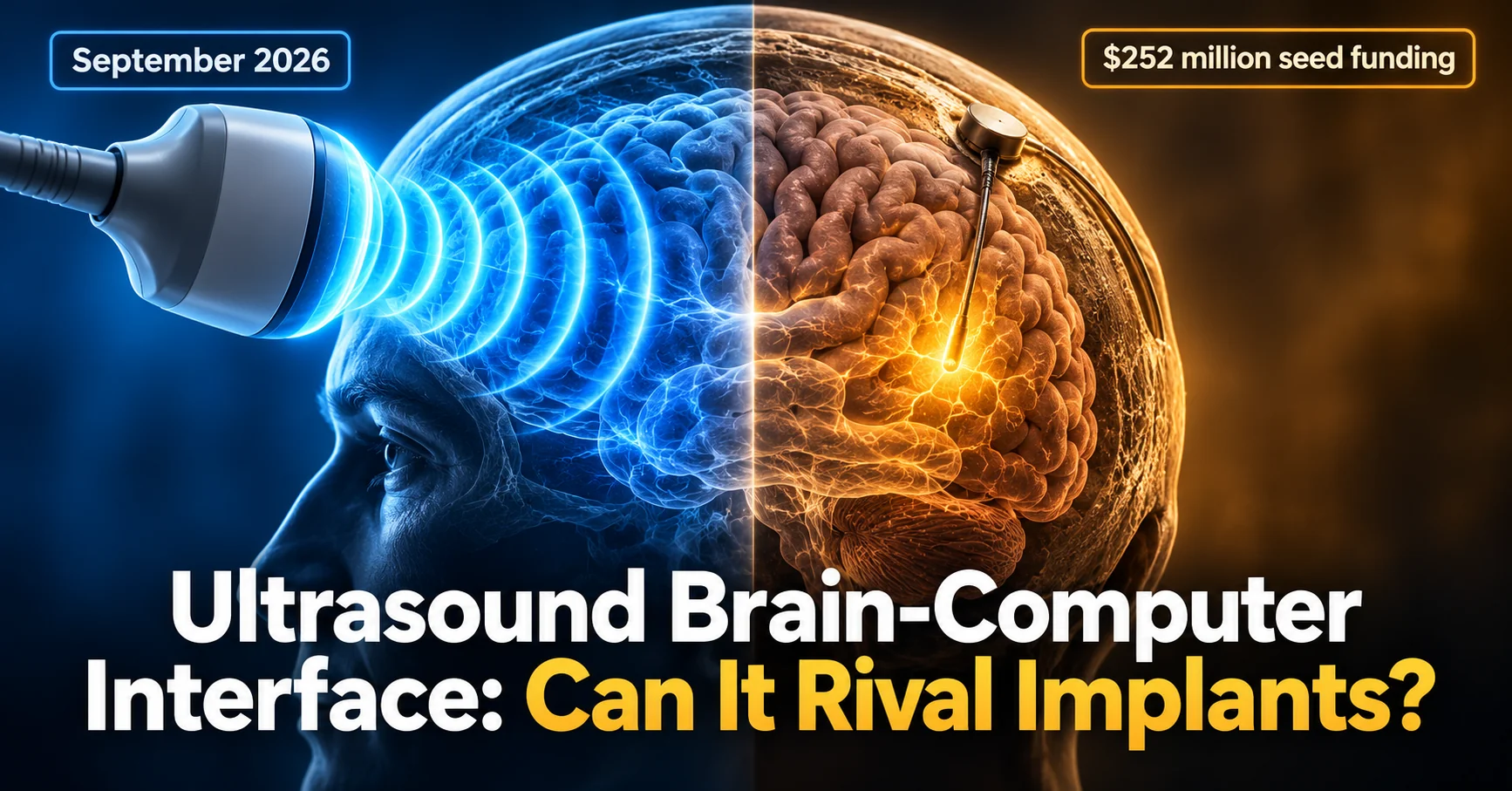
The brain-computer interfaces that make headlines today are implants, and implants need a neurosurgeon. That one requirement decides who gets one and how fast the field can grow. An ultrasound brain-computer interface offers a different bargain. Nothing goes into brain tissue. And if the engineering works, maybe nothing has to go through the skull either.
In early September 2026, that bargain picked up a serious backer. Merge Labs, the brain-interface startup co-founded by OpenAI CEO Sam Altman, announced a multi-year licensing agreement with Butterfly Network. The prize: Butterfly’s ultrasound-on-chip technology. Merge isn’t a garage project, either. It launched in January with $252 million in seed funding.
So can sound do what electrodes do? About two months on, my answer is not yet, and maybe not in the way the hype implies. The reasons are more interesting than a flat no.
What the Merge Labs and Butterfly deal actually includes
Strip out the press-release language and the agreement is fairly specific. According to DigitalHealthNews’s report on the deal, Merge gets Butterfly’s Poseidon family of ultrasound-on-chip technology. It comes through Butterfly Embedded, the company’s licensing and co-development arm.
The money side covers:
- upfront and milestone-based license payments
- hardware purchase commitments
- technology access fees
- ongoing royalties on future commercial sales
Nobody disclosed a dollar figure. Nobody said how many years “multi-year” means, either.
The exclusivity clause is the interesting bit. Butterfly becomes Merge’s exclusive chip-based ultrasound partner. Merge stays free to build its own neural interface technology. Butterfly, meanwhile, keeps the right to license its chips to other BCI companies. So Merge commits to one supplier, and the supplier keeps its options open. If I ran Butterfly, I’d want exactly that.
This isn’t a first date. Back in 2023, Butterfly started a five-year collaboration with Forest Neurotech on a whole-brain interface that could use ultrasound to image and stimulate the brain. Merge itself spun out of Forest Neurotech. The new license looks less like a pivot and more like one research family moving its work into a company with money.
The quotes fit that picture. Merge co-founder Tyson Aflalo said, “We believe ultrasound has tremendous potential to enable a new generation of neural interfaces.” Butterfly CEO Joseph DeVivo spoke of helping Merge “advance this work from research toward commercialization.” Notice the words potential and toward. These are people describing a starting line.
Why skip the implant at all?
Start with scale. Will Biederman, founder of the ultrasound startup Bridge Neurotech, puts it bluntly. Implantable systems, he says, “require neurosurgery and have so far reached only around 100 people.”
Keep in mind who’s talking. Biederman sells the non-surgical alternative, so he has every reason to stress the bottleneck. But the logic holds even if you discount the messenger. Every implant needs a surgical team and a patient willing to accept brain surgery. That caps how many people any implant program can reach.
That’s the core pitch for an ultrasound brain-computer interface: change the risk math. In Caltech’s primate work, which I’ll get to shortly, the probe sat outside the brain. The researchers say that lowers infection risk and leaves the dura, the brain’s tough outer membrane, intact.
Their system also needed no daily recalibration. Caltech’s release likens older brain-machine interfaces to a computer mouse that needs up to 15 minutes of recalibration before every use. For someone relying on the device to communicate, that difference isn’t trivial.
Then there’s reach. The 2023 Butterfly and Forest project aimed at a whole-brain interface. Implants record from wherever the surgeon places them. Ultrasound, in principle, could look across far more of the brain at once. “In principle” is doing heavy lifting there, and we’ll come back to it. Our breakdown of invasive vs non-invasive BCIs lays out the wider trade-offs.
How an ultrasound brain-computer interface reads the brain
Here’s what most deal coverage skips. An ultrasound brain-computer interface doesn’t listen to neurons the way an implant does. It watches blood.
Functional ultrasound, or fUS, tracks changes in blood flow. When a patch of brain gets busy, its blood supply shifts, and the scanner picks that up. Merge describes its own approach as “indirect neural sensing and modulation mediated by blood flow dynamics.” The word indirect is honest. It also matters.
The detail is sharper than you might guess. According to Caltech, fUS can resolve regions about 100 micrometers wide, roughly the width of a hair. It can track populations as small as about 60 neurons.
There’s a cost, though. Blood flow changes after neurons fire, not at the same instant. So a blood-flow signal should lag behind the electrical spikes an implant records. That’s my inference from how the method works, not a measured figure from the research I reviewed. Still, it’s the main reason I’d hesitate to call fUS a drop-in replacement for electrodes.
What the Caltech monkeys actually did
The strongest public evidence is still a 2023 Caltech study in Nature Neuroscience. Two monkeys planned hand or eye movements while the team recorded their posterior parietal cortex. A decoder then moved a cursor toward eight radial targets. Mean errors stayed under 40 degrees.
Caltech neuroscientist Richard Andersen called functional ultrasound “a completely new modality to add to the toolbox of brain–machine interfaces.” I agree with him. A cursor landing within 40 degrees of one of eight targets is a real result. It’s also a long way from fluent control of a computer.
One more detail. Sumner Norman, a co-first author on that study, is now a Merge Labs co-founder. So is Mikhail Shapiro, whom Caltech’s release quotes. The people behind the best public evidence now run the company betting on it. That’s not a scandal; it’s how science turns into a startup. You should still remember it when you read their optimism.
The skull problem: what the evidence shows so far
Now the hard part. Bone and ultrasound don’t get along.
Caltech’s monkeys didn’t have intact skulls over the recording site. The team needed a transparent window in the skull, because sound doesn’t pass through bone well. The probe stayed outside the brain, but this wasn’t a surgery-free setup.
Bridge Neurotech’s own materials say the same thing more plainly. Pulse 2.0’s report on its funding calls the skull “the fundamental technical challenge.” Bone “both blocks and soaks up sound,” and it varies from person to person. That makes one-size-fits-all hardware harder to build.
Look at who Bridge enrolled first. Its first study, now underway in Redwood City, California, includes adults who’ve had a cranioplasty with a PEEK or Longeviti implant. Healthy adults 18 and older can join too. A cranioplasty rebuilds part of the skull with implant material. It’s hard not to see that group as a way to start where the bone problem is smaller. That’s my read, not Bridge’s stated reason. The company frames the study as an early step toward testing whether it can generate and decode functional brain imaging at all.
Add it up and the public record looks like this:
- Primates decoded through a skull window (Caltech, 2023)
- A first human imaging study, partly in people with rebuilt skulls (Bridge, 2026)
- No published human decoding results from Merge or Bridge in the sources I reviewed
Nobody has publicly shown an ultrasound brain-computer interface reading intentions through an intact adult skull. That isn’t a dismissal. It’s the actual state of play.
Implants vs an ultrasound brain-computer interface, side by side
| Question | Implanted BCIs | Ultrasound BCIs (fUS) |
|---|---|---|
| What it measures | Electrical activity of neurons | Blood-flow changes, an indirect signal |
| Surgery | Neurosurgery required | No brain implant, but Caltech’s primates still needed a skull window |
| People reached so far | Around 100, per Bridge’s founder | A first human imaging study is underway |
| Spatial detail | Varies by device | About 100 micrometers; populations of about 60 neurons |
| Recalibration | Older systems can need it before each use | None needed daily in Caltech’s study |
| Biggest open problem | Scaling surgery to more people | Getting a usable signal through bone |
The two approaches aren’t fighting over the same weakness. Implants struggle with access. Ultrasound struggles with physics.
If you want the implant side in more depth, our Neuralink vs Synchron vs Paradromics comparison walks through the leading devices.
Who else is betting on ultrasound?
Merge has company, and much of it shares a family tree.
Bridge Neurotech is building its own ultrasound brain-computer interface. Pulse 2.0 reported its $13.5 million raise on October 7, 2026. Backers include General Catalyst, reMind Capital, Sunflower Capital and Scott Sandell. Its founder, Will Biederman, developed a neural interface chip that Neuralink used for its first implants. He also co-founded Forest Neurotech.
Forest Neurotech sits at the root. It’s a Los Angeles nonprofit, and it still operates independently after Merge spun out of it. Butterfly’s 2023 collaboration ran through Forest, too.
So when people call Merge and Bridge rivals, take it with some salt. They’re competitors with shared ancestry and a shared enemy: the skull.
The money gap is wide. Merge’s $252 million seed came from OpenAI, Bain Capital, Interface Fund, Fifty Years and Gabe Newell. Bridge’s round is a fraction of that. OpenAI’s role at Merge centers on scientific foundation models that interpret intent from limited, noisy neural signals. That’s a telling bet. If the signal through bone stays weak, software has to carry more of the load.
So can non-invasive brain interfaces compete with implants?
It depends what “compete” means. Here’s how I’d split it.
Confirmed:
- Functional ultrasound decoded movement plans in two monkeys, through a skull window.
- It resolves detail down to about 100 micrometers.
- Butterfly and Merge signed a licensing deal with real commercial terms, minus the numbers.
- Focused ultrasound already treats people. The FDA approved Insightec’s Exablate Neuro for tremor-dominant Parkinson’s in December 2018, for patients 30 and older.
Still projected:
- Reading brain activity through an intact human skull.
- A whole-brain interface that both images and stimulates.
- Any clinical or consumer ultrasound BCI product. None of the sources I reviewed gives a date.
That Exablate approval deserves a footnote. Its supporting trial had just 27 participants, split 20 treated to 7 sham, and it never reached its planned 30. And it stimulates tissue rather than decoding thoughts. Ultrasound’s medical track record is real, but it sits on the writing side of the brain, not the reading side.
My verdict: on raw signal, implants win today, and nothing public suggests that flips soon. On reach, an ultrasound brain-computer interface could win a race implants can’t even enter. A device that never needs a neurosurgeon could, in theory, serve far more than 100 people.
If the skull problem breaks, I doubt the two technologies compete head-on. They’d likely serve different people for different jobs. If it doesn’t break, ultrasound stays a research tool with a remarkable demo behind a window.
What changes if brain interfaces skip surgery?
This is the part I keep coming back to. Implants have a built-in gatekeeper: a neurosurgeon who has to decide you’re a candidate. Take the surgery away and that gate disappears.
That’s good news for access. It’s also the moment the questions in our piece on whether brain chips could deepen the class divide stop being hypothetical. Who can afford one? Who gets pressured into wearing one?
It changes the data question, too. Implant patients today sit inside clinical studies, with consent forms and oversight. A future non-surgical device might not. And Merge’s backers include OpenAI, whose job there is building models that infer intent from neural signals. I’d want to know who holds those inferences, and what a government could subpoena, long before I’d want the device itself.
So yes, watch the skull. But watch the software and the data terms just as closely. If sound ever gets through bone cleanly, the hardest questions won’t be about physics anymore.