
A country’s standing in the most important technology of the decade now fits in a headline. Three percent. That’s the size of the US China AI gap, according to a Bloomberg Intelligence note that spread fast this month. It’s a tidy number, and it’s easy to misread.
Numbers like this travel. They turn up in policy arguments and investor pitches, and they quietly shape the story most of us tell ourselves about who’s winning. Few people stop to ask which test produced the number, or when.
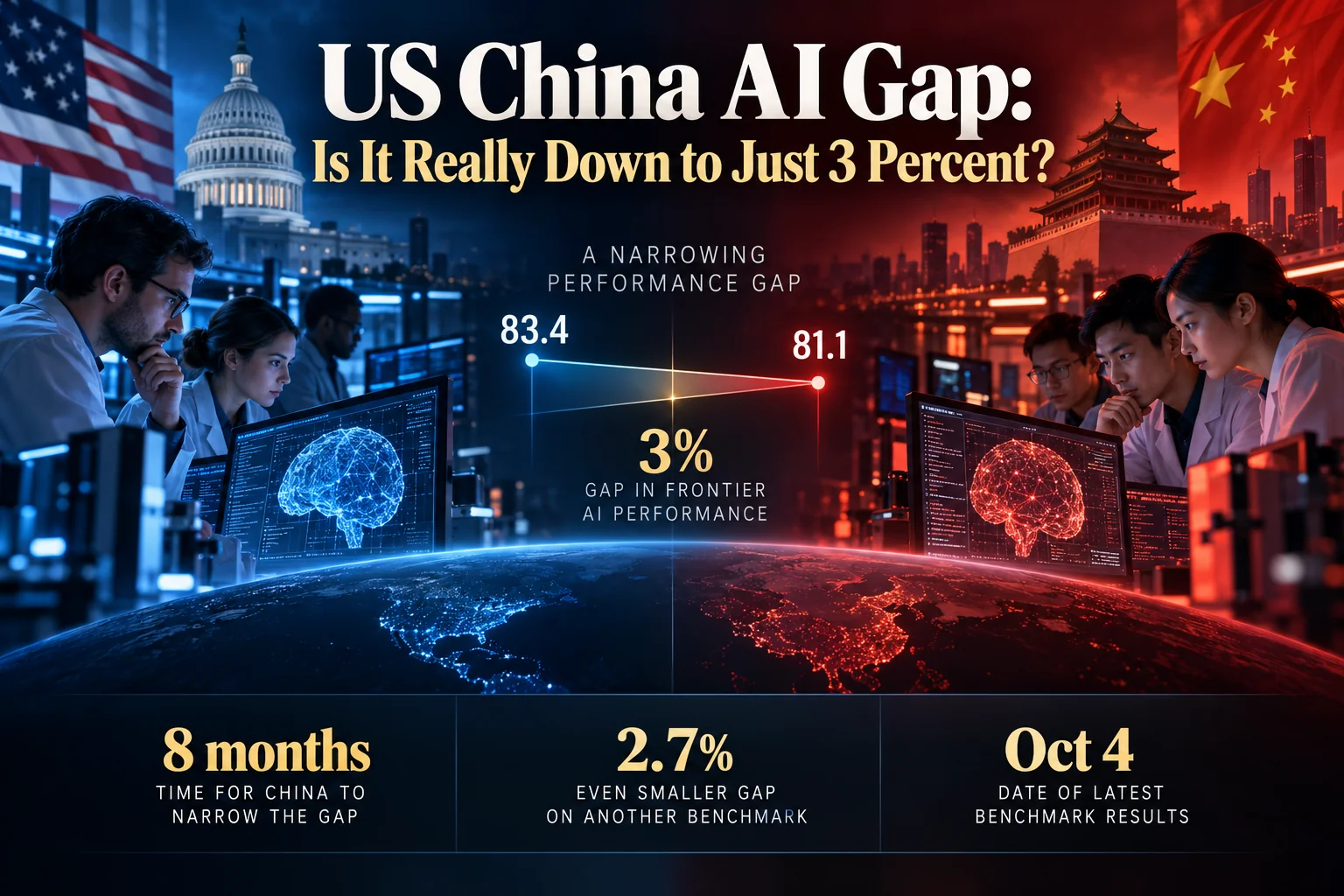
Those questions matter here. Three serious attempts to measure the same rivalry this year came back with three different answers: 3 percent, 2.7 percent, and eight months. They can’t all mean the same thing. The distance between them tells you more than any one of them does.
What Bloomberg Intelligence actually reported
The figure comes from Robert Lea, a senior analyst at Bloomberg Intelligence, in a note dated October 4. The original sits behind Bloomberg’s paywall. The numbers below come from secondhand coverage that agrees on the details, including a detailed breakdown from Implicator.
Lea’s trigger was DeepSeek V4.1 Flash, which the Chinese lab released on September 10, 2026. On the LiveBench leaderboard, the model’s Max Effort setting scored 81.1. Anthropic’s top entry, Claude Fable 5.1 Max Effort, scored 83.4.
That’s a 2.3-point difference. As a share of Anthropic’s score, it works out to about 2.8 percent. The headline rounded it to 3.
The trend is what grabbed attention. Bloomberg Intelligence put the gap at roughly 15 percent earlier in 2026 and about 9 percent in May. Now it sits at a record low. Lea said the result “raises fresh questions over how long the US can maintain its technological lead.”
Fair enough. But a 2.3-point lead on one leaderboard is a thin foundation for a claim about two national AI industries.
What does the US China AI gap actually measure?
Here’s the trouble with treating 3 percent as the US China AI gap. It describes one benchmark, on one day, comparing the single best model from each side. Change any of those three things and the number moves.
LiveBench: a moving exam with an answer key
LiveBench, the test behind the Bloomberg figure, leans on freshness. Its creators pull new questions from recent sources such as math competitions, arXiv papers and news. They grade answers against objective ground truth, with no AI model acting as judge.
The test covers math, coding, reasoning, language, instruction following and data analysis, and it updates monthly. It earned a Spotlight slot at ICLR 2025. That’s a respectable design.
It’s still one exam.
Stanford’s Arena reading: 2.7 percent
Stanford’s 2026 AI Index reached a similar number by a different route. As of March 2026, the top US model led the top Chinese model by 2.7 percent on Arena, a leaderboard that ranks models by human votes. The report didn’t hedge: “The U.S.-China AI model performance gap has effectively closed.”
Stanford also found the lead has stayed in single digits over the past year. Four companies now cluster within 25 Elo points of each other.
One detail deserves more attention than it gets. The same report found the top closed model leads the top open model by 3.3 percent, up from 0.5 percent in August 2024. So the open-versus-closed contest and the US-versus-China contest aren’t the same race, even where they overlap.
NIST’s “eight months”
The US government’s own evaluators tell a different story. On May 1, 2026, CAISI, the AI evaluation team at NIST, published an evaluation of DeepSeek V4 Pro. Its conclusion: “DeepSeek V4’s capabilities lag behind the frontier by about 8 months.”
CAISI ran nine benchmarks across five domains: cyber, software engineering, natural sciences, abstract reasoning and math. Two of them aren’t public: ARC-AGI-2 Semi-Private and PortBench. CAISI says it pre-committed to the full suite before testing.
Critics went straight for those two private tests. As Decrypt reported, the widest gaps showed up exactly where outsiders can’t check the work. On public benchmarks the distance shrank. DeepSeek scored 90 percent on GPQA-Diamond against 91 percent for Anthropic’s Opus 4.6, and 74 percent on SWE-Bench Verified against 81 percent for GPT-5.5.
A pseudonymous developer called Ex0bit went further: “There’s no ‘gap’, and no one’s 8 months behind.” Decrypt’s own read was more careful, and I think more correct. Poking holes in CAISI’s method doesn’t fully vindicate DeepSeek either.
Why the numbers disagree
Line the three up and the conflict mostly dissolves:
- Different yardsticks. LiveBench compares scores. Arena ranks models by human preference. CAISI converts benchmark results into months of lead time.
- Different dates. Stanford’s reading is from March, CAISI’s from May, Bloomberg’s from October.
- Different models. CAISI tested V4 Pro, an older model than V4.1 Flash.
Then there’s the view from Beijing. Zhang Yaqin, founding dean of Tsinghua’s Institute for AI Industry Research, said: “Before DeepSeek emerged, China was two to three years behind the US in large AI models.” He now puts the gap at two to three months.
None of these numbers is wrong, as far as anyone can tell. They answer different questions, and a headline only has room for one.
Why a near-tie at the top isn’t parity
Here’s the part of the US China AI gap story that the headline buried. Only 3 of the top 15 LiveBench entries are Chinese. China hosts more than 1,100 large language models, yet the catch-up shows up at the very tip of the pyramid, not across it.
Chinese experts say as much themselves. Yu Xiaohui, formerly of the China Academy of Information and Communications Technology, and Tsinghua’s Tang Jie both say China still trails in demanding reasoning and tool use. They also point to high-end chips and original innovation.
One third-party snapshot even had DeepSeek ahead on an agentic coding sub-benchmark, 77.3 to 66.1. Bloomberg’s note didn’t include it, and nobody has confirmed it. Treat it as a curiosity, not a result.
Implicator’s caveats are worth keeping close:
- A benchmark lead doesn’t establish national leadership.
- Score gains say nothing about enterprise reliability or secure deployment.
- Lower token prices don’t automatically mean cheaper completed tasks.
- Open weights don’t reveal what a model learned from.
That last point is the human one. If your employer picks a model to handle customer records, a 2.3-point LiveBench edge tells you almost nothing about whether that’s a safe choice. You’d want to know what went into it.
What closed the US China AI gap: efficiency, domestic chips, price
Lea credits two things: better technical capability and tighter optimization for China’s domestic hardware.
DeepSeek’s own explanation centers on efficiency. The company says V4.1 Flash activates only a small portion of its parameters for each answer and shrinks the conversation cache. Both changes, it claims, cut the compute and memory needed to serve responses. The model also handles images natively. These are DeepSeek’s claims, not independent findings.
Price did the rest. From September 10, DeepSeek set off-peak API rates at half its peak price. If you missed it, our coverage of the DeepSeek V4 launch explains where this model line started.
Usage is starting to reflect it. In the week to September 7, Chinese models processed more tokens than US models on OpenRouter, according to a JPMorgan Asset Management analysis. US models still handled slightly more requests. Token share isn’t market share, though, and one router’s traffic isn’t the world’s.
CAISI found something similar on cost even while scoring V4 behind. V4 beat GPT-5.4 mini on cost efficiency in five of seven benchmarks. The range ran from 53 percent cheaper to 41 percent more expensive.
Chip export controls and the AGI race
This is where the US China AI gap stops being a leaderboard story. Lea says the result raises questions about whether US chip export controls are working. A lab that squeezes frontier-level scores out of domestic hardware is, at minimum, an awkward data point for that policy.
Awkward isn’t proof, though. Implicator argues the benchmark alone can’t settle whether export controls work. And Chinese researchers still name high-end chips as a weak spot. If you want the physical side of this argument, our look at AGI hardware requirements explains why chips, memory and power set the pace.
The money tells a stranger story. Lea doesn’t expect China’s AI sector to turn a profit until 2030 at the earliest. “Putting China’s AI sector on a sustainable profit footing will require a cooling of competitive pressures,” he wrote. ByteDance’s Doubao leads in app monetization. DeepSeek and Tencent give their chatbots away free.
So Chinese labs are closing the gap partly by competing on price so hard that nobody makes money yet. That’s a strategy you can sustain for a while. It’s not obviously one you can sustain forever.
For the wider picture of who’s ahead and why, see our breakdown of the AGI development race in 2026. For a model-by-model comparison, GPT-5 vs Gemini vs Claude vs DeepSeek V4 covers the frontier as it stood earlier this year.
What to watch next
A few signals will show whether this reading of the US China AI gap is a turning point or a snapshot:
- The next LiveBench updates. The benchmark refreshes monthly. One good month doesn’t make a trend.
- An independent check on the agentic coding score. If 77.3 versus 66.1 holds up, it’s real news. If it doesn’t, it’s noise.
- Any new CAISI evaluation. A government test of V4.1 Flash rather than V4 Pro would make the comparison far cleaner.
- Real task costs. Cheaper tokens matter only if finished work gets cheaper too.
So, is the US China AI gap really down to 3 percent? On one exam, on one day, for one model, yes. Across the whole industry, nobody has shown that.
What I keep coming back to is the shift in what “behind” means. For years the question was whether China could build a model this good. Now it’s whether “nearly as good, for half the price” wins. If it does, the next fight won’t be about benchmarks at all. It’ll be about trust. Which model do you let near your data, and can anyone tell you what it learned from?