
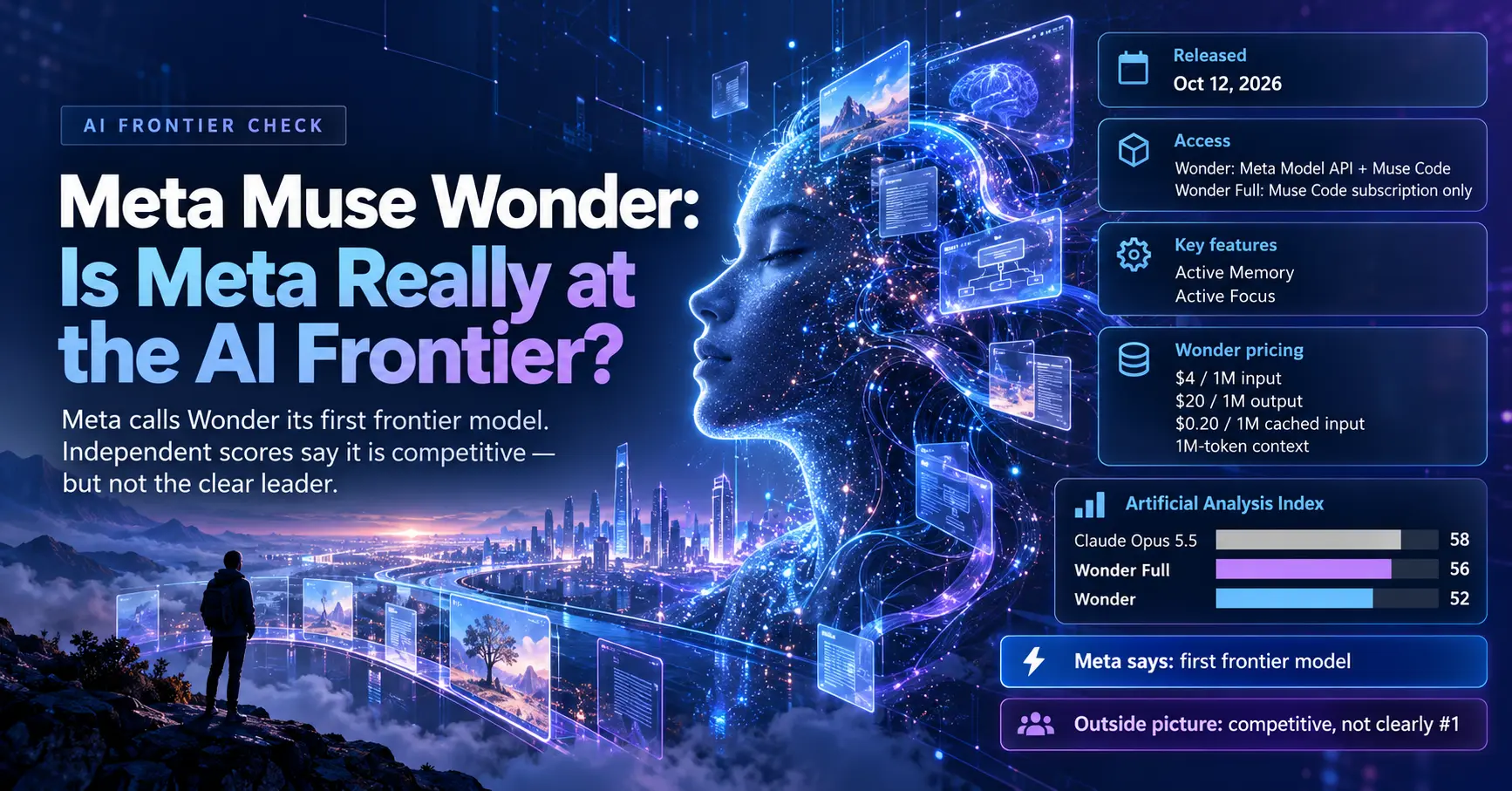
Meta Muse Wonder is the first model Meta has been willing to call “frontier.” Picture a student who writes the exam, sits it, and then marks it. That’s unfair, but only partly. A good chunk of the evidence behind Meta’s claim comes from tests Meta built or ran itself.
Meta Superintelligence Labs launched Muse Wonder and its bigger sibling, Muse Wonder Full, on October 12. Nine days later, Mark Zuckerberg’s Q3 earnings release called Wonder “our first frontier model” and tied it to his favorite phrase: personal superintelligence.
So is Meta actually at the frontier? On some tasks, yes, since outside testers back that up. On others, the case rests on Meta’s own homework. Still, “personal superintelligence” is a product pitch. It isn’t a step toward AGI in the sense we usually mean here.
What Meta Muse Wonder actually is
Meta Muse Wonder comes in two versions, and you get to each one differently.
- Muse Wonder is available through the Meta Model API and Muse Code, Axios reports. Technology.org lists its price at $4 per million input tokens and $20 per million output tokens, with $0.20 cached input and a 1-million-token context window.
- Muse Wonder Full isn’t on the API at all. You only get it on Muse Code’s Power Usage ($50 a month) and Maximum Usage ($200 a month) plans. Meta hasn’t published a per-token price.
The headline features are two agent skills. Active Memory lets the model keep important details about you across conversations and pull them into new tasks. Active Focus keeps an agent pushing toward a goal and tries other approaches when it hits a wall. It also makes the model check in before important actions.
Alexandr Wang, who runs Meta Superintelligence Labs, didn’t hedge: “These are true frontier models, competitive with the best models in the world.” He also told Axios that memory matters so users aren’t “re-explaining themselves every time.”
Keep one detail in mind. The stronger model is the one outsiders can’t call directly. That shapes everything below.
Meta Muse Wonder benchmarks: what’s proven and what’s claimed
Benchmark charts all look alike. The evidence behind them doesn’t. So sort it into three tiers.
Tier 1: Meta grading Meta
- Meta’s internal Personal Super Intelligence Index puts Wonder Full at 59.1. That’s ahead of Claude Opus 5.5 (55.2), GPT-6 Astra (54.5) and Fable 5.1 (49.9). Even MindStudio’s benchmark breakdown calls that “directional rather than definitive.”
- On MemoryBench, Wonder scored 85.6 and Wonder Full 85.5, against 81.5 for Opus 5.5 and 81.4 for Astra. But Meta wrote MemoryBench. The result shows the model is good at Meta’s definition of remembering.
- On the DeepSWE 1.1 coding test, Wonder Full hit 79.0 against 74.2 for Opus 5.5. Technology.org points out that Meta compiled most of these figures itself, and nobody had checked them independently.
There’s another catch. SiliconANGLE reports that Meta’s model card calls its runs of rival models “best-effort.” It also says the SWE-Marathon figures are “not a controlled comparison.” Credit to Meta for writing that down. Still, the flashiest gap, 57.5% vs 46.3% for Opus 5.5 on SWE Marathon, isn’t a clean fight.
Tier 2: outside scorekeepers
The independent picture is tighter. It’s also less flattering.
| Model | Artificial Analysis Intelligence Index |
|---|---|
| Claude Opus 5.5 | 58 |
| Muse Wonder Full | 56 |
| GPT-6 Astra | 53 |
| Fable 5.1 | 53 |
| Muse Wonder | 52 |
So the claim that Meta’s model sits “level with GPT-6 Astra” holds for the smaller Wonder, at 52 vs 53. Wonder Full beats Astra but trails Opus 5.5. On the Vals index, which MindStudio describes as independent, Wonder Full ranked fifth at 64.57%. That put it ahead of every OpenAI model tested.
That’s real progress. Meta climbed from 31 on Artificial Analysis with the original Muse Spark to 56 with Wonder Full, in about six releases over six months.
One asterisk, though. Artificial Analysis flagged that Wonder Full had no public API at launch, so outside verification has limits.
Tier 3: what people actually saw
Early creator demos looked rougher than the benchmark charts suggested. Testers reported flickering and clipping in a game inspired by Fall Guys, along with shadow and reflection glitches in a 3D ocean scene. Opus 5.5 and GPT 6.1 Soul handled similar prompts more cleanly.
Then there’s history. In April 2025, Meta sent a specially tuned Llama 4 Maverick to LMArena, and the public couldn’t download that version. It proves nothing about Wonder. It does explain why people want receipts this time.
Where Meta Muse Wonder wins and where it loses
Here’s the plain scorecard.
Wins
- Long-horizon coding: DeepSWE and SWE Marathon, both on Meta’s runs.
- Memory: MemoryBench, which is Meta’s own test.
- Legal agent work: Wonder Full scored 13.1 on Harvey Legal Agent, vs 4.2 for Opus 5.5. But Grok 4.7 reportedly scored 19.6% there and didn’t appear on Meta’s chart. Picking your opponents is a quiet way to win.
Ties
- Terminal Bench, where Wonder Full lands around 57 to 59, roughly in line with rivals.
Losses
- Artificial Analysis overall: 56 for Wonder Full vs 58 for Opus 5.5.
- OSWorld, the computer-use test: Opus 5.5 at 81, Wonder Full 78.4, Astra 75 and Wonder 72.6.
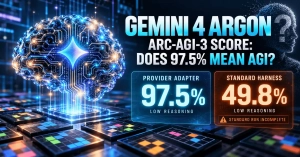
Our read? Meta Muse Wonder is frontier-competitive, especially for agentic coding. It isn’t the clear leader that Meta’s own charts suggest. For another case of a headline number that needs context, see our look at Gemini 4 Argon’s ARC-AGI-3 score.
“Personal superintelligence” isn’t AGI
Here’s where the language gets slippery. Axios describes personal superintelligence as Zuckerberg’s term for “AI that understands an individual’s goals and preferences.” Then on the Q3 call, according to the Benzinga transcript, he said “Muse is the product form of this vision.”
A product form. Read that twice.
AGI, in most serious debates, means broad human-level ability across many kinds of tasks. ASI goes beyond human ability. We lay out that spectrum in AGI vs ASI vs Narrow AI. Personal superintelligence describes something narrower: an assistant that knows you and does things for you. In other words, an agent with memory.
That might be very useful. But a lead of nearly five points on a coding benchmark Meta ran itself says nothing about general intelligence.
Zuckerberg does think it leads somewhere bigger. On the call he said Meta “will be able to build superintelligence through scaling,” and he added that larger models are already in the works. That’s a bet about the future. It isn’t a property of Wonder.
Closed flagship, open sidekick
For years Meta was the lab that gave its weights away. Wonder breaks that pattern. Axios reports that Meta won’t say whether any Wonder model will go open, though Wang insisted “we’re still committed to open source.” Meta did recently release weights for a smaller model, Muse Glimmer.
Meta’s developer blog also describes Muse Spark Open, an open-weight model under Meta’s own Muse Model License. It’s a separate model, not a cheap Wonder. And open-weight under a custom licence isn’t the same thing as open source.
On cost, ignore the confident takes for now. VentureBeat places Wonder in the upper-middle of frontier pricing. Cost-per-task comparisons against GPT-6 Astra point in opposite directions depending on who you read, and we couldn’t confirm either. So test your own workload before you trust anyone’s math.
Meta Muse Wonder and memory: the human question
This is the part that matters for most people.
On the October 21 call, Zuckerberg said more than 10 million people in the US and Canada had set up Muse agents, according to CNBC’s coverage. About a quarter use them daily. He said compute, not demand, limits growth. Meta also said Muse is coming to Meta Glasses starting next month.
Now combine those pieces. For example, Active Memory keeps details about your life. Active Focus keeps the agent acting toward goals. Then, the assistant moves onto a device you wear on your face. Meta’s own blog says a personal agent may handle messages, calendars and private documents, which demands “discretion with private information.”
Axios flagged the same tension: agents that remember you and act for you create new privacy and security problems. Meta says it added protections for personal information and tightened safeguards against cyber and bio misuse. A fuller safety report is still pending. And SiliconANGLE reports that the model card doesn’t rule out Wonder Full reaching Meta’s “high” risk threshold in chemical and biological domains before mitigations.
Meta hasn’t clearly answered the questions people will actually ask:
- Who can see what the agent remembers?
- Can you delete a memory, and does delete really mean gone?
- When the agent acts and gets it wrong, who’s accountable?
These are the human-control questions agentic AI keeps raising. Glasses make them sharper, and we’ve already asked whether smart glasses are finally ready for everyday life.
What would change our mind
Meta closed most of the gap to the leaders in six months. That’s genuinely impressive. But “frontier” should survive other people’s tests, not just your own.
What would convince us? Wonder Full on a public API, so outsiders can test it directly. Memory benchmarks that Meta didn’t write. And the safety report Meta has promised but not yet published.
Until then, Meta Muse Wonder looks like a strong contender with an unusually loud press release. If an agent is going to remember your life, wouldn’t you want someone other than Meta checking its homework?