

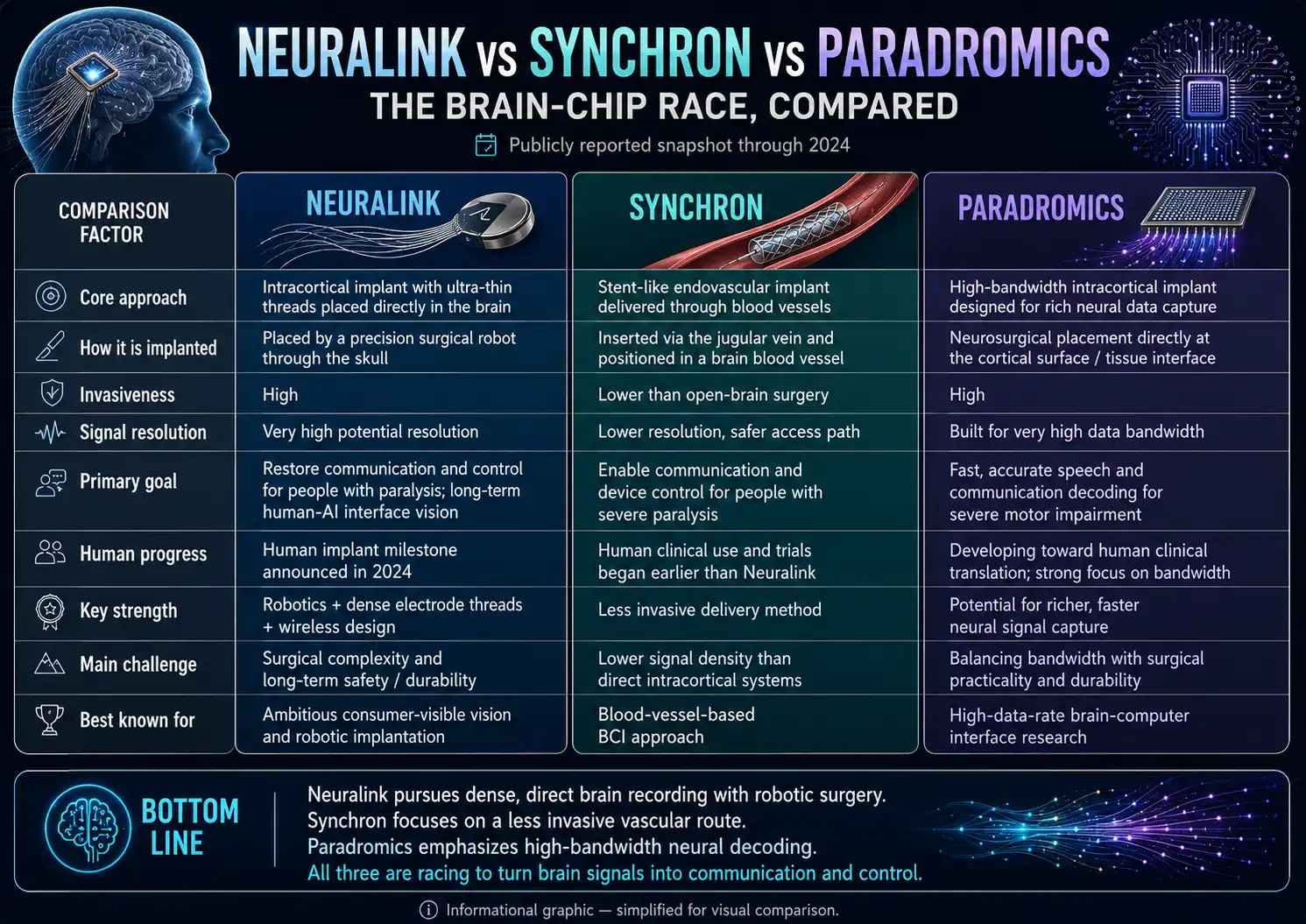
For years the brain-computer interface field was basically one company and a lot of speculation. That is no longer true. Three names now define the race — Neuralink, Synchron, and Paradromics — and they have each placed a very different bet on how a machine should connect to the human brain. If you only track one of them, you are missing the more interesting story, which is the trade-off they are all wrestling with.
That trade-off is bandwidth versus invasiveness. The more directly you tap into neurons, the more data you can read — and the more serious the surgery. Neuralink and Paradromics chase bandwidth with electrodes placed into the cortex. Synchron takes the opposite view: get useful signal without ever opening the skull.
The three companies at a glance
| Neuralink | Synchron | Paradromics | |
|---|---|---|---|
| Approach | Flexible cortical threads | Stent through a blood vessel | High-density microelectrodes |
| Invasiveness | Open-brain surgery | No open surgery | Open-brain surgery |
| Main focus | General-purpose BCI | Movement & communication | Speech restoration |
| Bandwidth | Very high | Lower | Very high |
Neuralink: bandwidth first
Neuralink is the one everyone has heard of, and its pitch is raw capability. Its device uses thousands of ultra-thin, flexible threads, stitched into the cortex by a purpose-built surgical robot, to read from a very large number of neurons at once. That high channel count is the whole point — more channels means richer signal, which in principle means smoother, more capable control. The cost is that this is genuine brain surgery, and the long-term durability of threads sitting in living tissue is exactly the kind of question that only years of human data can answer. Our piece on Neuralink and the next phase of brain-computer interfaces goes deeper on where it stands.
Synchron: skip the surgery
Synchron made a bet that looks almost contrarian next to Neuralink: what if you could avoid opening the skull entirely? Its Stentrode is threaded up through a blood vessel and parked against the motor cortex from the inside of a vein — a procedure closer to a routine stent placement than to neurosurgery. The signal it reads is coarser than a cortical implant’s, so the bandwidth is lower. But for restoring basic control — letting a paralysed person move a cursor or send a message — lower bandwidth can be plenty, and the far lower surgical risk is a serious advantage. It is a reminder that in medicine, “good enough and much safer” often beats “best on paper.”
Paradromics: built for speech
Paradromics is less of a household name but arguably the most focused of the three. Its high-density electrode array is built to move enormous amounts of neural data, and the company has aimed squarely at one life-changing application: restoring speech to people who have lost it. That specificity is a strategy in itself — rather than a general BCI platform, it is engineering around a single, clearly valuable outcome. It sits on the same invasive, high-bandwidth side of the map as Neuralink.
So who is winning?
It depends entirely on what you mean by winning. On raw bandwidth, the cortical implants from Neuralink and Paradromics lead. On safety and near-term accessibility, Synchron’s vascular approach is hard to beat. And on regulatory progress, the leaderboard keeps shifting as human trials advance. The honest answer is that these are not really the same product — they are three answers to the same question, and it is plausible that different approaches win for different patients. For the underlying science of how any of these actually read intention from the brain, start with how brain-computer interfaces read your thoughts, and for the state-versus-safety debate, China’s brain-computer chip is a useful contrast.