
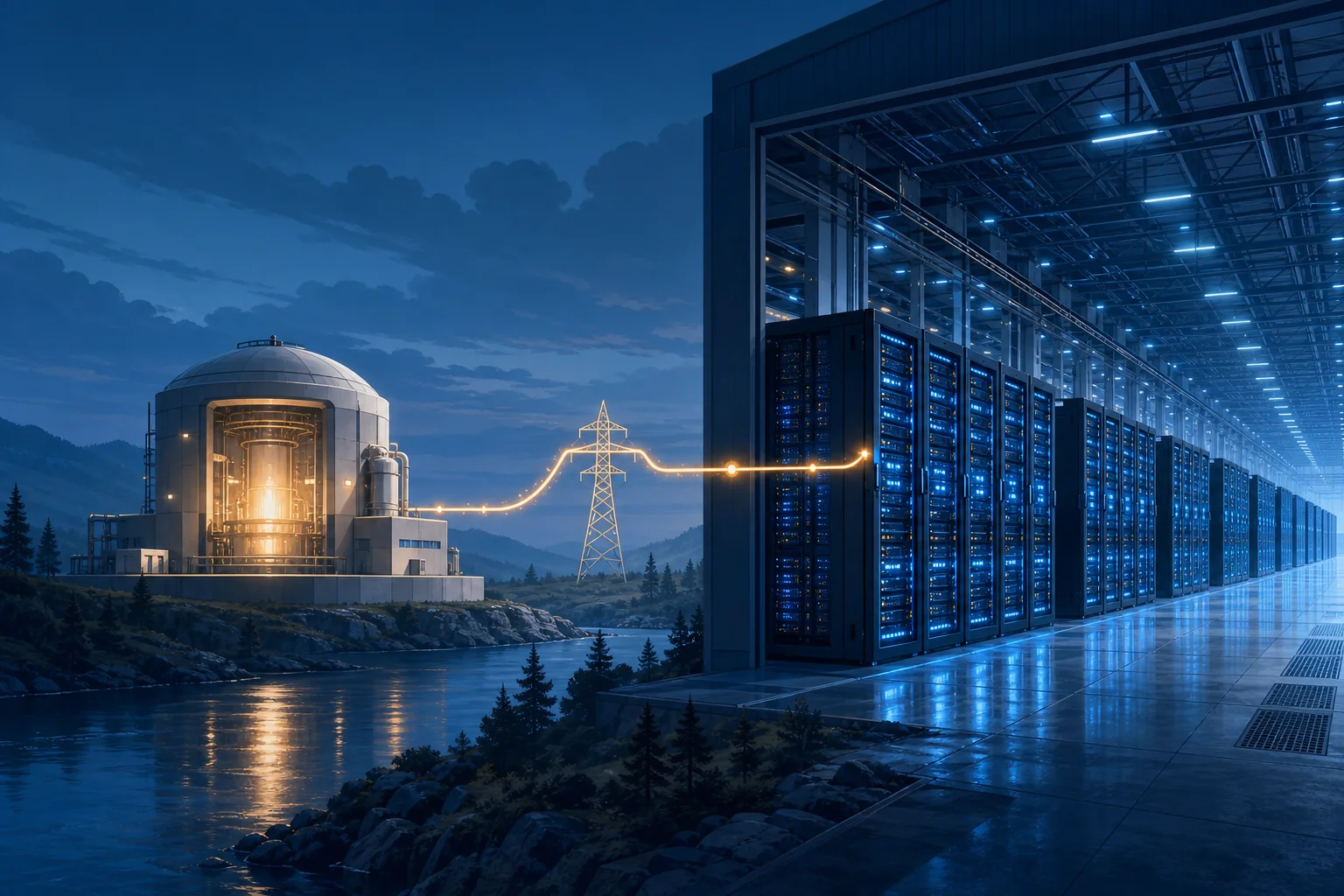
On July 1, 2026, in the small town of Orangeville, Utah, a computer chip did something quietly historic. It ran on electricity pulled straight from a nuclear reactor barely bigger than a school bus. Nvidia and a startup called Valar Atomics staged the demo, and it’s a sharp snapshot of why AI data centers are turning to nuclear power: the machines behind the AI boom are starving for electricity the grid was never built to serve (Deseret News).
The reactor, called Ward250, went critical on June 18 and now puts out about 100 kilowatts. That’s enough to run a chip, not a city. Its designers say the fuel load could last 165 years.
Keep your expectations grounded, though. Ward250 makes roughly 300 times less power than a data center already approved down the road, and it still needs a federal license before it can sell a single watt. The milestone is real. The scale is not, yet.
So here’s the question worth sitting with. Is AI quietly restarting a nuclear age we walked away from decades ago, and if so, who gets a vote?
How much electricity does AI actually need?
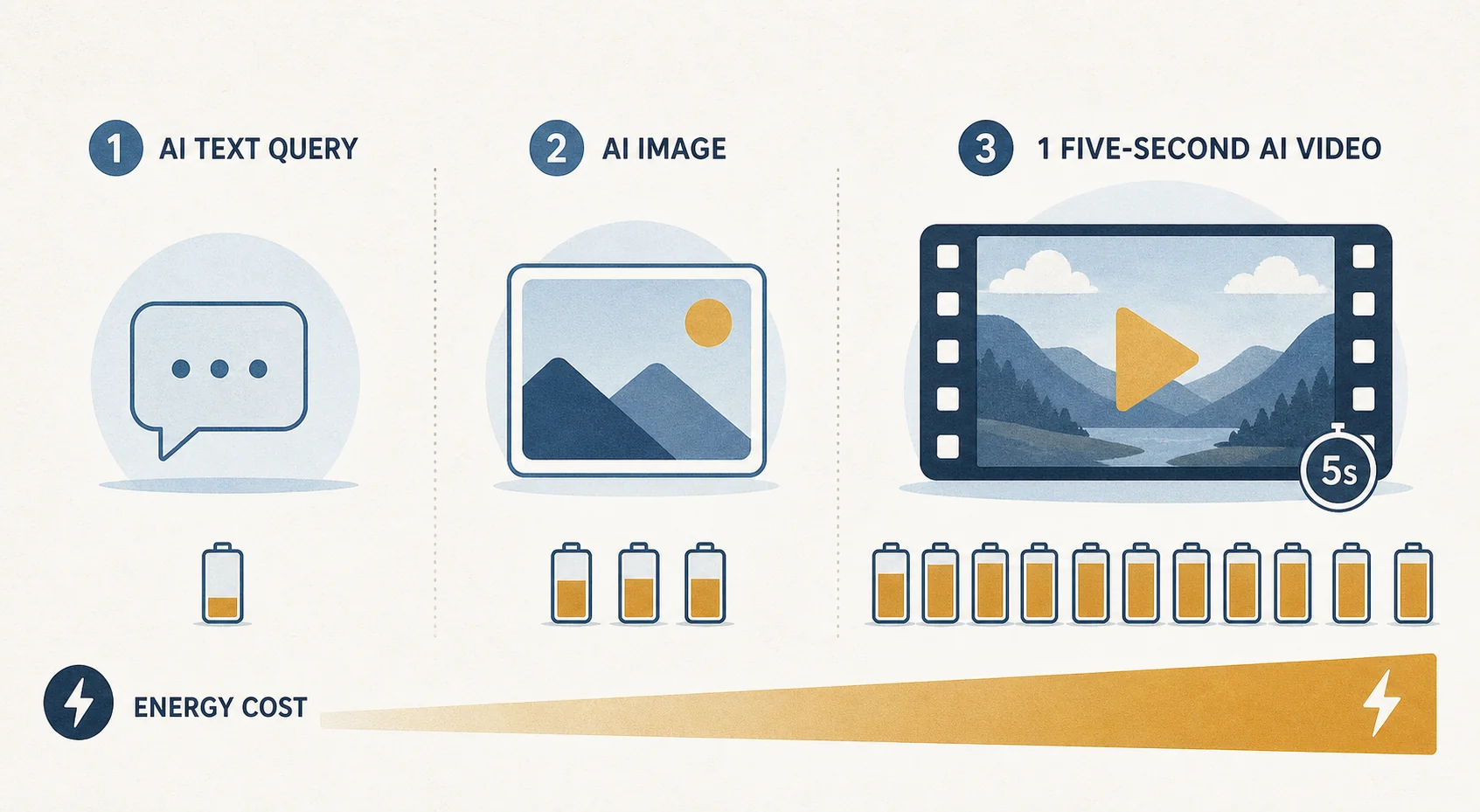
Start small. A single text question to a mid-sized model burns about 114 joules once you count the cooling. Ask the 405-billion-parameter version and you’re near 6,700. Generate an image and it’s roughly 2,282 joules. Ask for a five-second AI video and the cost leaps to about 3.4 million joules, the same energy as riding an e-bike 38 miles (MIT Technology Review).
Now multiply. OpenAI says ChatGPT alone fields around a billion messages a day, plus 78 million images.
The buildings that do this work are enormous. A typical hyperscale data center pulls about 100 MW, roughly what 100,000 homes use. Meta’s Hyperion campus in Louisiana needs at least 5 GW. That’s triple the electricity of all of New Orleans, on a site four times the size of Central Park (Consumer Reports).
Zoom all the way out and the figures turn dizzying. The IEA expects global data-center electricity use to roughly double, from 485 TWh in 2025 to about 950 TWh by 2030, with the AI slice tripling (IEA, Electricity 2026). Goldman Sachs first pegged the growth at 165% by 2030, then quietly revised it toward 220% in a later 2026 forecast (Goldman Sachs Research). Even the forecasters keep raising their own numbers.
If data centers were a country, they’d be the world’s fifth-largest electricity consumer, wedged between Japan and Russia (Brookings). That is the appetite nuclear is being asked to feed. It mirrors the raw compute arms race we traced in the AGI development race, where every leap in model size carries a hidden power bill.
Why AI data centers are turning to nuclear power now
Here’s the appeal in one line. Reactors run flat out, day and night, rain or shine. Solar stops at dusk and wind comes and goes, but a GPU cluster training a model can’t pause for a cloudy afternoon. Nuclear delivers steady, carbon-free baseload, the round-the-clock kind AI craves.
The IAEA doesn’t hedge about it. “Only nuclear energy can meet the five needs of low-carbon power generation, round-the-clock reliability, ultra-high power density, grid stability and true scalability,” says Director General Rafael Mariano Grossi (IAEA).
So the deals pile up. On January 9, 2026, Meta announced agreements for up to 6.6 GW of nuclear power, more than the entire state of New Hampshire uses. The structure tells the story. One slice is a 20-year contract with Vistra for 2.6 GW from existing plants. Another is a first-of-kind advanced reactor with Oklo, targeting first power around 2030. A third is up to eight TerraPower Natrium reactors for 2.8 GW more (Utility Dive). Already built, under construction, still on the drawing board, all in one shopping list.
Microsoft went further back in time. Its deal with Constellation restarts Three Mile Island Unit 1, idle since 2019, now rebranded the Crane Clean Energy Center. It restores 835 MW to the grid, backed by a $1 billion federal loan, with power expected in 2027 (Utility Dive). Yes, that Three Mile Island. The plant synonymous with America’s worst commercial nuclear accident, revived to feed AI. It’s hard to invent a sharper symbol.
Others are lined up behind them. Google is backing Kairos toward a 2030 reactor, and Amazon anchored X-energy toward as much as 5 GW by 2039 (WWT). Tech firms have even pledged to help triple global nuclear capacity by 2050 (UN News).
The bill nobody voted for
Here’s where the abstract turns personal. John Steinbach has lived in Manassas, Virginia for almost 40 years. In January 2026 his electricity bill came to $281, up from about $100 the month before. “It’s just so far beyond any bill that I’ve ever had,” he told Consumer Reports.
He isn’t imagining the link. A November 2025 survey of 2,146 adults found 78% worried new data centers would push their own bills up. Residential prices climbed 7.1% in 2025, more than double general inflation. Bloomberg went sharper still: in areas thick with data centers, electricity prices jumped as much as 267% over five years (Bloomberg).
Most people never got asked. In 25 of 31 Virginia communities with proposed data centers, nondisclosure agreements kept residents in the dark about the deals. You can’t vote on a project nobody told you about. It’s the same equity question that runs through who gets access to brain chips: when a new technology arrives, someone always pays the hidden cost.
Would you rather have a reactor or a data center next door?
Now the twist the investor blogs keep missing. Ask Americans what they’d rather live beside, and the reactor wins. A Gallup survey found 71% oppose a local AI data center, against 53% opposed to a nuclear plant (Gallup). Read that again. More people fear the server farm than the reactor.
That 71% isn’t just high. It beats the strongest opposition to nuclear plants Gallup has recorded since it began asking in 2001, a previous peak of 63% (Forbes). Seventy percent of the objectors cite environmental impact: water use, energy, lost farmland.
The irony runs deep. Three names once wrecked nuclear’s reputation. Three Mile Island in 1979, Chernobyl in 1986, Fukushima in 2011. Yet by the cold math of mortality, nuclear ranks among the safest sources we have. It causes under 0.1 deaths per terawatt-hour, against 25 for coal and 3 for natural gas, even counting its disasters (Our World in Data).
Reactors didn’t suddenly get safer in the public eye. Something people trust even less just moved in next door.
Who actually gets a say?
This is where it gets murky, and it’s the most interesting part. You might assume a company can just drop a private reactor behind its own fence and run. It can’t, quite.
Under the Atomic Energy Act of 1954, the Nuclear Regulatory Commission is the only body that can license a private reactor (Congressional Research Service). Siting and permitting, though, mostly belong to the states. Selling power straight to one corporate customer “behind the meter” can count as a retail sale under state law, which some states can restrict or block outright (POWER Magazine). The rules are a patchwork, and the patchwork is where the fights happen. It echoes the regulatory scramble we mapped in how governments plan for superintelligence: the technology sprints ahead while the rulebook limps behind.
You could hear those fights in a Pennsylvania hearing room. In February 2026, more than 100 people packed an NRC session on the Three Mile Island restart. One resident recalled a “metallic taste in my mouth” during the 1979 crisis. Another put it plainly: “Our community, which has experienced the worst nuclear accident in U.S. history, deserves to be protected, and the NRC will have to earn our confidence back” (Pennsylvania Capital-Star).
The backdrop got tenser in June 2026, when the Trump administration fired one of the NRC’s five commissioners after an executive order pushing the regulator to move faster. Critics see a safety agency being told to hurry. Speed is exactly what worries people who want a careful reviewer.
What’s real, and what’s still a pitch?
Before anyone declares a nuclear renaissance, look at the scoreboard. As of 2026, only 18 of 346 tracked AI data-center facilities worldwide run on nuclear power, about 31 GW, most of it from old reactors under new contracts rather than shiny new SMRs (AI Data Center Index). The buildout is still mostly promises with 2030s delivery dates.
The economics humble the story too. Georgia’s Plant Vogtle, the only new large U.S. reactors finished in decades, was pitched at roughly $14 billion and landed near $35 billion, years late (Inside Climate News). Small modular reactors, the supposed fix, remain unproven. The only three running today all blew past budget by 300 to 400%, and independent estimates put their power cost above $200 per megawatt-hour, versus $45 to $74 for gas (ScienceDirect).
Even nuclear’s fans admit the timing problem. Natural gas is “the king right now” for near-term data-center power, cheaper and quicker to build (Data Center Knowledge). Nuclear’s real edge isn’t speed or price. It’s steady, carbon-free power at scale, years from now. It’s the same infrastructure puzzle behind whether DNA could one day become a data-center storage layer: plausible future, not here yet. And the demand keeps climbing with every new model, including the open-source ones now nipping at GPT-5’s heels.
So who really decides?
Strip away the press releases and you’re left with a strange trade. AI’s hunger is doing what decades of climate arguments couldn’t: making nuclear respectable again. Reactors are winning back trust not on their own merits, but because the thing moving in next door, opaque and water-hungry and negotiated in secret, spooks people more.
The reactors, if they come, will mostly arrive in the 2030s. The bills are arriving now. And the machinery for deciding any of it, state retail-power law, FERC cost fights, NRC hearings where neighbors still name 1979, gets tested faster than it can adapt.
So the honest answer to why AI data centers are turning to nuclear power isn’t only about physics or carbon. It’s about who gets a vote when a company wants a reactor on your horizon to run a model you never asked for. Put that question to your own utility before the next one breaks ground. What would you want next door, the reactor or the server farm?