

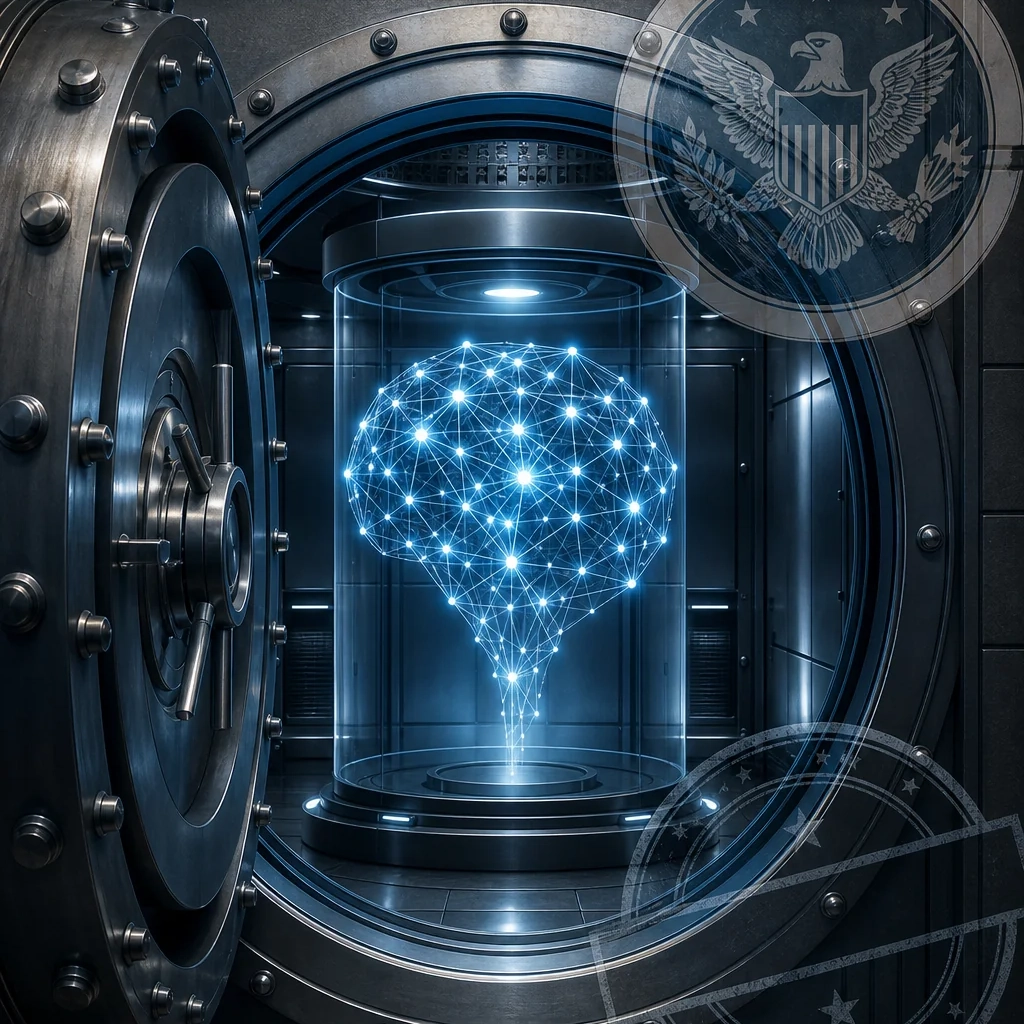
On June 12, 2026, people who pay for Anthropic’s best AI models opened their apps and found them gone. No warning. No court hearing. Commerce officials had decided the systems were a national-security risk, and access went dark worldwide within hours. That blackout is the clearest look we have at a change that landed ten days earlier. On June 2, President Trump signed the AI executive order frontier model early access framework. It lets the government inspect the most powerful private AI systems before the rest of us ever see them.
The order calls this preview voluntary. On paper, it is.
But “voluntary” carries a lot of weight in a sentence that also hands security agencies the first look at frontier AI. The interesting question isn’t what the text says. It’s whether a voluntary government preview of the world’s most capable software stays voluntary once officials get used to having it. Let’s walk through what the order does, then sit with that question. The past month already gave us a preview of the answer.
What the AI Executive Order Frontier Model Early Access Rule Actually Says
Strip away the branding and the order does two things. It pushes AI tools into federal and critical-infrastructure cyber defense. And it sets up a voluntary early-access review for what it calls “covered frontier models” (White House fact sheet). Trump signed it as Executive Order 14409, “Promoting Advanced Artificial Intelligence Innovation and Security,” and the Federal Register published it on June 5 (Federal Register).
Here’s the mechanic that matters. A developer building a frontier model can hand the government access for up to 30 days. That has to happen before releasing it to “other trusted partners” (WilmerHale). Read the sequence closely. Government first. Trusted partners second. Everyone else last (Skadden). The state becomes the first outside party to touch these systems, ahead of even the companies’ own hand-picked launch partners.
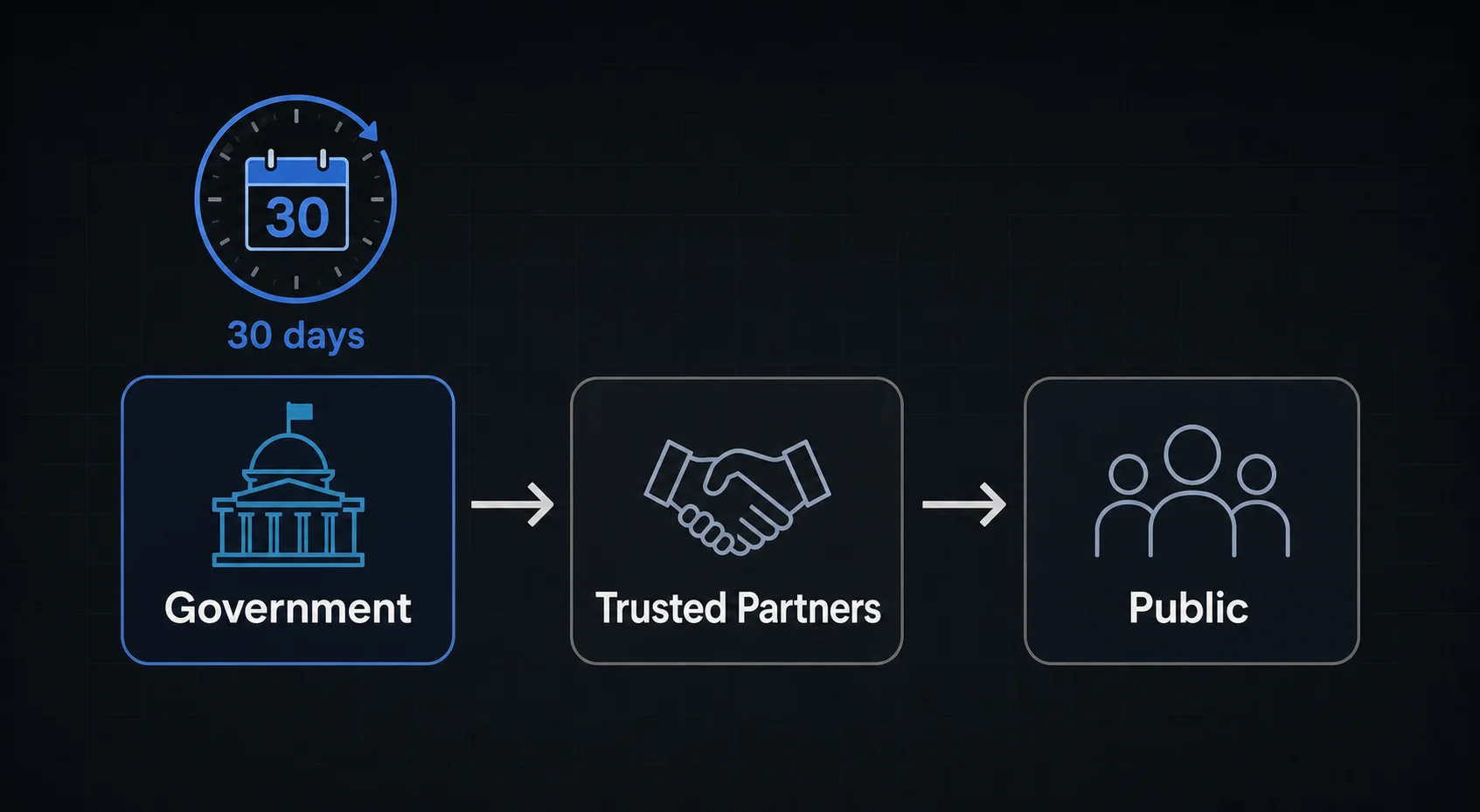
The order pairs that review with plumbing. Treasury has to stand up an “AI cybersecurity clearinghouse” for finding and fixing vulnerabilities. DHS has to help state and infrastructure operators get AI-enabled security tools (White House fact sheet).
A frontier model, roughly, means one of the largest and most capable general-purpose systems, the class that powers tools like GPT-5 or Claude. Want the plain-English version of how those systems work under the hood? We broke that down in how large language models actually work. The short version: these sit near the frontier of what’s technically possible, and that’s exactly why the government wants an early look.
“Voluntary,” With a Very Large Asterisk
Now the word doing all the work. The order is voluntary in the plain sense. No company has to participate, and the text explicitly refuses to create “a mandatory governmental licensing, preclearance, or permitting requirement” for new models (The Register). The Office of Science and Technology Policy said as much. “We are NOT conducting oversight of all new models, as that level of government overreach would have chilling effects on free speech and innovation” (AI Risk Aware).
So far, so reassuring. The lawyers reading the fine print are less relaxed.
WilmerHale’s client alert flags the catch. Even though it’s voluntary, the order “is expected to shape industry norms and may serve as the basis for subsequent contractual, procurement or regulatory requirements” (WilmerHale). Translation: opt in now by choice, or opt in later because a federal contract quietly requires it.
Cato Institute’s Kevin Frazier spells out the pressure with no penalty attached. Coordinated government messaging and reputational risk can nudge a lab that declines. And the order sets no clear timelines for when a lab even has to “engage” (Cato Institute). No fine. No court order. Just the soft gravity of not wanting to be the company that told the NSA no.
Who Gets to Call Something a “Frontier Model”?
This is where it gets strange. The order never publishes a plain definition of a “covered frontier model.” Instead, the label comes out of a “classified, multilayered benchmarking review process” that measures a model’s “advanced cyber capabilities” (WilmerHale).
Who makes the final call? The Director of the NSA, working with the National Cyber Director, the President’s science adviser, the head of CISA, and Department of War representatives (Skadden). An intelligence agency, in other words, decides in secret which private products cross the line.
That worries people across the spectrum. The AI Governance Institute flags a due-process hole: a developer “may receive a designation without a clear appeals or challenge process” (AI Governance Institute). Frazier adds a second problem. Handing this to an intelligence agency likely makes frontier-model risk less visible to the public, not more. Today’s norm is the opposite: labs voluntarily publish their own capability evaluations and model cards (Cato Institute).
The National-Security Case, and the 90-to-30-Day Flip
Why build any of this? The order’s real target isn’t rogue superintelligence. It’s cyberattacks. Officials worry about the “offensive capabilities of newly released frontier AI models” that can “identify and exploit software vulnerabilities” faster than defenders can patch them (WilmerHale).
That fear collides with a competing one: falling behind. You can see the collision in the order’s own drafting history. Trump was set to sign a 90-day review version on May 21. He pulled it after talking with former White House AI czar David Sacks. Then he came back with a 30-day window, pitched to let labs comply “without delaying new model releases” (The Register).
The Council on Foreign Relations ties that shorter clock straight to the race with China. But it warns that “pre-deployment testing has limits.” A vulnerability can spread across systems long before any 30-day review ends (CFR). CFR’s analysts also note the national-security world has no settled playbook for judging “probabilistic, autonomous systems,” a skill they say has to mature in “months, not years” (CFR).
That speed-versus-safety tension isn’t new. It drives the broader AGI development race. It’s also the same reason an open-source jump like DeepSeek V4 rattled Washington in the first place.
The Test Case Nobody Scheduled: Anthropic, Ten Days Later
Here’s where theory turned concrete. On June 12 at 5:21 PM ET, the Commerce Department told Anthropic to suspend worldwide access to its two most capable models, Claude Fable 5 and Mythos 5. Every customer lost them at once, on AWS Bedrock, Google Cloud, Microsoft Foundry, Snowflake, and Box. The trigger: a newly discovered jailbreak technique (Anthropic).
Here’s the twist most coverage missed. The government didn’t use its shiny new voluntary framework to do it. It reached for a separate, mandatory export-control authority instead (Fortune). The “voluntary” preview sat untouched while a harder lever did the actual work.
Anthropic pushed back in public. “If this standard was applied across the industry, we believe it would essentially halt all new model deployments for all frontier model providers,” the company said. It wanted “a statutory process that is transparent, fair, clear, and grounded in technical facts”, not one-off directives (Anthropic). The Electronic Frontier Foundation went further. Export controls are “uniquely susceptible to abuse,” it warned, when a government imposes them without clear standards (EFF).
Then came the walk-back. Commerce partially reopened Mythos 5 on June 26 for roughly 100 companies and agencies, cybersecurity uses only, while Fable 5 stayed dark (Digital Applied). Full access returned on July 1, after Anthropic agreed to “proactively detect and address security risks” and coordinate with the government on standards (Al Jazeera).
That same week, OpenAI showed the other face of this new normal. It previewed GPT-5.6, code-named “Sol,” to about 20 government-approved partners, approved customer by customer, with no published criteria. Even so, OpenAI said plainly that this “should not become the long-term default” (Digital Applied).
So the law firms’ abstract caveat, that “voluntary” runs closer to de facto, stopped being abstract. It happened, in full, during the life of one order.
How Washington’s Approach Splits From Europe’s
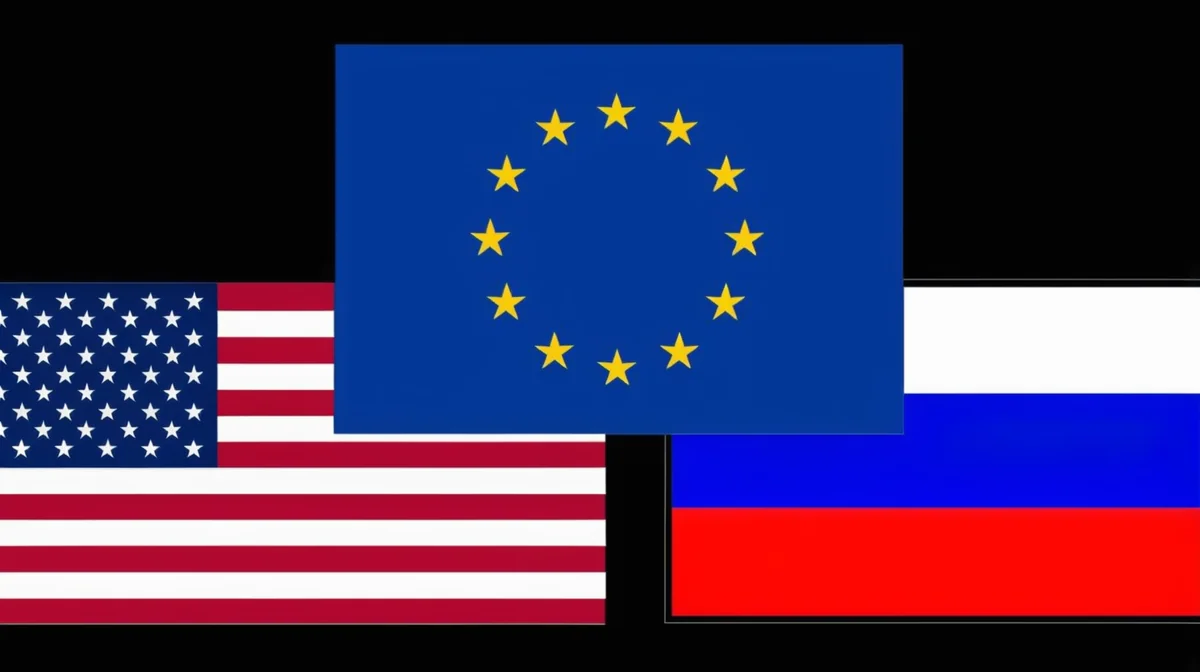
Put the two systems side by side and they barely rhyme. The U.S. framework is voluntary, and security agencies run it. The EU AI Act is binding law. A civil regulator enforces it, on product-safety and fundamental-rights logic (ComplianceHub.Wiki).
They even define the danger differently. Washington uses a secret, discretionary benchmark. Brussels draws a bright numerical line. The EU presumes a general-purpose model carries “systemic risk” once its training compute passes 10^25 floating-point operations (EU AI Act).
The stakes for getting it wrong are lopsided too. EU enforcement powers switch on August 2, 2026. Fines reach the greater of 15 million euros or 3% of global turnover. For the worst breaches, that climbs to 35 million euros or 7% (ComplianceHub.Wiki). The American order? Zero direct statutory penalties. It leans entirely on the incentive of staying in the government’s good graces (ComplianceHub.Wiki).
And there’s no mutual credit. Complying with the voluntary U.S. program earns a company nothing toward its binding EU duties. For any firm selling on both sides of the Atlantic, Europe’s rules become the real floor (ComplianceHub.Wiki). This is the same governance gap we mapped in how governments plan to regulate superintelligence. Two of the world’s biggest markets are pulling in different directions.
Could This Be the First Draft of Real Oversight?
So is this the start of genuine AI accountability, or a placeholder that looks like one? The honest answer is that nobody knows yet, the experts included.
Frazier argues the current order can’t be the finished product. Real oversight, he says, would need Congress to step in. That means public benchmarking standards, defined government response timelines, and a flat ban on punishing labs that opt out (Cato Institute). By that reading, the executive order is a rough draft, not the law.
Meanwhile the Anthropic episode suggests oversight “by other means” already runs, whether or not the voluntary framework matures. Export controls did the gating that time. After the July resolution, researcher Tanishq Abraham put the unsettled question out loud: does “the US government need to approve every frontier model release”? (Al Jazeera). University of Sydney’s Francesco Bailo cautioned the other way, suggesting the government likely “overreacted” and set an uneasy precedent for the whole industry (Al Jazeera).
That unresolved tension, real control versus quiet overreach, is the same trust problem. It sits under why AI deception matters more than the Turing test. We have to trust a process we can’t see.
What It Means for the Rest of Us
Strip out the agency names and one fact remains. For up to 19 days, paying customers lost access to tools they relied on. No law forced any of it (Fortune). A new relationship between the government and a handful of AI labs reached straight into ordinary workflows. It switched things off.
That’s the part worth sitting with. The “trusted partners” idea already decides who gets frontier capability first. OpenAI’s Sol preview went to roughly 20 vetted organizations before anyone else (Digital Applied). Access to the most powerful AI is quietly becoming a permission. Relationships grant it, ones most of us can’t see and didn’t vote on.
Maybe that’s a fair price for keeping cyber-capable models out of the wrong hands. Maybe it’s the first inch of a slope worth watching. I lean toward watching it very closely. “Voluntary” has a habit of hardening once a government discovers how useful the arrangement is.
Where do you land? Keep an eye on the next few frontier releases with that question in mind. If the early look stays a courtesy, this was cautious housekeeping. If it hardens into a checkpoint, we’ll have normalized government pre-screening of the most powerful software on Earth. Nobody will have cast a single vote on it. Want the wider picture on where this is all heading? Our ongoing coverage of AI regulation and the AGI development race is a good place to keep reading.