
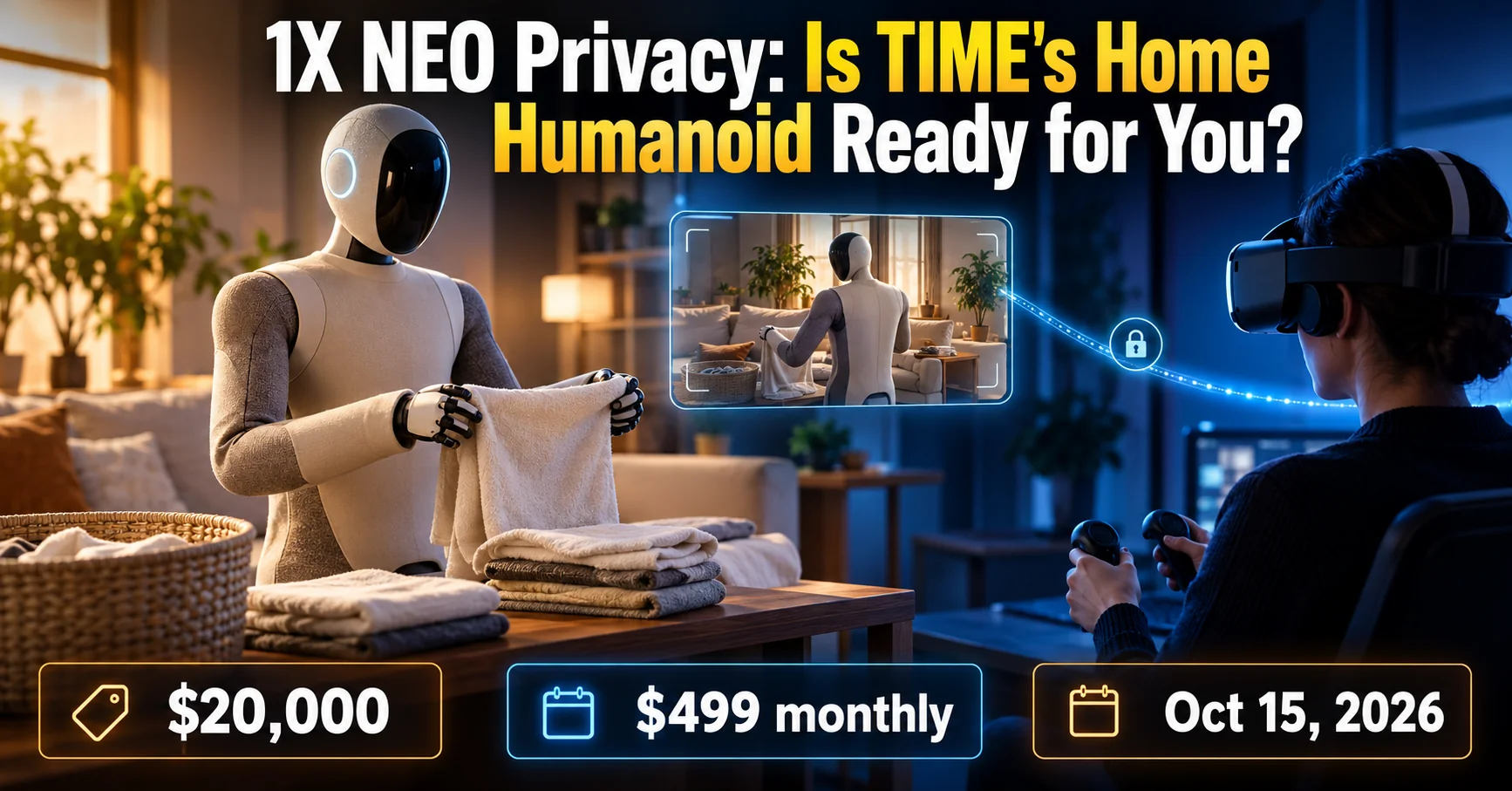
Picture someone folding your laundry while you’re at work. Now picture that person somewhere else in the United States, wearing a VR headset. They’re steering a robot through your living room by video. That’s the 1X NEO privacy question in a single image, and TIME just turned it into a mainstream one.
TIME put NEO on its Best Inventions of 2026 list on Oct 15. The entry calls it “the first humanoid robot widely available for home use.” The price is $20,000 outright, or a $499 monthly subscription. Preorders opened exactly a year ago today, on Oct 28, 2025.
The hardware is impressive. That isn’t really the issue.
The issue is trust. What are you agreeing to when a machine with cameras and a remote human pilot moves into your home? That’s what the 1X NEO privacy debate is actually about. My view, up front: NEO can be a fair trade for some households. But 1X hasn’t published enough yet for most families to know whether they’re one of them.
What TIME’s Best Inventions 2026 pick actually says about NEO
Strip away the headline and TIME’s entry reads mostly like a spec sheet. According to humanoid.guide’s write-up of the TIME listing, NEO weighs 66 lb, can lift more than 150 lb and can carry 55 lb. Those last two are separate figures, not a typo.
CEO Bernt Børnich lists the chores he expects it to handle:
- fetching items from other rooms
- tidying countertops
- folding laundry
- unloading the dishwasher
- carrying groceries
He adds that NEO “will learn additional tasks over time.” Hold onto that phrase. How it learns sits at the heart of this story. Specs tell you what NEO can carry. They tell you nothing about 1X NEO privacy.
The part of the TIME entry that deserves a raised eyebrow is “launched globally.” On July 16, 2026, a RoboZaps fact-check, relayed by the analysis site ai2.work, found no independently verified customer delivery. 1X opened its Hayward factory on Apr 30, 2026. Its own message to buyers stayed careful: “some of you will get your NEO this year, some will get them later.”
The company cites capacity of 10,000 units a year, with a target of 100,000+ by the end of 2027.
So which is it, launched or still arriving? Nobody can settle that from the outside, and you shouldn’t treat either source as the final word. We’ve watched the same gap between announcement and delivery across the field, in our look at which humanoid makers actually ship.
How NEO works at home: autonomy vs teleoperation
Here’s what the glossy coverage tends to skip. NEO isn’t fully autonomous. For complex chores, a human teleoperator takes over and can see inside your home, once you approve the session.
When reviewers got hands-on time in October 2025, the gap showed. In the Wall Street Journal’s test, Joanna Stern reported that a human pilot in a VR headset did the tasks. Fetching a water bottle took over a minute. Loading dishes took more than five.
1X calls the takeover “Expert Mode.” When NEO can’t finish a job, you schedule a session and a US-based 1X operator pilots the robot. Each session also produces training data. On board, NEO runs Redwood, a 160M-parameter vision-language model that ticks along at roughly 5 Hz. Cooking stays off the menu at first.
If you want the mechanical side, our explainer on how humanoid robots work covers the actuators and joints.
This is where 1X NEO privacy stops being abstract. 1X doesn’t publish how many minutes of teleoperation each robot needs per day. One back-of-envelope estimate from ai2.work, its own math rather than a 1X figure, says the $499 subscription covers roughly 49 minutes a day of operator time at $20 an hour.
Think about what that implies. Part of the “autonomy” you’d pay for is, for now, human labour plus your household’s data.
That’s not a scandal. Plenty of AI products start this way. It does change what you’re buying, though. We asked a similar question about crowdsourced robot pilots in Enigma’s robots.online experiment: who is really training these machines, and what do they see while they do it?
1X NEO privacy controls: what a remote operator can and can’t see
1X describes a layered set of safeguards. No third party has audited any of them, so read the list as company claims:
- Explicit approval. An operator session needs the owner’s okay, inside time windows the owner picks.
- Blurring. The system can blur people in the home within the operator’s feed.
- No-go zones. NEO respects software-enforced boundaries during teleoperation.
- A visible signal. A light ring on NEO’s ear shows when a session is live.
- No profiling. 1X says it doesn’t profile users or sell their data.
That’s a sensible starting design, and the consent gate matters most. A robot no one can pilot without your tap is a different product from one that wakes up on someone else’s schedule.
Still, the operator has eyes on parts of your private space. Blurring covers people. Does it cover the prescription bottle by the sink, or the open laptop on the table? 1X’s published claims don’t say.
Critics have framed the wider worry plainly: a networked robot with cameras and remote operators, sitting inside private homes. That’s the core of home humanoid robot privacy, and NEO is simply the first one to make it concrete.
Where the data goes, and why 1X says it needs it
Every 1X NEO privacy conversation lands on the same two lines. “You have to be okay with this for the product to be useful,” Børnich said at the unveiling, as Decrypt reported. Then: “Without your data, we can’t make the product better.”
He frames it as a “Big Brother, Big Sister” principle. Share more data and the robot gets more helpful. You pick your own point on that scale.
I’ll give him credit for candour. Most consumer tech buries this deal in a terms-of-service page. 1X said it out loud, on the record. Its website adds: “We do not use this data to build a profile for you, nor do we sell this data.”
But honesty about a deal isn’t the same as detail about it. Nothing we reviewed says how long 1X keeps session recordings. Nothing says who inside the company can watch them. AI researcher Gary Marcus summed up the skeptic’s case in six words: “The privacy concerns will be huge.”
The open 1X NEO privacy questions nobody has answered
The most neutral read comes from the OECD. Its AI incident monitor classes NEO as an “AI Hazard”, not an incident. In plain terms, nobody has reported actual harm. The concern is that cameras, microphones and remote teleoperation could “expose sensitive household data and activities to external operators.”
The entry adds that teleoperators viewing homes could plausibly violate privacy rights. One caveat: the OECD’s summary is AI-generated, so treat it as a flag, not a ruling.
That leaves a short list of open questions. We couldn’t confirm an answer to any of them in a verifiable source:
- Legal access. Could police or a court compel 1X to hand over session footage? Some coverage has floated a law-enforcement scenario, but we couldn’t verify it. Our piece on what governments can really subpoena shows why that question rarely stays hypothetical for long.
- Retention. How long does a recorded session live, and does deleting it actually delete it?
- Regional law. Do state biometric-privacy rules apply when an operator sees your face? Some coverage claims they do. We found no verified source to back it.
- Teleoperation volume. How much of a typical day involves a human watching? 1X doesn’t say.
Now the fair counter-argument. Børnich has reportedly called NEO “more secure than hiring a cleaner,” though that quote reached us secondhand. There’s something to it. A cleaner is also an unaudited stranger in your home, seeing your mail.
The difference is scale. A cleaner’s glance doesn’t become training data. And 1X’s controls, unlike a cleaner’s references, haven’t faced outside testing.
A household trust checklist before inviting a humanoid in
If you’re on the waitlist, or just curious, these are the 1X NEO privacy questions I’d want answered in writing before a humanoid crosses the doorstep. None of them needs an engineering degree.
- Can I see a log of every session? Who connected, when, and for how long.
- Who is the operator? Ask whether it’s a 1X employee or a contractor, and how 1X vets them.
- What does the blur actually blur? Faces only, or screens and documents too?
- Where do my NEO no-go zones live? On the robot or in the cloud, and can an operator override them?
- How long do you keep recordings, and can I delete them?
- What happens if 1X receives a subpoena? Will they tell me?
- Who else in the house gets a say? If your kids or a guest are home, does anyone check with them before a session starts?
Use the refund window while you ask. The $200 deposit stays refundable until 14 days after your Order Invitation arrives. Advertised pricing can also change before you accept, so read the final offer closely.
Then do a gut check. Picture the light ring glowing while you’re out. Picture a person you’ll never meet looking down your hallway. If that’s fine with you, NEO’s bargain might work. If it makes your stomach drop, no subscription price will fix it.
So, is NEO ready for real households?
For some, yes, with eyes open. A tech-comfortable adult living alone, who reads the terms and keeps the robot out of the bedroom, can make a rational call here. 1X offers a clear swap: help with chores now, in exchange for data and occasional human eyes.
For most families, I’d say not yet. The robot isn’t the weak link. The trust paperwork is. TIME has a point that NEO marks a real moment, a humanoid you can order for your home. But “widely available” and “ready” aren’t the same thing, and 1X could close much of that gap simply by publishing what it already knows.
Until it does, 1X NEO privacy rests on faith in a company’s word. So here’s the question worth sitting with. If 1X published its session logs and its retention rules tomorrow, would you let the robot in? Or was the stranger behind the camera always the real problem?