
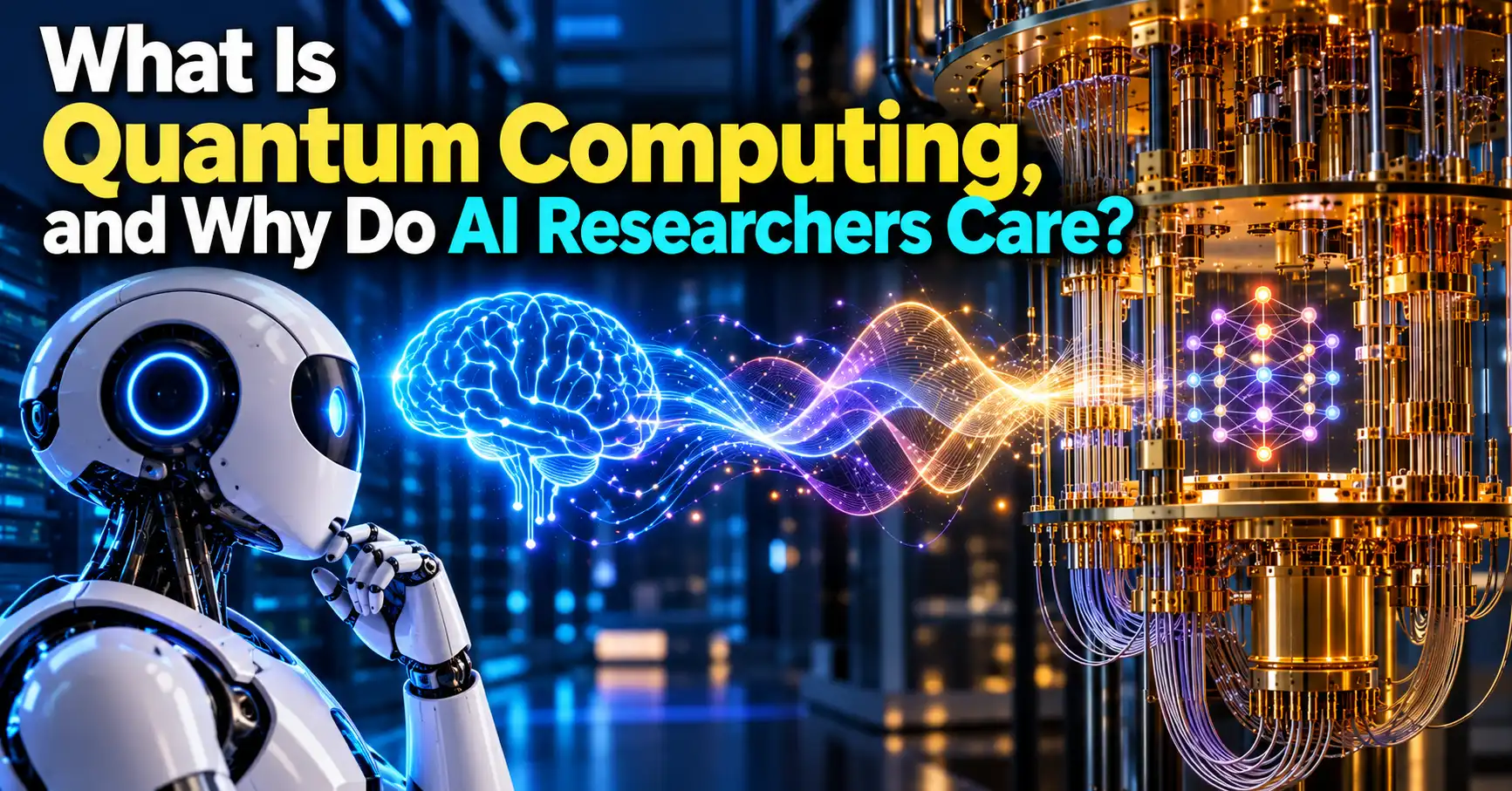
For its entire history, AI has run on one humble idea: a switch that’s either on or off. Every chatbot reply and every generated image comes down to billions of those switches flipping. So what is quantum computing, and why should anyone who cares about AI pay attention? It’s a machine that breaks the on-or-off rule. And a growing number of AI researchers now think the two fields need each other.
That’s a big claim. Quantum computing has been “ten years away” for so long that skepticism feels like the default setting.
But the evidence shifted over the past two years. In December 2025, a 28-author team led by NVIDIA published a review in Nature Communications. Its argument: AI now beats traditional engineering at nearly every layer of the quantum stack. Quantum hardware makers have started wiring AI decoders straight into their machines. And the money has followed.
A quantum computer won’t replace your laptop. The live question is whether AI’s next generation gets a second kind of machine to think with, and who gets to use it.
Why does a new kind of computer matter to AI?
Start with the money, because it tells you what serious people believe.
Quantum startups pulled in $12.6 billion in 2025, roughly six times the ~$2.1 billion they raised in 2024, according to McKinsey’s Quantum Technology Monitor 2026. Private capital did almost all of that. The government share fell from about a third of the total to just 3%. Quantum companies also crossed $1 billion in revenue for the first time, and McKinsey expects $4.4 billion by 2028.
Read those as market signals. McKinsey’s biggest number, up to $2.7 trillion in cumulative economic value by 2035, is a projection. It measures investor conviction. It doesn’t prove the machines can do anything yet.
Still, the shift matters for AI in particular. Modern AI lives and dies by compute, and the industry already strains against its limits. That pressure is part of why AI data centers are turning to nuclear power. If quantum machines take on even a narrow slice of the hardest workloads, the question of who can build advanced AI, and how, gets reopened. That part is speculation. The investment surge is on the record.
What is quantum computing, actually?
Your phone stores everything as bits. A classical bit is a 0 or a 1, nothing in between.
A qubit is different. As IBM’s quantum computing explainer puts it, a qubit can exist as “a weighted combination of both simultaneously.” One qubit on its own isn’t very impressive. The power comes from scale. Link 100 qubits together and, in IBM’s words, “the range of possibilities is astronomical.”
A spinning coin is the usual analogy. It isn’t heads or tails until it lands. Physicists will wince at that picture, and they’re right to. Still, it gets you closer than “it’s 0 and 1 at the same time,” which makes the whole thing sound like magic.
The plain answer to what is quantum computing, then: it’s computation that uses quantum physics to represent and process information in ways ordinary bits can’t. Think of it as a different instrument, tuned for a particular set of problems.
The three ideas that make quantum computing strange
Most explainers stop at two concepts. The third one matters most.
Superposition
Until you measure it, a qubit’s state is a combination of its possible configurations. The moment you measure, it collapses to a definite 0 or 1.
That collapse is the catch. You never get to read out the whole cloud of possibilities. You get one answer.
Entanglement
Entangled qubits behave as a linked system. Measure one, and you instantly learn something about its partner, however far apart they sit. IBM describes these systems as “intrinsically linked.”
Entanglement is why adding qubits grows the state space so fast. Linked qubits combine, and the possibilities compound.
Interference: the part everyone skips
IBM calls interference the actual “engine of quantum computing,” and I wish more explainers led with it.
Superposition alone gives you a huge pile of possibilities and a single random readout. That’s useless on its own. Interference makes the readout useful. Quantum states behave like waves, and waves can reinforce or cancel each other. A good quantum algorithm choreographs those waves so wrong answers cancel out and right answers get louder.
When someone says a quantum computer “tries every answer at once,” they’re skipping this step. It doesn’t try everything and pick the best. It stacks the odds so the right answer is the one you’re most likely to see.
How is quantum computing different from the computer on your desk?
That combination of superposition and entanglement suits quantum machines to specific problem classes: simulating molecules and materials, optimization, and factoring. For everyday work, classical computers stay better and cheaper. Nobody will run a spreadsheet on one.
The field also has a vocabulary problem, and it trips up a lot of coverage. Two terms matter:
- Quantum utility: a quantum computation that gives reliable, accurate results beyond what brute-force classical simulation can manage. IBM demonstrated this in 2023.
- Quantum advantage: beating all known classical methods on a problem. IBM expects the first true advantage “by late 2026”, which means the deadline IBM set for itself is arriving right about now.
Keep that distinction handy. When a headline says a quantum chip “beat a supercomputer,” ask which bar it cleared.
The other big shift is reliability. Qubits are noisy, so the field’s long-term plan builds logical qubits out of many physical ones, with error correction holding them together. In December 2024, Google’s Willow processor hit a milestone called below-threshold error correction. Its logical-qubit error rate fell exponentially as the team added more physical qubits. That’s the direction everyone needed: more hardware, fewer errors.
IBM’s public roadmap builds on the same idea. It targets a 200-logical-qubit system running 100 million quantum gates by 2029, then 2,000 logical qubits and a billion gates by 2033. Those are targets, and IBM hasn’t hit them yet. If you want the longer view on whether any of this bends the AGI curve, we dug into it in how close quantum computing really puts us to AGI.
How is AI already helping quantum hardware?
The evidence on this side is firmer than most people expect.
The NVIDIA-led review brought in researchers from Oxford, Toronto, Waterloo, the Perimeter Institute, NASA Ames and others. As The Quantum Insider reported, the team found AI outperforming traditional engineering across “nearly every layer of the quantum-computing stack.” A few examples:
- Compiling circuits. AI systems such as GPT-QE and AlphaTensor-Quantum produce shorter, hardware-aware circuits than older methods. On noisy hardware, fewer steps means fewer chances to go wrong.
- Calibrating devices. Reinforcement-learning agents now auto-tune semiconductor spin qubits and adjust Rabi oscillation speeds. Humans used to do much of that tuning by hand.
- Reading results. Working out what state a quantum system is actually in, a process called quantum state tomography, normally takes a huge number of measurements. Machine learning “cuts the number of required samples by orders of magnitude.”
Error correction: the hardest job for AI
The same paper singles out error correction as the toughest layer. Conventional decoders “struggle to keep pace as systems expand.” Decoders built on CNNs, and on transformers (the architecture behind today’s chatbots), “adapt to complicated noise” and generalize better across different code sizes.
There’s a real-world result here too. Quantinuum built an NVIDIA GPU-based decoder into the control engine of its Helios machine. According to Quantinuum’s own write-up, it lifted the logical fidelity of quantum operations by more than 3%.
Three percent sounds modest. It’s also a measured gain on a shipping machine, and this field produces fewer of those than its press releases suggest.
Don’t overread it, though. The paper’s central conclusion is more modest: AI and quantum computing “may need to be developed as a single hybrid ecosystem,” with each covering for the other’s weaknesses.
Can quantum computing make AI faster?
Hype runs loudest on this side of the partnership, so it pays to be careful.
There’s one solid data point. Quantinuum’s ADAPT-GQE framework uses quantum methods to help model molecules. It achieved a 234x speed-up in generating training data for complex molecules compared with the previous approach. That data feeds AI models used in pharmaceutical research.
Notice how narrow that is. What quantum did was produce better raw material for one specific kind of AI, in chemistry.
The NVIDIA-led review adds the counterweight. Core deep-learning work, including data preprocessing, gradient-based optimization and transformer training, is already highly efficient on classical hardware. These processes “sometimes lack clear quantum speedups.”
My read: anyone promising that quantum computers will train your favorite chatbot ten times faster is selling something. The honest version is smaller and, frankly, more interesting. Quantum machines may end up as specialist suppliers. They’d generate hard-to-get data about molecules and materials, and ordinary AI would learn from it.
Hybrid quantum-classical systems: the version that actually ships
Forget the image of a lone quantum computer humming in a lab. The deployable version today is a partnership.
Quantinuum and NVIDIA built their approach around NVQLink, which lets developers “interleave quantum and GPU-accelerated classical computations in a single workflow.” Developers write for it with NVIDIA’s CUDA-Q and CUDA-QX tools and Quantinuum’s Guppy language.
Helios itself launched on November 17, 2025. It’s a trapped-ion machine that Quantinuum bills as the “world’s most accurate quantum computer.” Quantinuum made it compatible with NVIDIA’s Grace Blackwell platform from day one, and customers can reach it via cloud or run it on-premise.
The mental model worth keeping:
- The GPUs handle the heavy classical math, including the AI decoding.
- The quantum processor handles the slice of the problem that genuinely needs quantum behavior.
- Results pass back and forth inside one shared workflow.
That’s less cinematic than a standalone quantum brain. It’s also real, and you can rent time on it.

What’s confirmed, and what’s still a bet?
This field rewards anyone who keeps these two lists separate.
Confirmed:
- IBM demonstrated quantum utility in 2023.
- Google’s Willow achieved below-threshold error correction in December 2024.
- An AI decoder improved logical fidelity by more than 3% on Quantinuum’s Helios in 2025.
- Quantinuum’s ADAPT-GQE produced a 234x speed-up on one narrow chemistry-data task.
- Private investors put roughly $12.6 billion into quantum startups in 2025.
Still speculative:
- Broad quantum advantage over all classical methods. IBM’s own target is late 2026 at the earliest, and only for specific problem types.
- General quantum speedups for mainstream deep-learning training. The NVIDIA-led review calls these unclear.
- IBM’s 2029 and 2033 logical-qubit milestones. They’re roadmap goals.
- McKinsey’s $2.7 trillion figure for 2035. It’s a market forecast.
If an article about quantum AI blurs these lists together, you can stop reading.
Why are AI researchers watching so closely right now?
Because the convergence has turned structural. The two communities now share hardware, code and papers.
NVIDIA is building open hardware links like NVQLink specifically for quantum labs. Quantum vendors are putting GPU decoders directly inside their control loops. And a peer-reviewed paper from 28 authors across major institutions argues the two technologies may have to develop together as one ecosystem.
Here’s what I’d watch over the next year. Ignore raw qubit counts in press releases; they tell you very little. Watch whether IBM, or anyone, shows a clear and reproducible quantum advantage on a real problem as 2026 closes out. Watch whether AI decoders keep squeezing reliability out of noisy hardware. If both happen, AI researchers won’t be watching quantum computing from the sidelines much longer.
If you’re still getting comfortable with the classical side of this partnership, how large language models actually work is a good next read. Then come back to the harder question this one leaves open. When a new kind of intelligence needs both a GPU cluster and a quantum processor to exist, how many organizations on Earth will be able to build it?