
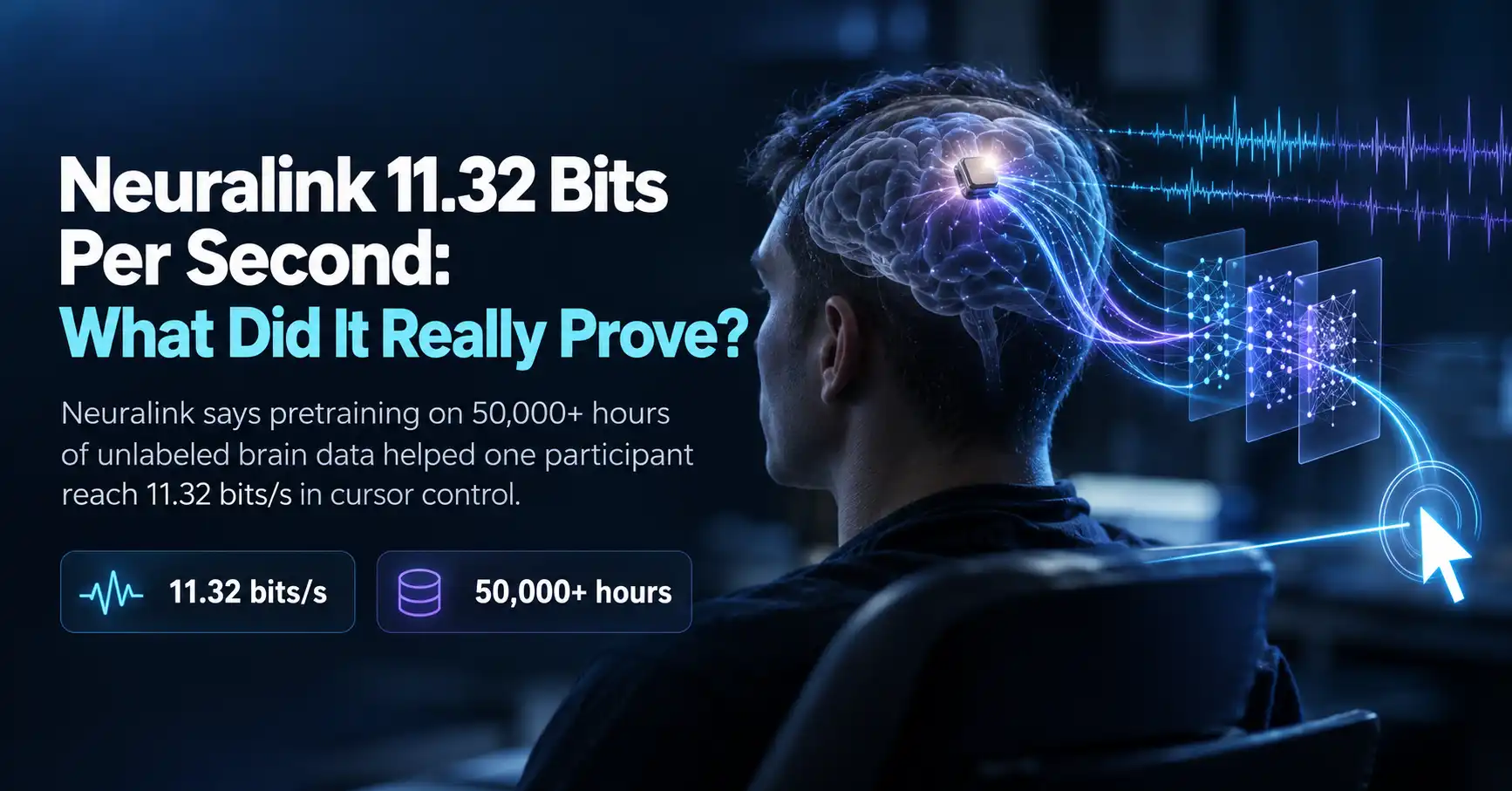
Every brain implant runs on a quiet bargain. You let a machine listen to your neurons, and it tries to guess what you meant to do. On October 1, Neuralink said a trial participant reached 11.32 bits per second in cursor control. The company calls it a record for brain-computer interfaces.
The number got the headlines. So the method deserves them more. Neuralink got there by pretraining on more than 50,000 hours of unlabeled brain recordings. That’s loosely the recipe behind large language models neuralink bits per.
If the approach holds up, “reading the brain” stops meaning a fresh decoder every morning. It starts meaning a model that has learned how one person’s motor cortex tends to behave neuralink bits per.
That’s a real shift. For now, it’s also a company’s own account of its own trial. So it’s worth taking the announcement apart slowly.
What Neuralink announced on October 1
The update arrived as a technical post titled “Pretraining on 50,000 Hours of Unlabeled Brain Data.” Outlets picked it up on October 2, including Interesting Engineering. I couldn’t get the full text of Neuralink’s own page to load, so every figure below comes via outlets that worked from it.
Here are the claims that matter:
- The record: Neuralink says a participant known as P15 hit 11.32 bits per second. Its previous best was 10.39.
- The spread: the median across participants sits around 10 BPS. Six people set personal bests, and three of them beat the old mark.
- The data: more than 50,000 hours of unlabeled neural recordings, gathered over the two years since the trial began. The first participant alone contributed over 9,000 hours, or 22.4 billion neural spikes.
- The chore: recalibration used to average 55 minutes a week, usually about 10 minutes each morning. Some participants now need only about 10 minutes a week.
- The shelf life: decoders once needed refitting every few days. Some now hold up for three weeks or more. One participant still uses a decoder about a year and a half old, and another held 10 BPS for five straight days on the same one.
The most careful breakdown I’ve found is Pebblous’s analysis. It also does the best job of separating what Neuralink reported from what anyone has checked.
One wrinkle. Some coverage says calibration fell from about 10 minutes a day to 10 minutes a week. Other outlets say 55 minutes a week. The two fit together once you notice that 55 minutes is five or six short morning sessions.
Neuralink Hit 11.32 Bits Per Second. What Does That Measure?
Bits per second sounds like a download speed. It isn’t. According to Interesting Engineering, BPS captures how quickly and accurately a user selects the targets they intend to hit. It doesn’t track how fast the cursor flies across the screen. It isn’t a typing speed either. Neuralink says 11.32 bits per second exceeds the performance of most able-bodied people. Interesting Engineering adds that this comparison has not been independently verified. Let’s Data Science offers a sharper caution. Cursor-control rates can come from different tasks, so comparisons across BCI systems are limited. A score from one task design doesn’t translate cleanly to another.
For scale, neuroscientists Jieyu Zheng and Markus Meister argue that the information throughput of a human being is about 10 bits/s. Their paper, “The Unbearable Slowness of Being,” is headed for the journal Neuron. The Register covered it. They listed typing among the activities that run at roughly that rate. Don’t line those numbers up too literally. The tasks and the metrics differ. Still, the comparison reframes the record. A person moving a cursor by intent alone now works at roughly the pace of ordinary human behavior.
That’s remarkable. It also hints that the next bottleneck may be human, not silicon. Zheng and Meister put it bluntly: “One really needs to convey only a few bits per second to and from the brain.”
Neuralink also showed an experimental “teleporting cursor” that predicts the target location directly. It crossed 10 BPS in testing. Click decoding improved too, with fewer accidental clicks.
Why do brain implants need constant recalibration?
Neural signals drift. The pattern of spikes behind the same intended movement can look slightly different from one day to the next. A decoder trained on last week’s brain slowly stops matching this week’s. Interesting Engineering’s section heading puts it plainly: “Brain signals keep shifting.”
Hardware adds its own trouble. In May 2024, Neuralink disclosed that a number of threads have retracted from Arbaugh’s brain in the weeks after his January 2024 implant. That left fewer working electrodes. The company answered in software. It reworked its recording algorithm, its interface and its cursor-translation methods. Every recalibration is time a person spends teaching the machine before they can use it. Fifty-five minutes a week isn’t a disaster. It is a standing appointment with your own implant, though, and that kind of friction decides whether a device feels like a limb or a chore.
Cutting it to about 10 minutes a week, even for some participants, probably matters more to daily life than the extra bit per second. If you want the full chain from electrode to cursor, our explainer on how brain-computer interfaces work walks through it neuralink bits per.
How Neuralink Bits Per Second Connects to Brain Foundation Models
Here’s the method as Pebblous and explainx.ai describe it. Each participant gets a dedicated neural encoder. That encoder trains on thousands of hours of the person’s own recordings, with no labels attached. A small cursor decoder then sits on top of what the encoder learned, and only that final layer needs labeled examples.
The training game is simple to state. Hide half the recording channels, then predict them from the rest. Pebblous names the objective “spatially masked auto-Poisson regression.” The reported architecture is Mamba2, a state-space model, and it treats each spike roughly like a token neuralink bits per.
If that sounds familiar, it should. Large language models learn by filling in hidden words before anyone tunes them for a specific job. Here, spikes stand in for words. Treat that as an analogy, not an identity. Neurons aren’t vocabulary, and nobody knows what a “sentence” of motor cortex activity would look like.
The payoff shows up as efficiency. In one comparison explainx.ai describes, 30 seconds of labeled embeddings matched about 3.5 minutes of raw spikes. The same write-up suggests intention sits in a “stable subspace.” Day-specific noise fades in the model’s middle layers and returns at the output. That’s explainx.ai’s reading, not something Neuralink has confirmed. Here’s the catch most short coverage skipped. A language model learns from text written by millions of people. Every real-time result behind Neuralink’s 11.32 bits per second came from a model trained on one participant’s data.
When Neuralink pooled several participants into one decoder, it did no better in real time than the single-person models.
There’s one promising hint. Offline, a model built from participant P9 transferred to P2 with 99% of its weights frozen. It still beat P2’s existing decoder. Tesla North points out that this was a single experiment.
So “foundation model” describes where Neuralink wants to go more than where it stands. A shared model across people remains a stated goal.
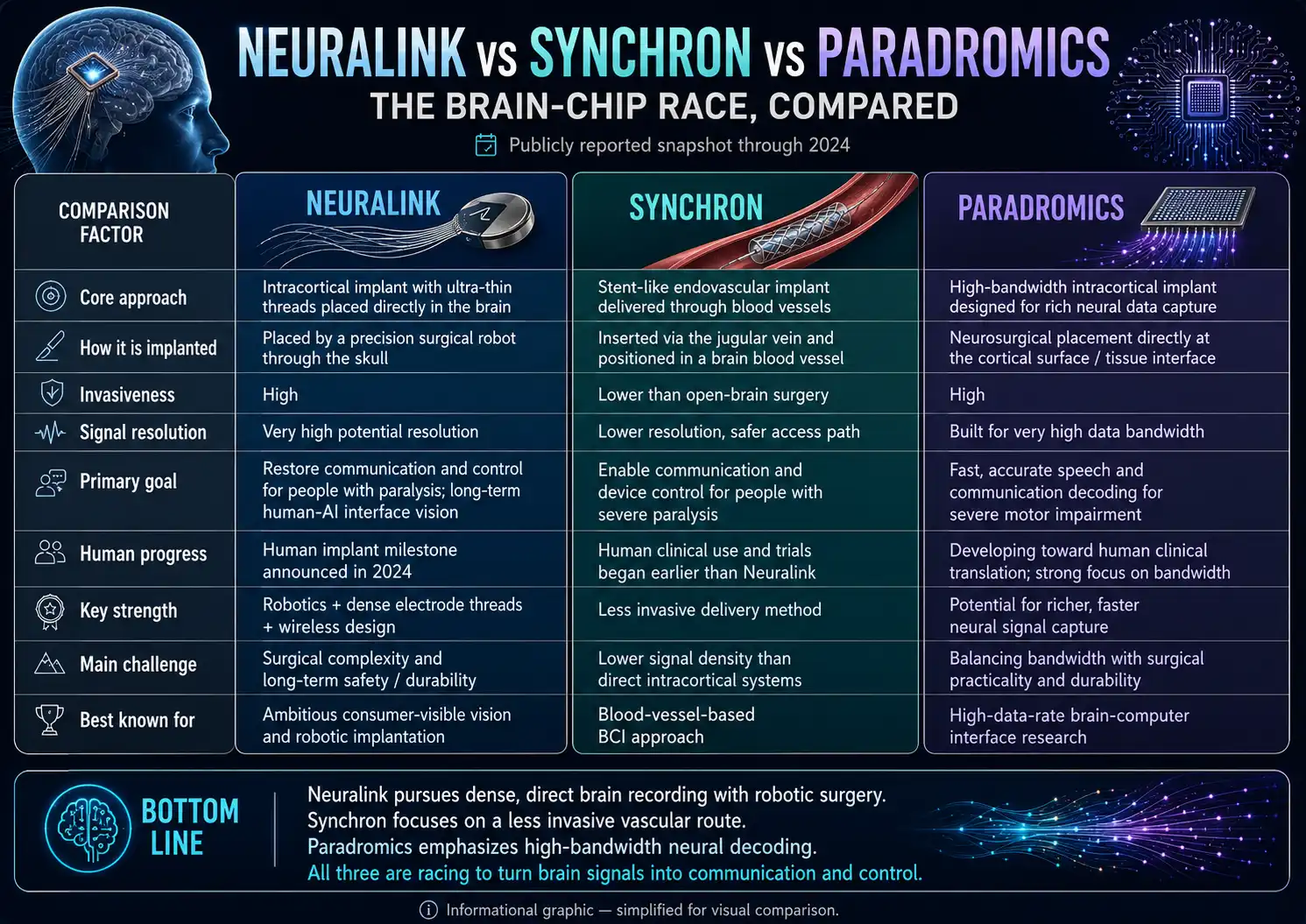
Neuralink isn’t the only company reaching for the label. In March 2025, Synchron CEO Tom Oxley said: “We are building a brain foundation model using generative pre-training techniques that learn directly from neural data.” Synchron’s own release pitched that model, Chiral, as a plan rather than a finished product. For how the hardware compares, see our Neuralink vs Synchron vs Paradromics breakdown.
What’s Confirmed, Company-Reported, and Unknown About Neuralink Bits Per Second
Sorting the claims into piles helps.
Company-reported (which means all of it, for now)
- Every Neuralink figure in this post traces back to the company itself.
- No peer-reviewed paper exists yet, and nobody has independently replicated the results.
- The device is investigational, not an approved product.
- Tesla North notes the update doesn’t describe sample size or study design.
True, but narrow
- Neuralink reports 11.32 bits per second for one participant. The median sits around 10.
- The drop to about 10 minutes of calibration a week applies to some participants, not all.
- The P9-to-P2 transfer happened once, offline.
- Teleportation mode is still experimental.
Unknown
- How much the 50,000 hours themselves contributed. Neuralink hasn’t published performance broken down by data volume, so nobody can isolate the effect of scale.
- Whether a shared decoder can beat per-person ones in real time.
Does more brain data always help?
Outside research says not automatically. A 31-author team from Carnegie Mellon, Northwestern, Pitt and other institutions built NDT3, described in A Generalist Intracortical Motor Decoder. They pretrained it on 2,000 hours of data from more than 30 monkeys and humans.
Adding data didn’t help unless the model grew too. A 45-million-parameter version saturated, while a 350-million-parameter one kept improving. Pretraining helped most when little downstream data existed. Its benefit largely vanished at about 1.5 hours of downstream data. The authors argue that scaling alone probably won’t fix sensor variability neuralink bits per.
A September 2026 preprint called iBrain tested pretraining at 500, 1,000, 2,000 and 7,160 hours. Gains were modest and shrank past 2,000 hours. Its authors suggest that recordings from the same person and session repeat themselves, so real diversity grows more slowly than the hour count. Nobody has peer-reviewed it yet neuralink bits per.
Pebblous observes that 50,000 hours sits far past iBrain’s saturation point. Without Neuralink’s breakdown, though, that proves nothing either way.
Does this change what “reading the brain” means?
I think it does, just not in the way the headline suggests.
For years the routine went like this. Record a person’s signals, fit a decoder, watch it decay, fit it again. Pretraining tries to build something steadier: a learned picture of how one person’s motor cortex expresses intent, one that survives the drift underneath. If intention really does live in a stable subspace, the machine isn’t reading signals so much as modelling a person.
Neuralink’s stated next steps push further. It wants one-shot and zero-shot calibration, a shared drift-resistant foundation model across participants, and what it calls an “API for the motor cortex.” explainx.ai stresses that the API is a long-term vision, not a product. Neuralink itself says decoders that last a year or more would need to adapt as signals change. That problem remains open.
Now the part I haven’t seen any coverage take up, so read it as my analysis rather than reporting. A shared model improves by pooling many people’s neural recordings. That turns those recordings into a training asset, much as our public writing became one for chatbots.
Who owns a model that learned from your motor cortex? Can you pull your hours back out of it? We’ve asked versions of that question about minds living in the cloud. They stop being hypothetical once a company’s product gets better with every participant it adds.
My read: of all the numbers Neuralink published, 11.32 bits per second matters least. The calibration figures matter more to the people living with these implants. The pooled-decoder result matters more to the “foundation model” story. Watch for two things next: a peer-reviewed paper and a curve showing performance against hours of data. Until both exist, Neuralink has an encouraging method and an unaudited scorecard.