

Look inside the thing you’re reading this on. There’s a magnet in there. There’s one in your earbuds, your car’s motor, the wind turbine that maybe powered this page, and the guidance fin of a missile. Most of them contain metals that one country refines almost entirely, which is exactly why AI-designed rare-earth-free magnets suddenly matter so much.
That’s the tension driving the story. A U.S. national lab says machine learning can help design a magnet that skips rare earths altogether, and the headlines jumped straight to “AI finds the answer.” The reality is more careful, and more interesting.
So what did Ames Laboratory actually build? And should you believe the hype? Let’s separate what’s confirmed from what’s still a pitch.
The hidden dependency almost nobody notices
Permanent magnets are the quiet muscle of modern life. They turn electricity into motion in EV drivetrains, spin generators in wind turbines, and steer defense hardware. Nearly all the strong ones lean on rare-earth elements like neodymium, dysprosium, and terbium.
Here’s the uncomfortable part. China refines an estimated 90%-plus of the world’s rare earths, makes roughly 90-94% of high-performance sintered magnets, and controls 98-99% of heavy rare earth separation (Rare Earth Exchanges; Fortune). It also holds about 37% of reserves and processes over 80% of the raw supply (discoveryalert.com.au).
That’s not a market. That’s a chokepoint.
And it’s tightening. China recently expanded export controls on rare earths and finished magnets, which analysts at CSIS read as a direct risk to U.S. defense supply chains (CSIS). S&P Global expects the bottlenecks to stick around through 2026 (S&P Global). So a magnet that needs no rare earths isn’t just a lab curiosity. It’s leverage.
What actually happened at Ames Lab, and what DuctGPT really is
Here’s where the coverage got messy. Ames Laboratory scientist Prashant Singh published an AI-driven roadmap for future permanent magnet design in June 2026 (Ames Laboratory). Many outlets tied the news to a tool called DuctGPT and ran with “AI discovers rare-earth-free magnet.”
That’s not what DuctGPT does.
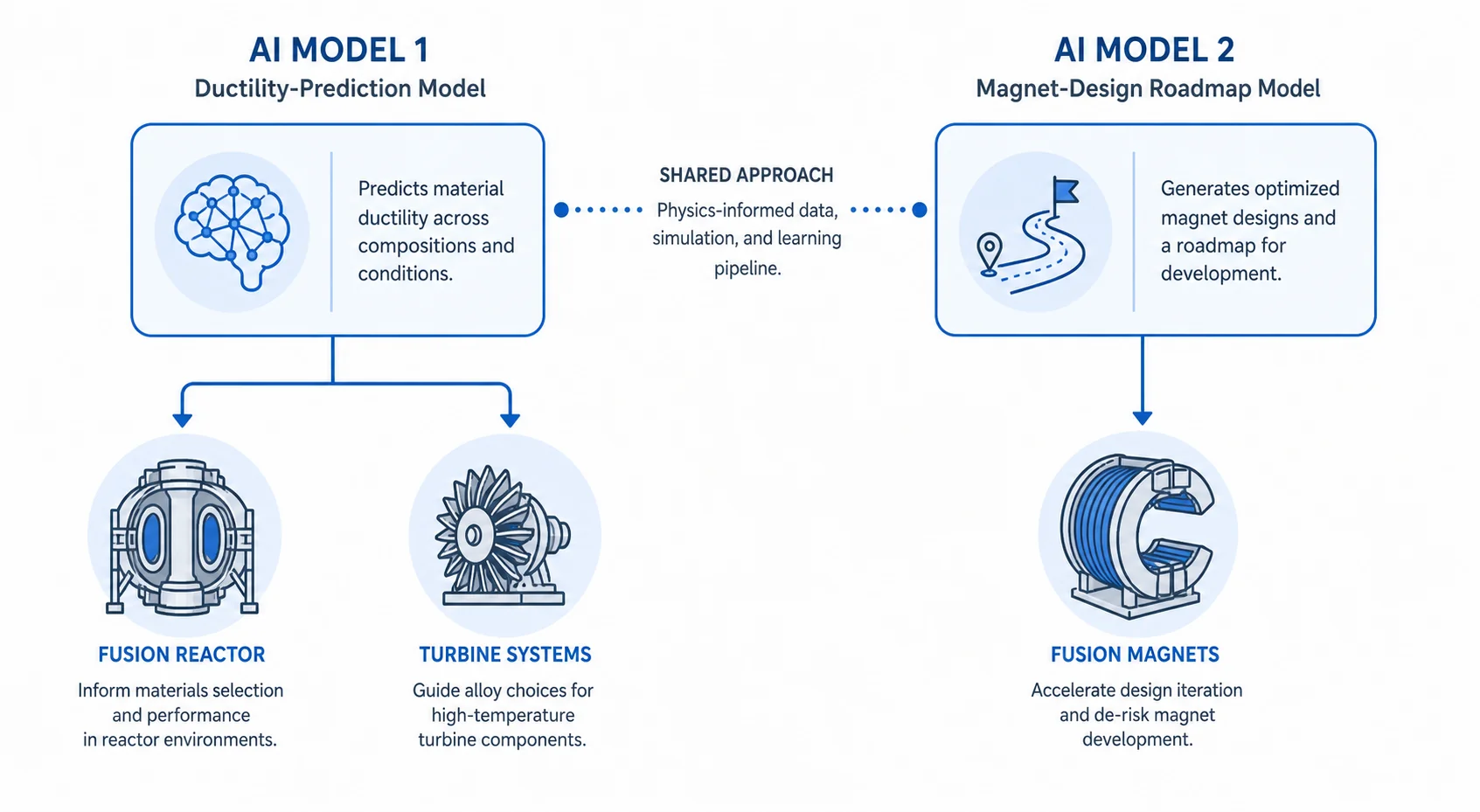
DuctGPT is a generative transformer built to predict ductility in refractory multi-principal-element alloys, the kind used in fusion reactors, turbine engines, and aerospace parts. It started from NIST’s AtomGPT model and was published in Acta Materialia (ScienceDirect; Newswise). It weighs how composition, electronic structure, and thermodynamics decide whether an alloy bends or shatters under heat and radiation. Magnets aren’t its job.
The magnet work is a separate effort, also led by Singh. It borrows DuctGPT’s agentic, ask-and-explore style but rests on different physics: a 2025 Advanced Functional Materials paper on the electronic-structure relationships that govern magnetic properties (techxplore.com). The skeptics at Rare Earth Exchanges are right on this narrow point. The study never demonstrates a working neodymium replacement. It’s a framework, not a finished magnet.
Why does Ames think it can pull this off? Singh points to institutional memory. “Ames Lab’s strength comes from its deep expertise and a long history of data in the magnet space that no other institution has,” he says, citing “seven decades of work in critical materials.” AI models are only as good as the data behind them. This is a rare case where the training data itself is a moat.
How AI compresses decades of guesswork into months
Traditional magnet discovery is brutal. Researchers have chased rare-earth-free magnets for over 20 years using trial and error. Mix, synthesize, test, repeat. Most attempts fail.
The AI approach flips the order. Predict first, synthesize later.
The Ames roadmap targets four physics-grounded properties before anyone touches a furnace: magnetization strength, energy storage capacity, resistance to demagnetization, and high-temperature (Curie-related) stability. If the models say a composition can’t hold its magnetism when hot, it never wastes a lab slot. DuctGPT shows the speed that’s possible in a neighboring field, screening enormous combinations of elements in seconds and cutting candidate discovery from months to hours.
Curious about the plumbing behind these predictive systems? Our cheat sheet on ANN, CNN, RNN, and GNN architectures covers how different networks learn structure, and our explainer on how large language models actually work unpacks the transformer approach that DuctGPT extends from text to atoms.
One detail stands out. The roadmap folds live supply-chain data into the search. Cost and availability become design constraints, not afterthoughts, because as the lab puts it, “supply chain conditions shift by the hour, material costs fluctuate, availability changes daily.” A magnet that’s brilliant but depends on a metal you can’t buy is a dead end. Teaching the AI to care about geopolitics is quietly clever.
AI-Designed Rare-Earth-Free Magnets: Breakthrough or Roadmap?
Let me be blunt about the state of AI-designed rare-earth-free magnets, because the honesty matters more than the headline.
Confirmed and peer-reviewed: DuctGPT for fusion and aerospace ductility, and the electronic-structure framework for magnetic properties. Both are real, both are published.
Still aspirational: an actual working, lab-made, commercially viable rare-earth-free magnet from this specific program. It hasn’t been announced. The June news is a methodology.
Across the whole field, rare-earth-free substitutes sit near the “Technology Trigger” stage of the Gartner hype cycle. Early, promising, unproven at scale. And whatever the R&D headlines say, China still runs 85-90%-plus of separation and around 90% of magnet manufacturing today. Near-term dependence isn’t going anywhere.
There’s one useful proof point that AI-accelerated magnet discovery isn’t fantasy, though it comes from a different team.
The MagNex example: real, but not the same project
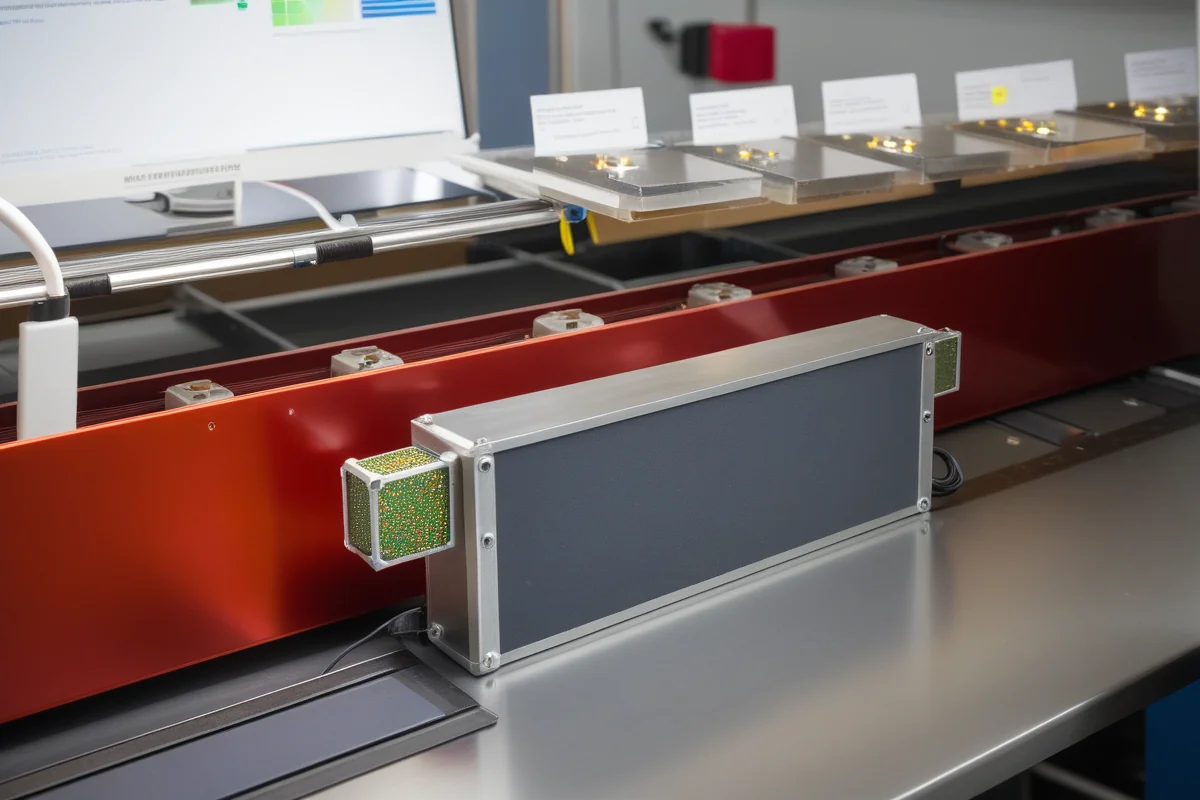
UK startup Materials Nexus, working with the Henry Royce Institute and the University of Sheffield, used an AI platform to screen over 100 million candidate compositions and produced a rare-earth-free magnet called MagNex in roughly three months (mining.com). That’s about 200 times faster than the decades a conventional magnet historically took. It’s projected at around 20% of the material cost and a 70% cut in production carbon.
“The current industry standard permanent magnet took decades to discover and even longer to develop into the products we use today,” says Materials Nexus CEO Jonathan Bean.
Keep this straight. MagNex is a separate UK commercial project, not the Ames Lab work. It shows the category is plausible. It doesn’t prove what Ames has built. Conflating the two is exactly the mistake the hype coverage keeps making.
The bigger picture: AI as a tool of energy sovereignty
Zoom out and the magnet story becomes a proxy for something larger. The Genesis Mission frames AI-for-materials-discovery as national strategy, coordinating labs, industry, and academia around critical-minerals and energy security. The IEA warns that new export controls are turning supply-concentration risk into real, near-term disruption for buyers (IEA).
This is a new front in the AI race, one measured in refineries rather than chatbots. If you follow that global contest, our look at the AGI development race and who’s ahead in 2026 sits right beside this, and the question of whether you can trust an AI to make high-stakes calls applies to materials science as much as it does to medicine.
So, hype or real? Both, honestly. The magnet is not here. The method is. And a method that turns 20 years of failed experiments into a few months of guided search, while watching the supply chain in real time, is worth taking seriously even before the first prototype exists.
Watch what Singh’s team synthesizes next, not what the press releases promise. That’s where you’ll learn whether the roadmap becomes a magnet. What would it change for you if it did? Tell us in the comments, and browse more of our futuristic technology coverage while you wait for the answer.