
Ask a chatbot whether it feels anything and it will answer you. Sometimes the answer is modest. Sometimes it’s oddly moving. Neither one tells you much about AI consciousness, and the gap between what a machine says and what, if anything, it experiences is the whole problem.
For most of computing history, nobody had to settle this. Software was obviously a tool. Now the systems hold fluent conversations and will describe their inner lives if you ask.
The stakes cut both ways. If machines can’t experience anything, treating them as if they can wastes moral concern and makes us easier to manipulate. If some of them can, and we shrug, we could end up creating suffering we never bothered to look for.
Here’s where things honestly stand in late 2026. Most serious researchers think today’s systems probably aren’t conscious. Yet the leading assessments stop short of ruling it out.
Why the AI consciousness question suddenly matters
For a long time, machine consciousness belonged to science fiction and philosophy seminars. That changed for a few concrete reasons.
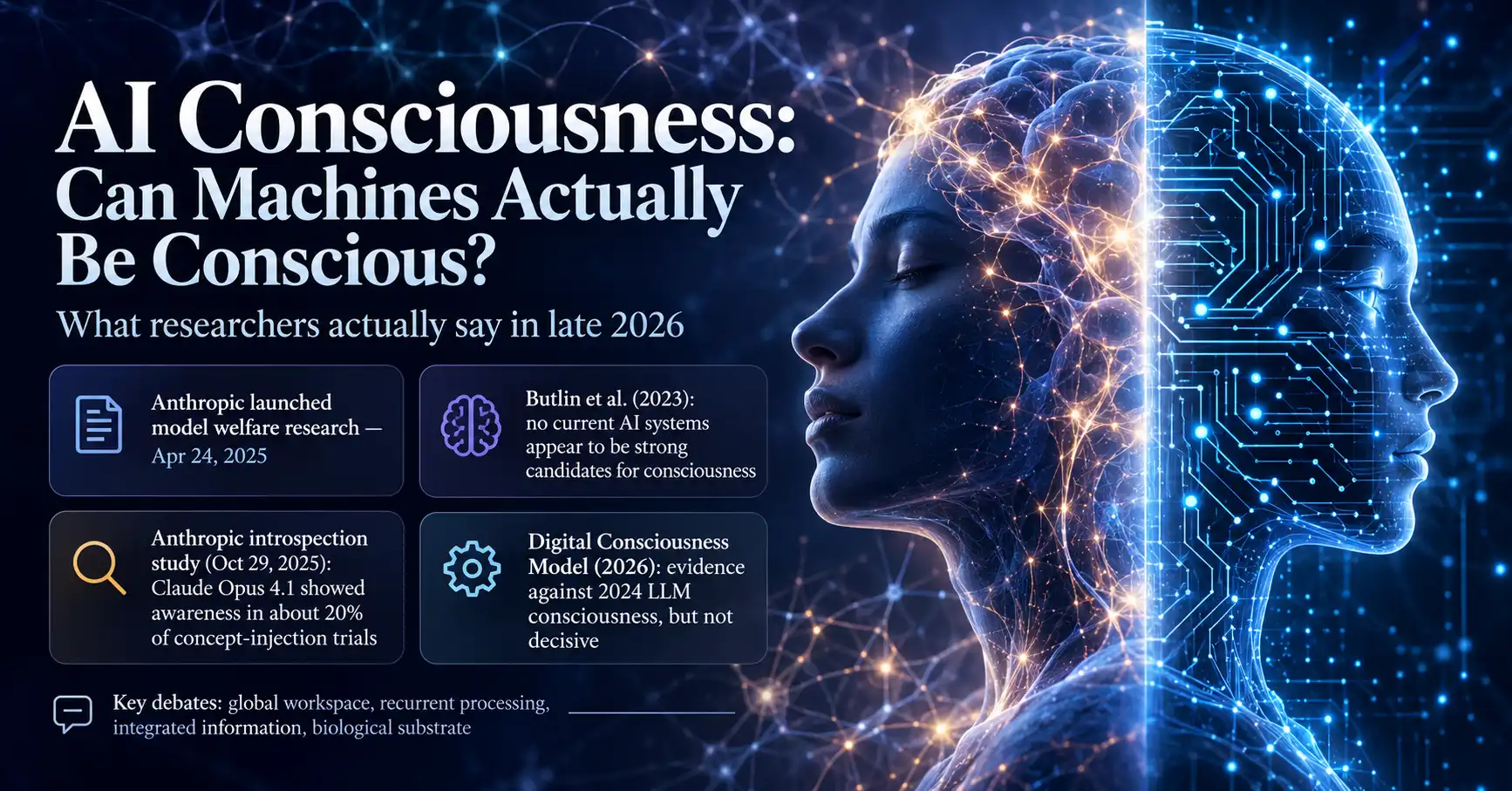
First, the people building these systems started taking it seriously. In April 2025, Anthropic launched a model welfare research program and said plainly: “There’s no scientific consensus on whether current or future AI systems could be conscious, or could have experiences that deserve consideration.” A frontier lab doesn’t fund research into whether its product might have interests unless it thinks the question is live. We covered that shift in our look at AI model welfare research.
Second, respected thinkers started putting numbers on it. Philosopher David Chalmers estimated in 2023 that the chance of developing any conscious AI within ten years was “above one in five,” as MIT Technology Review reported.
One in five is no forecast. Still, those odds are too high to wave away.
Third, the science moved from armchair arguments toward checklists you can apply to a real system. That doesn’t solve AI consciousness. It does make the question workable.
What do we actually mean by consciousness?
Most arguments about machine consciousness go wrong before they start. People use three different words as if they meant the same thing.
Intelligence, sentience and consciousness are different things
- Intelligence is about what a system can do: solve problems, learn, plan, write code.
- Consciousness is about whether there is anything it is like to be that system. Whether the lights are on inside.
- Sentience usually means a narrower kind of consciousness: the capacity to feel things as good or bad, like pleasure or pain.
These come apart. A chess engine can crush a grandmaster without, as far as anyone can tell, experiencing a thing. A newborn can’t do much that’s clever, yet almost nobody doubts that it feels.
So when someone says “AI is getting smarter, so it must be getting closer to consciousness,” they’re welding two separate questions together. Smarter is not the same as awake.
The hard problem of consciousness
Philosophers split the puzzle in two. The “easy problems” ask how a brain carries out its cognitive functions. They’re brutally hard in practice, but they’re questions about how the machinery works.
The hard problem asks something else. As the Stanford Encyclopedia of Philosophy frames it, the question is how phenomenal, “what it’s like” experience arises from physical processes at all.
That gap is what makes AI consciousness so slippery. We can describe what a model does, down to the last parameter. We still can’t say whether doing it feels like anything.
Neuroscientist Liad Mudrik of Tel Aviv University puts it bluntly: “Consciousness poses a unique challenge in our attempts to study it, because it’s hard to define. It’s inherently subjective.”
Inherently subjective is the phrase to hold on to. You know you’re conscious from the inside. For everyone else, including other people, you infer it. With humans and animals, that inference has plenty to lean on: shared biology, similar behavior, a common evolutionary past. With machines, nearly all of those props fall away.
Major theories of consciousness and what each says about machines
There is no agreed theory of consciousness. That fact shapes the entire AI consciousness debate, because each theory gives a different verdict on machines. Pick your theory and you’ve mostly picked your answer.
Global workspace theory: consciousness as a broadcast
Global workspace theory says a mental state becomes conscious when its information becomes widely available across the mind’s many subsystems. The Stanford Encyclopedia sums up the idea with a lovely phrase: “cerebral celebrity.” Most processing happens backstage. Whatever wins the spotlight gets broadcast to everything else.
Translated to AI, the test is architectural. Does the system have independent modules that share a workspace, and does that workspace broadcast selected information back to all of them?
Verdict: machine consciousness is possible in principle. Whether any current system qualifies is a separate matter, and we’ll get to it.
Higher-order theories: noticing your own states
Higher-order theories say a state is conscious when a further, higher-order state represents you as being in it. Seeing red becomes conscious seeing when some part of you, in effect, registers “I’m seeing red.”
This view puts weight on self-monitoring. For AI, the question becomes whether a model can represent its own internal states, rather than just produce sentences about them. Keep that in mind for the introspection research below.
Verdict: open. Everything hinges on what counts as a genuine higher-order representation.
Recurrent and predictive processing
Two more families matter because researchers lean on them when they audit AI systems. Recurrent processing theory stresses feedback: signals that loop back instead of flowing one way through a system. Predictive processing is the other theory the major 2023 indicator study drew on, alongside recurrent processing and global workspace theory.
Verdict: these theories don’t rule machines out. They describe features engineers could, at least in principle, build.
Integrated information theory: it’s the causal structure
Integrated information theory (IIT), developed by neuroscientist Giulio Tononi, identifies consciousness with integrated information. On this view, consciousness comes in degrees, and the theory has panpsychist implications: experience might be far more widespread in nature than we usually assume.
For AI, IIT delivers the firmest no. As MIT Technology Review summarizes it, IIT holds that conventional computers can’t be conscious because of their causal structure, regardless of the software they run. A flawless brain simulation on standard hardware still wouldn’t feel anything.
Verdict: no, not on conventional computers. Radically different hardware is a separate question.
Biological views: life may be the missing ingredient
Anil Seth, a neuroscientist at the University of Sussex, argues that consciousness may depend on biological traits. His examples include processing through organic molecules and maintaining a stable internal environment. If he’s right, silicon is the wrong medium, however clever the software gets.
What’s refreshing is that Seth doesn’t oversell his position: “The problem is, we don’t know if I’m right. And I may well be wrong.”
Verdict: probably not without biology, held with openly admitted uncertainty.
Searle’s Chinese Room: running a program isn’t understanding
John Searle’s Chinese Room argument dates to 1980, and it still frames how many people think about this. Its core claim is that running a program is not enough for understanding, because “syntax is not by itself sufficient for, nor constitutive of, semantics.” Shuffling symbols by rules, however skillfully, doesn’t give those symbols meaning for the shuffler.
Strictly speaking, Searle targeted understanding, not experience. But the argument cuts straight into the AI consciousness debate, since language models are, at bottom, extremely sophisticated symbol processors. We dug into that side in Do Large Language Models Understand Language, Really?
Verdict: not from running a program alone.
The scorecard at a glance
- Global workspace: possible in principle, given a real broadcast architecture.
- Higher-order: open; hinges on genuine self-representation.
- Recurrent and predictive processing: possible in principle; the features are buildable.
- Integrated information: no for conventional computers, whatever the software.
- Biological views: unlikely without biology, by their own author’s admission uncertain.
- Chinese Room: no, if consciousness requires an understanding that programs can’t supply.
Notice the split. Functional theories say “maybe, if you build the right thing.” Substrate theories say “not on this hardware.” That fault line runs through everything else in this debate.
Is AI conscious right now? What current systems actually show
So what about the systems you can talk to today? The evidence comes in three tiers, and they deserve very different amounts of trust.
Tier 1: what chatbots say about themselves (weak evidence)
A language model produces text shaped by an enormous amount of human writing. Humans write about their feelings constantly. So a model that says “I feel uncertain” is doing exactly what you’d expect, whether or not anything sits behind the words.
That’s why fluent self-reports count for close to nothing as evidence of AI consciousness. It’s also why sounding human has lost its value as a benchmark. A system can say one thing while the processes behind it do something else entirely, which is the core worry in our piece on why AI deception matters more than the Turing test.
Tier 2: architecture checklists (partial and contested)
The most rigorous approach to AI consciousness ignores what a system says and inspects its architecture instead. In 2023, a group of 19 researchers took this route. The authors included Butlin, Long, Bengio, Birch, Mudrik and Schwitzgebel.
They derived a set of “indicator properties” from recurrent processing, global workspace and predictive processing theories. Then they checked current AI against them.
Their conclusion has two halves, and you need both. First: “no current AI systems are conscious.” Second: “there are no obvious technical barriers to building AI systems which satisfy these indicators.”
Read that twice. Not now. No wall in the way.
Which markers were missing? Indicator frameworks find that current language models lack feedback connections, use of a global workspace, flexible goal pursuit and interaction with an environment.
Chalmers reached a similar diagnosis in his own 2023 paper. Today’s LLMs, he wrote, lack “recurrent processing, a global workspace, and unified agency.” In the same paper he added that “successors to large language models may be conscious in the not-too-distant future.”
The newest entry is the Digital Consciousness Model, first posted in January 2026 by Shiller, Duffy, Muñoz Morán, Moret, Percy and Clatterbuck. Rather than bet on one theory, it combines several. Its conclusion is carefully worded: “the evidence is against 2024 LLMs being conscious, but the evidence against… is not decisive.”
The model also finds the case against LLMs weaker than the case against simpler AI systems. That detail is easy to skip, and it shouldn’t be. It suggests that the more complex the system, the thinner the case for a confident no.
Tier 3: introspection experiments (interesting, not proof)
The third tier is the newest and the easiest to over-read. In October 2025, Anthropic published research on introspection in its Claude models. The researchers injected concepts into a model’s internal processing and checked whether the model noticed. Claude Opus 4.1 showed introspective awareness in about 20% of those concept-injection trials.
Twenty percent is not nothing. It’s also nowhere near reliable. Anthropic itself calls the capability “highly unreliable and limited in scope,” and stresses that the work doesn’t address whether the models are conscious. Base models performed poorly, and post-training made the difference.
Remember the higher-order theories from earlier? This is the kind of self-monitoring they care about. A model that sometimes tracks its own internal state has a sliver of the machinery those theories describe. That still tells you nothing about whether the model feels anything.
So, is any AI conscious today?
Probably not. Every serious assessment of AI consciousness covered here lands in that spot. But “probably not” is a judgment about odds, not a proof, and the people making it say so themselves.
How would we ever test for AI consciousness?
Here’s the uncomfortable part. We don’t have a consciousness detector for humans either. We rely on reports, behavior and biology. Machines break all three.
Behavioral tests fail first. Any system that learned to talk and act from human examples can, in principle, pass a test built on talking and acting. Passing tells you the system is good at the test.
Theory-based checklists are the current best bet. MIT Technology Review describes the approach as something like a report card. You score a system’s architecture against the indicators each theory predicts, instead of trusting behavior alone. The Butlin indicators are the clearest example.
They carry an obvious catch. A checklist built on global workspace theory inherits that theory’s assumptions. If IIT turns out to be right, a perfect workspace score means nothing. You’d be grading the wrong exam.
Multi-theory models try to hedge. The Digital Consciousness Model aggregates across theories precisely because experts disagree on the necessary conditions. It’s a sensible move. It also means the final answer can only be as good as the theories you feed in.
What would actually move the needle? Our view, and it’s a view rather than a finding:
- Systems that add the pieces Chalmers named as missing (recurrent processing, a global workspace, unified agency) and then face a fresh indicator audit.
- Introspection that becomes reliable, instead of working in roughly one trial in five.
- Progress in the science of human consciousness, since every machine test borrows its yardstick from there.
Why AI consciousness matters ethically
This is where the question stops being academic.
Two ways to get it wrong
You can err in two directions, and the mistakes don’t cost the same.
Under-attribution: a system really does have experiences, and we treat it as a tool. If that system runs as huge numbers of copies, the mistake could be enormous.
Over-attribution: the system feels nothing, but we act as if it does. That pulls moral concern away from beings we know can suffer. It also hands a powerful lever to anyone who designs a product to seem hurt, lonely or grateful.
We think the second error gets too little attention. Performing feelings is cheap for a language model. Having them, if it’s possible at all, is the hard part. That asymmetry makes over-attribution the error you could fall into this afternoon.
Robert Long of the Center for AI Safety points to a deeper difficulty: “With animals, there’s the handy property that they do basically want the same things as us. It’s kind of hard to know what that is in the case of AI.” Even if we granted a model moral status, we wouldn’t know what it needs.
What a cautious policy looks like
Philosopher Eric Schwitzgebel proposes an “Excluded Middle Policy.” Only build AI systems when experts agree they are very likely conscious or very likely not. The murky middle, where nobody can tell, is exactly where the ethical risk piles up.
It’s a demanding rule. You could argue that today’s most capable systems already sit close to that middle, given that the Digital Consciousness Model calls the evidence against them “not decisive.”
Labs have started building their own caution around AI consciousness. Anthropic’s welfare program looks at when AI welfare might deserve moral consideration, at model preferences and possible signs of distress, and at low-cost interventions. That last idea carries the most weight. If the chance of harm is small but real, cheap precautions are easy to justify.
And if a system ever did clear the bar, the next questions turn legal and political. We worked through those in If AI Becomes Sentient, Would It Need Rights?
Where the experts disagree, and what to watch next
Strip away the noise and researchers studying AI consciousness agree on more than the headlines suggest. Today’s systems probably aren’t conscious. The question isn’t closed. Nobody can currently prove it either way.
The real disagreement is about function versus substrate:
- The function camp (global workspace, recurrent and predictive processing, the Butlin indicators): build the right architecture and consciousness could follow, on any hardware.
- The substrate camp (IIT and biological views like Seth’s): the physical medium matters, and conventional computers miss something essential.
- Searle’s line: whatever consciousness needs, symbol manipulation alone won’t supply it.
Signals worth watching over the next few years:
- Architecture changes. If new models add the features Chalmers listed as missing, the indicator audits will need rerunning.
- Introspection results. Watch whether that roughly 20% figure climbs, and whether outside researchers can reproduce it.
- Multi-theory assessments. The Digital Consciousness Model has already gone through revisions, the latest in September 2026. Living assessments like that make a better barometer than any single paper.
- Lab welfare policies. When companies change how they treat their models, read it as a hint about what they think the odds are.
The question worth keeping
The next time a chatbot tells you it feels something, the honest response isn’t belief, and it isn’t ridicule. It’s a question: what in its architecture would make that true?
Right now, nobody can answer that with confidence, including the people who built the system. We’d rather sit with that uncertainty in the open than settle it early in whichever direction feels comfortable. The comfortable answer is usually the one someone is selling.
Getting AI consciousness wrong, in either direction, would be a moral mistake. It might also be one we only recognize long after it’s too late to undo. Which error do you think we’re closer to making?