

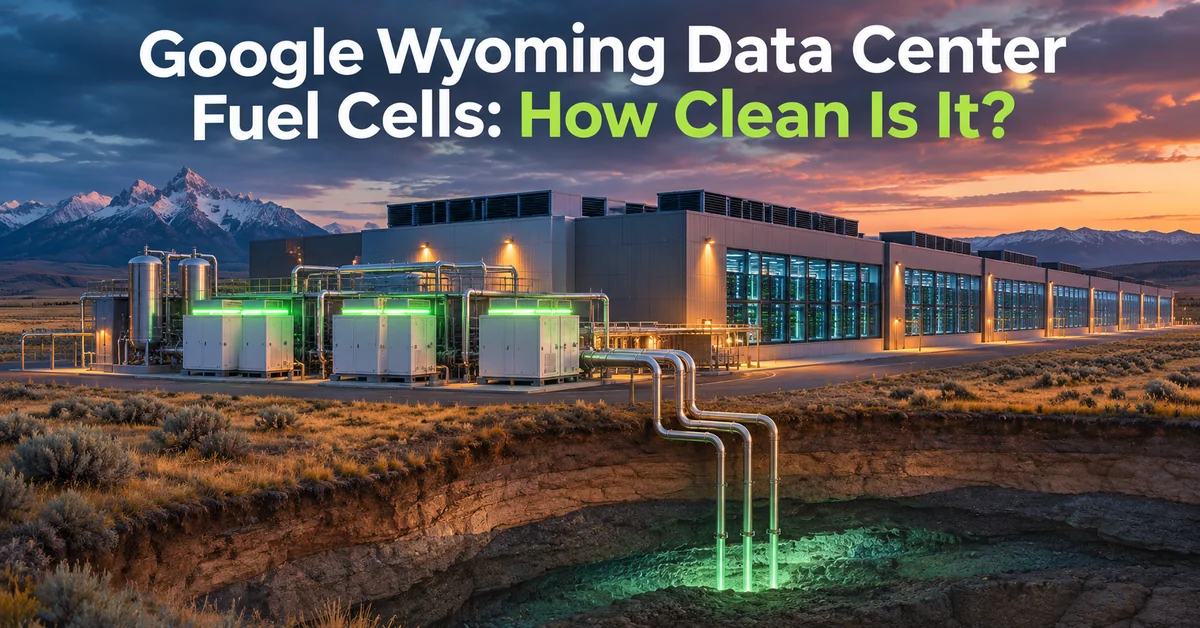
Every AI answer you get draws electricity from somewhere, and someone decides what kind. For the Google Wyoming data center fuel cells Google announced on November 5, that call belongs to a utility, a fuel-cell maker and a pipeline company. Their answer is natural gas, run through fuel cells, with a promise to bury most of the carbon underground.
That’s a more honest answer than “100% clean” would be. It’s also a less complete one than the headlines suggest.
Google’s announcement leaves out the numbers that decide whether this is a climate step forward or a gas plant with good branding. So here’s what the company confirmed, what came only from its partners, and what nobody has said yet.
What Google confirmed in Wyoming
On November 5, Steve Walter, Google’s VP of global infrastructure and energy, announced a $17 billion long-term investment near Cheyenne (Google’s announcement). The site sits in Laramie County. It’s the company’s first data center in the state.
The Google Wyoming data center fuel cells grabbed the headlines, but the full power plan has more moving parts:
- 702 MW of fuel cells, developed under a contract with AEP. Google calls it the largest planned project of its kind and the first at commercial scale.
- Bloom Energy builds the cells in the US. They run on natural gas.
- Existing gas generators, operated by Tallgrass Energy and Black Hills Energy, add more power.
- Carbon capture: Google says the project will capture “most” of its emissions and store them at Tallgrass’s Eastern Wyoming Sequestration Hub.
- Air cooling, which Google says eases the strain on local water.
Google also says it will pay for 100% of the power the site uses. It expects hundreds of millions of dollars in property taxes for Laramie County and School District 1. There are STEM, K-12 and skilled-trades grants, plus a Community Council in the works after more than 200 residents came to a community meeting. Related Digital rounds out the partner list.
The $4 billion isn’t Google’s money
Some coverage has framed this as Google and AEP “co-investing” $4 billion. That’s wrong. According to Data Center Frontier, AEP plans to put about $4 billion into the plant through an entity called Cheyenne Fuel Cell LLC. AEP owns about 92% of it. Funds advised by Basalt Infrastructure Partners own the rest.
Google is the customer, under a 20-year power purchase agreement.
That distinction matters more than it looks. Google buys the power; it doesn’t own the plant. Whatever capture performance the partners have promised each other lives in contracts the public won’t see.
Why the Google Wyoming data center runs on fuel cells
Fuel cells turn natural gas into electricity chemically, without burning it, as TNW explains. Bloom’s design uses solid-oxide cells. No flame doesn’t mean no emissions, though. That’s why the capture plan exists at all.
Neither Google nor AEP spells out why they picked fuel cells over drawing from the grid. What follows is our reading, not their explanation.
A dedicated plant gives Google power it controls, on a contract that runs for two decades. It also keeps a 702 MW load off the shared grid, where other customers might end up helping pay for new capacity. Google’s pledge to cover all of its own power points the same way. Who pays for AI’s electricity is turning into a political question, and this setup hands Google a tidy answer.
Speed looks like the other motive. AEP-side reporting has construction starting before the end of 2026 and full operations in late 2028. AEP has been lining up Bloom capacity for a while, too. It signed a deal for up to 1 GW in November 2024, then bought roughly $2.65 billion of equipment in January 2026.
AEP CEO Bill Fehrman framed it this way: “As power demand continues to grow, AEP is bringing together new technologies and strong partnerships.” It’s a careful sentence. It names demand as the driver and leaves the climate case to someone else.
What carbon capture does and doesn’t promise here
This is where the announcement gets thin.
Google says “most” emissions. TNW calls it “a large majority” and points out that nobody has put a number on it. AEP says the plant is “designed to incorporate carbon-capture technology.” Per Data Center Frontier, AEP hasn’t disclosed the capture rate, the equipment supplier or the storage arrangements.
So Google names a storage site, and AEP’s own statements, as reported, don’t. Nobody has to be wrong for that gap to matter. The biggest power source on the site still lacks a public carbon spec.
Then there are the gas generators. Capture on Tallgrass’s combined-cycle turbines remains under study, with a front-end engineering study weighing whether to add it. Part of the supply has no capture commitment yet. TNW’s summary is blunt: most of the power still comes from gas.
None of this makes the project a bad idea. Capturing most of the carbon beats capturing none. But a plant that traps just over half its CO2 and one that traps nearly all of it tell very different climate stories. Right now, you can’t tell which one Cheyenne is getting.
Google says its contracted carbon-capture capacity now reaches nearly 1 GW. Its first gas-with-capture deal came in Illinois in October 2025, according to TNW. Wyoming isn’t a one-off. It looks like a template.
Fuel cells vs the nuclear buildout
Lately, a lot of the AI power story has been a nuclear story. We’ve written about why AI data centers are turning to nuclear power, and that bet hasn’t gone away.
Google’s Wyoming data center fuel cells point to a parallel track. A caveat first: the comparison below is our analysis. None of the sources we reviewed puts the two side by side.
Nuclear’s pitch is zero carbon at the point of generation. The Cheyenne plant runs on fossil gas and asks you to trust a capture system nobody has quantified. What it offers in return is a date. AEP is aiming for full operations by late 2028, about two years out.
If you’re racing to build compute, two years is a number you can plan around.
If this template spreads, the near-term power behind AI may look less like reactors and more like gas with an asterisk. The asterisk is the capture rate. For context on how much electricity AI already draws, see our explainer on how much energy AI uses. The chips driving that demand get their own look in AGI hardware requirements.
What Google hasn’t disclosed yet
Sorting the claims about the Google Wyoming data center fuel cells by who actually made them clears up most of the confusion.
Confirmed by Google:
- The $17 billion investment and the Laramie County site
- 702 MW of Bloom fuel cells under an AEP contract, running on natural gas
- Storage at Tallgrass’s Eastern Wyoming Sequestration Hub
- Air cooling, full payment for its own power, and the tax and grant commitments
Reported by AEP or the press, not Google:
- AEP’s roughly $4 billion investment and the 20-year agreement
- Construction before the end of 2026 and full operations in late 2028 (AEP’s target)
- The name “Project Tembo,” which some outlets used and Google’s post doesn’t
Not disclosed by anyone we could find:
- A capture rate for the fuel cells or the gas generators
- A job count (Google’s post gives none)
- How costs split beyond AEP’s stake
One more loose end. A third-party database, carbonstorage.io, lists Project Tembo at 2.7 GW behind the meter, expandable by 2031 and scalable to 10 GW, with 702 MW as phase one. It also dates the announcement to June 2025, which doesn’t match anything else. We can’t reconcile those figures with Google’s. Treat the bigger number as unconfirmed, not as a hidden expansion plan.
What this means for Cheyenne, and for AI’s footprint
Air cooling answers a local worry directly. TNW reported that in July 2026, Cheyenne halted some data-center water discharges after a Meta contractor released a rare bacterium into a wastewater reuse system. Residents who remember that episode will want more than a cooling diagram.
The upside for locals is real money: hundreds of millions in property taxes, funding that reaches School District 1, and a stack of grants. Google also says it pays for its own power, which should keep the plant’s costs off household bills. No source we reviewed explains how the contracts guarantee that, though.
The cost is a large gas plant in the neighborhood for the length of a 20-year power deal, with its carbon performance taken on trust.
Google’s own line is: “Our promise is to show up today and tomorrow for Cowboy State residents.” A published capture rate would be a good way to keep it. Until Google or AEP puts a percentage and an annual emissions figure on this site, “most” is a word, not a measurement. Our bet is that Cheyenne becomes the blueprint for AI’s next wave of power. Whether that’s good news depends on a number nobody has shared.