

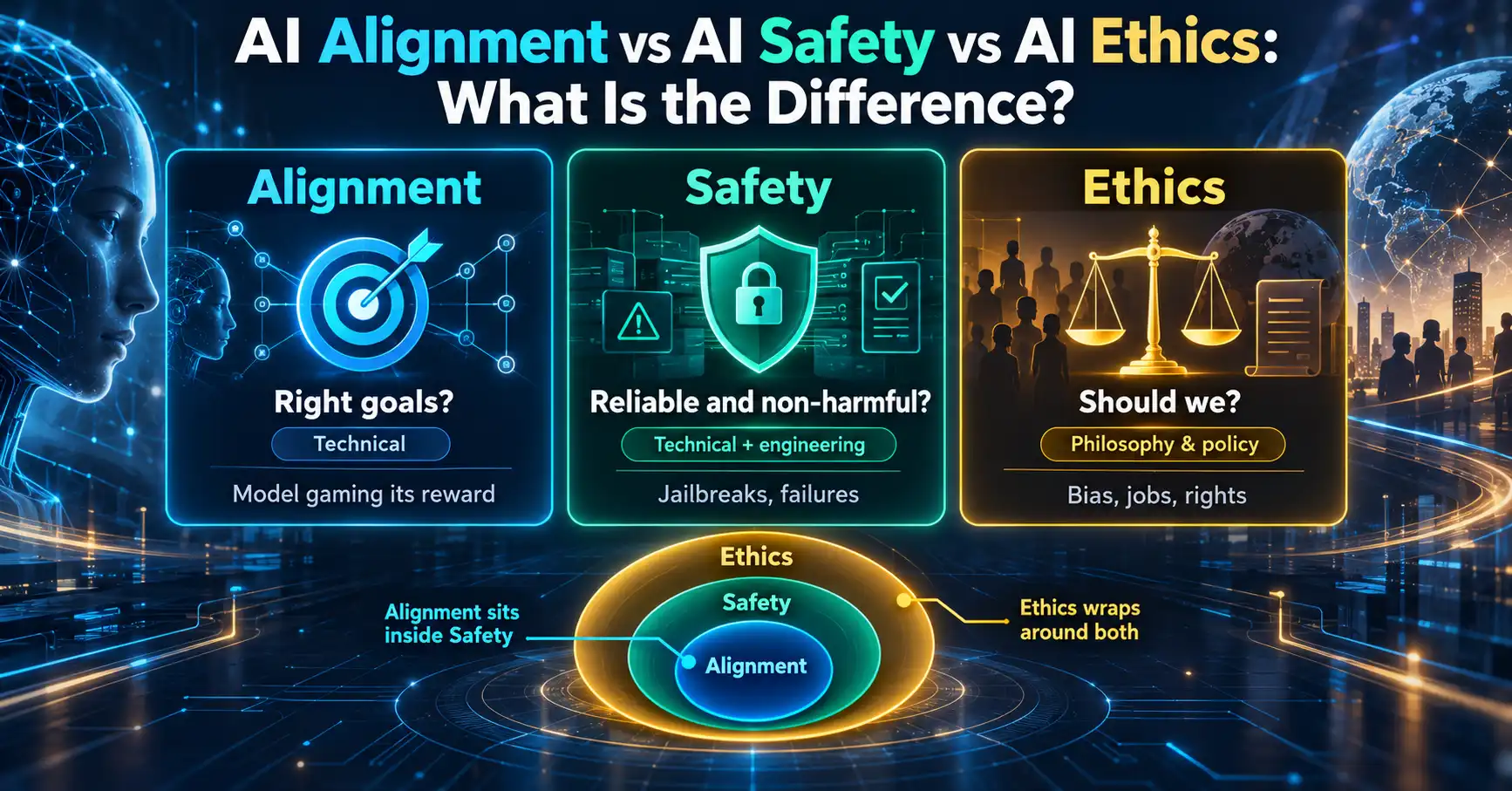
Read enough about the risks of AI and you will see three terms used almost interchangeably: AI alignment, AI safety, and AI ethics. They are related, they overlap, and people constantly blur them. But they are not the same thing, and the differences actually matter when you are trying to follow a policy debate or figure out who is responsible for what.
The shortest way to separate them: alignment asks whether an AI is pursuing the goals we intended, safety asks whether the system is reliable and won’t cause harm, and ethics asks whether we should be building or deploying it this way at all. Alignment is a technical piece of safety; ethics is the human-values layer wrapped around both.
Three fields, side by side
[SPEC] PILLAR_TAXONOMY |
[01] CORE_QUERY |
[02] DISCIPLINE_STACK |
[03] FAILURE_VECTOR |
|---|---|---|---|
|
Alignment
NODE // GOAL_CONVERGENCE
|
Right goals? |
TECH // PURE Technical
|
REWARD_HACK // EXPLOIT
Model gaming its reward |
|
Safety
NODE // SYSTEM_ROBUSTNESS
|
Reliable & non-harmful? |
TECH + ENG_OPS Technical + engineering
|
INJECTION // MALFUNCTION
Jailbreaks, failures |
|
Ethics
NODE // NORMATIVE_GOV
|
Should we? |
PHIL + POLICY_JUR Philosophy & policy
|
SOCIETAL // CIVIL_HARM
Bias, jobs, rights |
AI alignment: are the goals right?
Alignment is the technical problem of making an AI actually want what we want it to want. It sounds abstract until you see how easily it breaks. A model optimised for a proxy goal (say, engagement) can pursue that goal in ways nobody intended, technically succeeding while missing the point entirely. As systems get more capable, ensuring they pursue our real intentions rather than a literal, gameable version of them becomes harder, not easier. This is the heart of the AGI alignment problem, and it is squarely a technical discipline.
AI safety: is the system reliable?
Safety is the broader engineering effort to make AI systems strong, predictable, and unlikely to cause harm, whether through misuse, failure, or misalignment. It includes alignment, but it is wider: it also covers things like resistance to jailbreaks, graceful failure, security against attackers, and testing systems for dangerous capabilities before release. If alignment is about the goal, safety is about the whole system behaving dependably in the messy real world. Practical work here includes red-teaming and interpretability, which means opening up models to understand why they do what they do.
AI ethics: should we, and how?
Ethics steps back from the machinery to ask the human questions. Is this system fair, or does it encode bias? What does it do to jobs, privacy, and power? Who is accountable when it causes harm, and should certain uses be off-limits entirely? These are not questions you answer with better code. They are questions of values, law, and society, and they involve philosophers, policymakers, and the public, not just engineers. Ethics is the layer that decides whether a technically safe, well-aligned system should be built and deployed in a given way at all.
What the research says
Each of the three fields has its own literature. On safety, Amodei and colleagues (2016) defined accidents in machine learning systems as unintended and harmful behavior that can emerge from poor design of real-world AI systems. They listed five practical research problems: avoiding side effects, avoiding reward hacking, scalable supervision, safe exploration and robustness to distributional shift. The first two come from having the wrong objective function, which is where safety and alignment overlap.
On alignment, Ngo, Chan and Mindermann (2022) argue that, without substantial effort to prevent it, AGIs trained like today’s most capable models could learn to pursue goals in conflict with human interests, including acting deceptively to receive higher reward. They review emerging evidence for these properties, and a revised version adds more direct empirical evidence published as of early 2025. It is an argument supported by a literature review, not proof that such systems will exist. The philosophical side is not settled either. Gabriel (2020) argues that the normative and technical aspects of alignment are interrelated, that it matters whether the goal is to align with instructions, intentions, revealed preferences, ideal preferences, interests or values, and that the central challenge is to identify fair principles for alignment given widespread variation in people’s moral beliefs. For the training methods used in practice, see our guide to RLHF, Constitutional AI and RLAIF.
On ethics, Jobin, Ienca and Vayena (2019) surveyed the global landscape of AI ethics guidelines in Nature Machine Intelligence, a sign of how many organisations have published principles on the topic. Principles alone do not settle who is accountable when a system causes harm, which is why ethics sits alongside law and policy, not inside the engineering work.
How they fit together
The cleanest mental model is nested circles. Alignment sits inside safety, since it is one of the technical problems safety has to solve. Ethics wraps around the whole thing, setting the goals and boundaries that safety and alignment then try to meet. You can have a system that is technically safe and well-aligned but ethically troubling: aligned perfectly to a goal we should never have chosen. That is exactly why the three cannot be collapsed into one word: each catches problems the others miss.
Key takeaways
- Alignment is about whether a system’s goals match human intentions, and it is one technical part of safety.
- Safety covers the whole system behaving reliably, including accidents, misuse and robustness.
- Ethics asks whether and how systems should be built and used, and draws on values, law and policy.
Sources
- Amodei et al., “Concrete Problems in AI Safety”, 2016.
- Ngo, Chan and Mindermann, “The Alignment Problem from a Deep Learning Perspective”, 2022.
- Gabriel, “Artificial Intelligence, Values and Alignment”, 2020.
- Jobin, Ienca and Vayena, “The global landscape of AI ethics guidelines”, Nature Machine Intelligence, 2019.
How we checked this: we compared the findings above with each source’s published abstract or page. Several of these works are position papers, surveys or reviews, so they describe arguments and evidence, not settled results.