
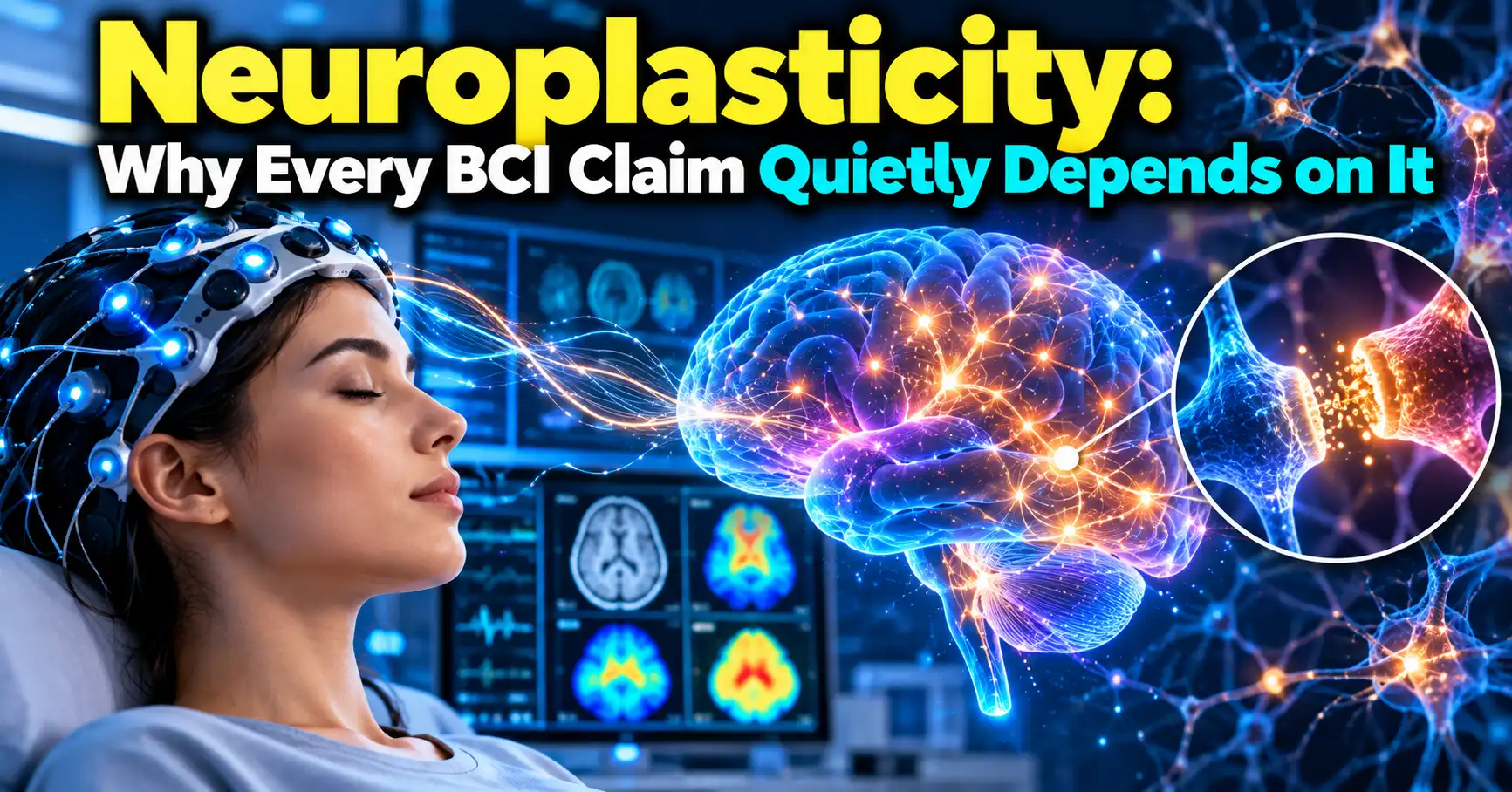
Every few months a headline announces that a brain chip helped someone move a hand again. Another promises a headband that sharpens your focus in minutes a day. The devices differ, but the promise underneath them doesn’t. Each one assumes neuroplasticity, the brain’s ability to rewire itself in response to experience, is real and ready to be switched on.
That assumption mostly holds. The trouble lives in the word “mostly.”
Brain plasticity is solid science. The version that shows up in press releases is a smoother, more obedient thing than the one in the lab, though. And the gap between those two versions decides whether a device helps a stroke survivor or just sells a subscription.
If you want to judge those claims for yourself, you need the mechanism first.
What Is Neuroplasticity, in Plain Terms?
The Cleveland Clinic defines neuroplasticity as your brain’s “ability to absorb information and evolve to manage new challenges.” When you take in something new, your brain forms fresh synaptic connections among its billions of neurons.
Put simply, the brain you have tonight isn’t quite the brain you woke up with. Learn a colleague’s name or a new route to work, and the wiring shifts a little to hold it.
Structural vs. functional plasticity
Clinicians usually split neuroplasticity into two types:
- Structural plasticity. Experience builds pathways that lock in what you’ve learned. Practice is structural plasticity doing its job.
- Functional plasticity. The brain builds new routes around damaged areas to work around an injury or weakness.
Hold on to that second one. It’s the type almost every medical BCI is betting on.
How Does Neuroplasticity Actually Work?
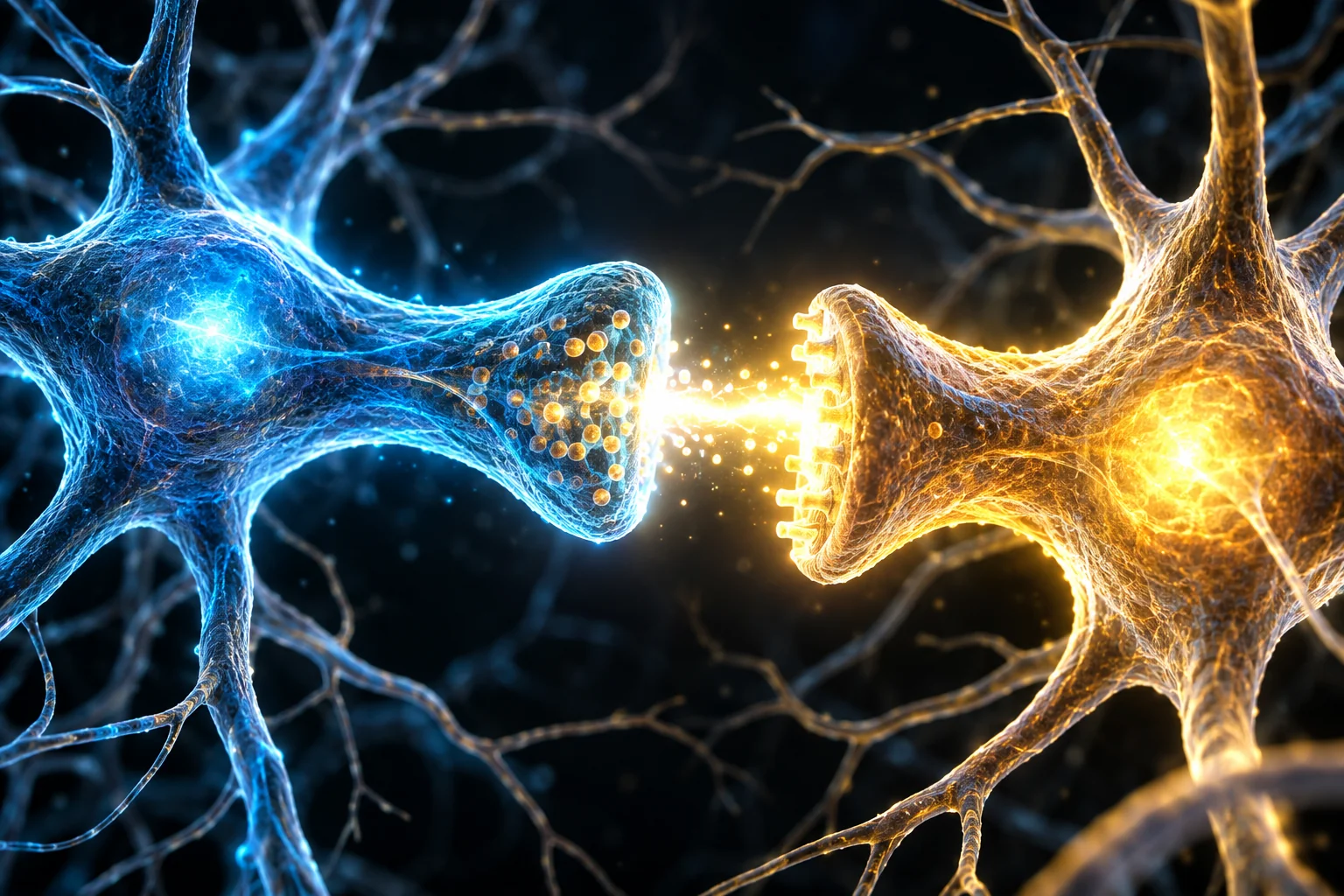
At the level of a single connection, neuroplasticity comes down to two opposing moves. Long-term potentiation (LTP) strengthens a synapse. Long-term depression (LTD) weakens one. Researchers have tied both processes in the hippocampus directly to learning and memory.
“Neurons that fire together wire together”
The rule that coordinates them is Hebbian plasticity. You’ve probably heard the shorthand: neurons that fire together wire together.
When a sending neuron and a receiving neuron fire at nearly the same moment, the link between them gets stronger. When their timing drifts apart, the link fades.
Most explainers treat that as a nice slogan. It’s more than that. Classic Hebbian strengthening plays out over milliseconds, and that tight window turns out to be the single most important engineering fact in rehabilitation BCIs. Keep it in your back pocket.
A 2026 discovery that complicates the textbook
For decades, that millisecond story sat at the center of how people explained memory. Then, in April 2026, Quanta Magazine reported on a different mechanism: behavioral timescale synaptic plasticity, or BTSP.
BTSP lets the brain encode a memory from a single experience. It relies on dendritic plateau potentials, electrical events that act over several seconds instead of milliseconds. Researchers including Jeffrey Magee at Baylor College of Medicine and Christine Grienberger at Brandeis University helped identify it.
Northwestern neuroscientist Daniel Dombeck put it plainly: “It’s pretty clear that [BTSP is] a strong, powerful mechanism that can lead to immediate memory formation.”
Why should a tech reader care? Because it shows the definition of neuroplasticity is still moving. Any company that says it has “cracked” how the brain rewires is claiming more than neuroscientists themselves would.
Does the Brain Stay Plastic for Life?
Short answer: yes. Just not at full strength, and not on autopilot.
The clinical consensus is reassuring on the basics. Adults keep the capacity to form new synaptic connections and reorganize existing circuits throughout life. That capacity holds up best in people who stay mentally and physically active.
The picture gets murkier with neurogenesis, the birth of brand-new neurons. In animal studies, neural stem cells shrink in number and lose some of their ability to divide as the animals age, and neurogenesis slows with them. How closely that maps onto human brains is still an open research question.
That distinction matters more than it looks. Wellness marketing uses neuroplasticity and neurogenesis almost interchangeably. They aren’t the same thing. You can rewire existing connections without growing a single new cell.
So here’s the honest version. An older brain still changes. It just doesn’t hand out change for free.
Why Every Brain-Computer Interface Claim Assumes Neuroplasticity Is Real
It helps to separate two jobs a BCI can do. One kind reads brain activity and routes around damage, turning intent into a cursor movement or a synthetic voice. The other kind tries to help the brain repair itself. If you want the signal-processing side, our guide to how brain-computer interfaces work walks through the full pipeline.
This section is about the second job. That’s where neuroplasticity stops being a metaphor.
The 100–200 millisecond window
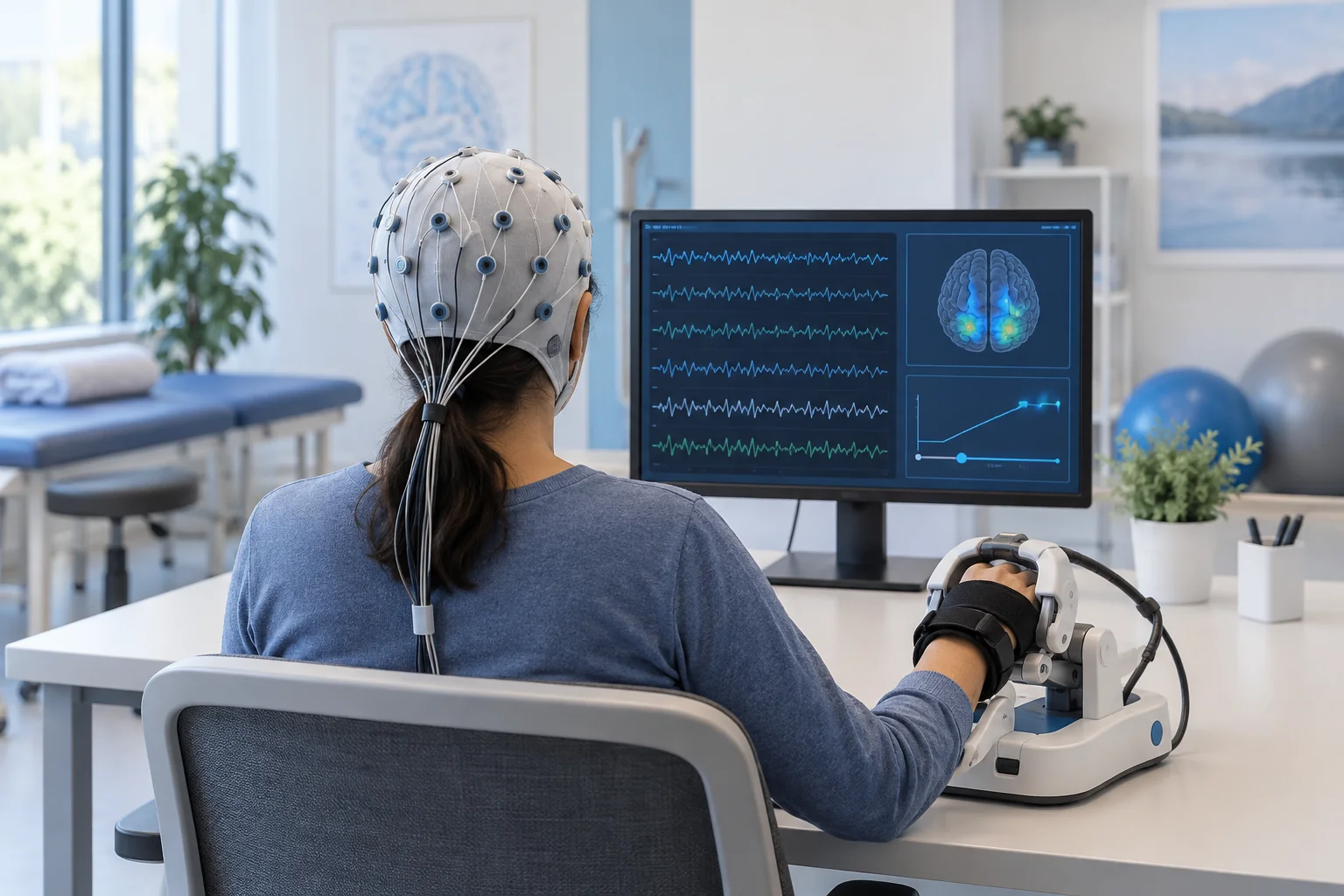
Closed-loop BCIs for stroke rehabilitation follow a simple loop. The system detects a patient’s intent to move, then delivers feedback in response.
The catch is speed. A 2026 review in Frontiers in Human Neuroscience explains that feedback has to land within roughly 100 to 200 milliseconds of the detected intent. Inside that window, it falls within the synaptic plasticity time window and triggers LTP-like strengthening. Miss it, and in the review’s words, “the feedback will fail to effectively activate Hebbian mechanisms.”
This is the load-bearing link. A rehab BCI isn’t vaguely “encouraging the brain to heal.” Engineers build it around a timing constraint that comes straight out of Hebbian plasticity. If neuroplasticity didn’t behave the way the research describes, the device would have nothing to work with.
What the stroke evidence shows
The results are real. The same review cites a meta-analysis of 476 stroke patients who used multimodal closed-loop BCI rehab. It found a moderate effect size, a standardized mean difference of 0.53.
Transcranial magnetic stimulation also picked up motor-evoked-potential amplitude increases of 62–79% after the intervention. In plain terms, patients’ motor pathways responded more strongly once treatment ended.
And what it doesn’t show
The review is candid about the limits:
- Most published randomized trials enroll fewer than 20 participants per arm.
- Few use active-sham controls, the comparison that separates a real effect from expectation.
- Only one study has followed neuroplastic gains out to 4.5 years. Long-term durability remains largely unproven.
A separate 2026 review in Frontiers in Neurology adds a harder ceiling. Between 15% and 30% of stroke patients can’t generate stable, decodable EEG signals at all. For them, an EEG-driven system has nothing to latch onto.
Safety looks acceptable so far. Non-invasive systems mostly caused mild problems like headache and fatigue. Invasive systems logged about 5.6 adverse events per 1,000 device-days, with no reported deaths.
So I’d read any “brain chip restores movement” headline with two questions in mind. How many patients? And for how long? The mechanism deserves your trust. The durability claims haven’t earned it yet. We’ve tracked where implant claims actually stand in neural implants for paralysis in 2026.
Why Cognitive-Augmentation Claims Lean on Neuroplasticity Too
Consumer brain tech makes a softer promise than a rehab BCI. It borrows the same logic anyway. A focus headband, a brain-training app and a stimulation wearable all imply that the right stimulus will push your brain to reorganize in a useful direction.
That’s a neuroplasticity claim, whether or not the box uses the word.
Our look at wearable neurotechnology for focus and memory covers the devices themselves. The question here is narrower. Does the science behind them support the transfer they promise?
What tDCS actually does
Transcranial direct current stimulation, or tDCS, sits behind many “brain-zapping” wearables. A 2025 systematic review and meta-analysis pooled 19 randomized trials covering 945 older adults with cognitive impairment. Their average age was 71.7.
tDCS significantly improved global cognition, measured by the MMSE. It did not significantly improve memory or executive function.
That second finding is the one marketing tends to skip. The effect was domain-specific. It didn’t make people sharper across the board, and these were impaired older adults, not healthy 30-somethings chasing an edge.
Dose mattered too. The strongest results came from a current density at or below 0.06 mA/cm², sessions longer than 20 minutes, and no more than 15 sessions in total. More stimulation wasn’t simply better.
A device that promises benefits without disclosing its dosing parameters is claiming more certainty than the research supports.
The Lumosity precedent
We’ve already seen what happens when a company stretches the neuroplasticity story past its evidence. On January 5, 2016, the FTC announced a $2 million settlement with Lumos Labs, the company behind Lumosity.
The agency found that Lumos Labs lacked competent scientific evidence for its ads. Those ads said its games would delay age-related cognitive decline and protect against dementia and Alzheimer’s. They also promised to reduce cognitive impairment linked to stroke, PTSD, ADHD and chemotherapy.
Jessica Rich, then director of the FTC’s Bureau of Consumer Protection, didn’t soften it: “Lumosity preyed on consumers’ fears about age-related cognitive decline, suggesting their games could stave off memory loss, dementia, and even Alzheimer’s disease. But Lumosity simply did not have the science to back up its ads.”
The core question in that case never went away. Does practice on a narrow task carry over into real-world benefit? Swap “games” for “wearable” and you’re reading plenty of today’s neurotech copy.
Where the Neuroplasticity Hype Outruns the Evidence
Put the research side by side and a pattern shows up. In the peer-reviewed record, neuroplasticity is timing-dependent and dose-dependent. It varies by population, and the effects are often modest. In marketing, it turns into a generic upgrade switch you can flip on demand.
Most of the overselling lives in that gap. When you read a brain-tech claim, ask:
- What’s the timing? Rehab BCIs design around a 100–200 ms feedback window. Consumer gadgets rarely say anything about timing.
- What’s the dose? Intensity, session length and session count all changed tDCS outcomes. No parameters, no confidence.
- Who was studied? Results from impaired older adults or stroke patients don’t automatically carry over to healthy users.
- Which outcome improved? “Cognition” isn’t one thing. In the tDCS data, better global scores didn’t come with better memory.
- How long did it last? Even the stronger BCI evidence has a single study following gains out to 4.5 years.
- Who can’t use it? If up to 30% of stroke patients can’t produce a usable EEG signal, “works for everyone” is false on its face.
None of this makes neuroplasticity less real. It makes it specific. And specificity is exactly what a sales page tries to avoid.
The Question Neuroplasticity Leaves Us With
Here’s where I land. Neuroplasticity is the most solid thing underneath brain tech, and also the most casually abused. It’s why a closed-loop BCI can help a stroke survivor regain function. It’s also why a headband can sell you a vague promise with a straight face.
The more interesting problem arrives when these tools actually get good. If a device can reliably steer how your brain rewires, who decides which direction counts as an improvement? You, your doctor, your employer, the company that wrote the firmware? We’ve started working through that in our practical framework for cognitive enhancement ethics. It’s worth reading before the technology forces the question on you.
Your brain will keep changing whether you buy anything or not. What’s still up for grabs is who gets to point it.