Ask ten people which AI model is “the best” in 2026 and you will get ten answers, most of them out of date by the time they finish the sentence. The frontier moves fast, and the four names that matter most right now — GPT-5, Gemini, Claude, and DeepSeek V4 — have converged closely enough on raw capability that the old “which is smartest” question has stopped being useful. The better question is which one fits what you are actually doing.
The clearest dividing line is no longer benchmarks. It is openness. GPT-5, Gemini, and Claude are closed, commercial models. DeepSeek V4 is open — and the fact that an open model now sits in the same conversation as the big three is the real headline of the year.
The four, side by side
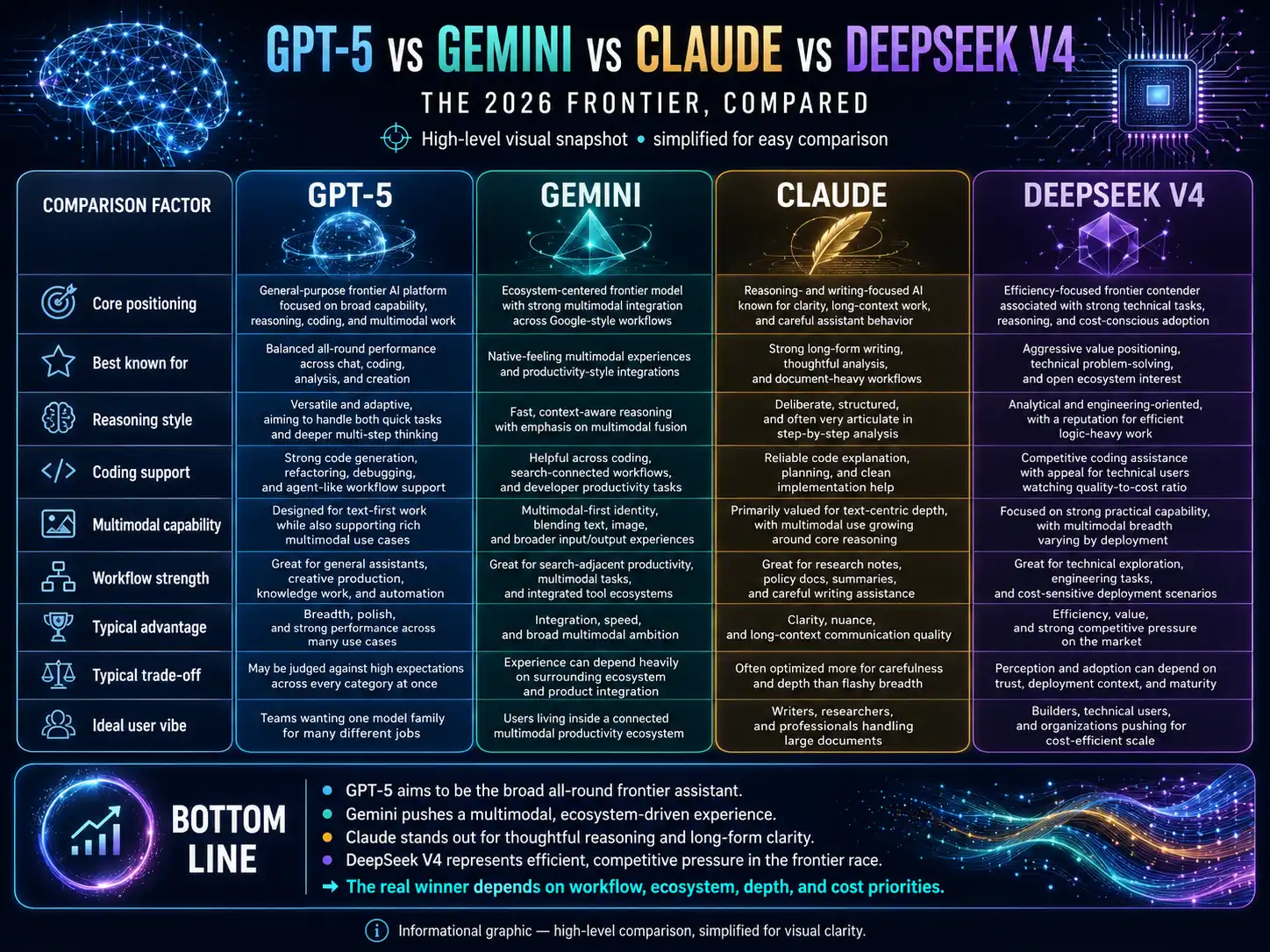
| GPT-5 | Gemini | Claude | DeepSeek V4 | |
|---|---|---|---|---|
| Maker | OpenAI | Anthropic | DeepSeek | |
| Openness | Closed | Closed | Closed | Open weights |
| Often chosen for | All-round use | Multimodal, Google tie-in | Long documents, coding | Cost, self-hosting |
Note: model capabilities shift constantly. Treat this as a snapshot and check current benchmarks before making a decision that matters.
GPT-5: the generalist
OpenAI’s GPT-5 is the model most people reach for by default, and there is a reason for that. It is a strong all-rounder — reliable across writing, reasoning, coding, and general questions — with the largest ecosystem of tools, plugins, and integrations around it. If you want one model that does most things well and plays nicely with everything else, this is the safe pick. Being closed and metered is the trade-off.
Gemini: multimodal and wired into Google
Google’s Gemini leans into two advantages Google is uniquely positioned to offer: genuinely strong multimodal understanding — text, images, audio, video handled natively — and deep integration with the Google ecosystem that many people and businesses already live in. If your workflow runs through Google’s products, or your task is heavy on mixed media, Gemini often feels like the path of least resistance.
Claude: the long-context specialist
Anthropic’s Claude has built a reputation in two areas in particular: working with very long documents and writing and reasoning about code. If you regularly feed a model an entire contract, codebase, or research paper and ask careful questions about it, Claude tends to be the one people name. It is closed, like the other two commercial models, but it occupies a clear niche at the demanding end of long-context work.
DeepSeek V4: the open challenger
DeepSeek V4 is the disruptive one. As an open model with published weights, it can be downloaded, inspected, fine-tuned, and self-hosted — which changes the economics entirely. For anyone worried about cost at scale, data privacy, or vendor lock-in, an open model that competes with the closed frontier is a genuinely big deal. It is the clearest sign yet that the cutting edge is no longer the private property of a handful of labs. We covered its launch in depth, and it is worth reading alongside the broader question of what artificial general intelligence actually means as these systems keep improving.
So which should you pick?
Skip the leaderboard and match the model to the job. Reach for GPT-5 when you want a dependable generalist with the biggest ecosystem. Reach for Gemini when the task is multimodal or lives inside Google’s tools. Reach for Claude when you are working with long documents or serious code. And reach for DeepSeek V4 when cost, control, or self-hosting matter more than a brand name. On pure capability, they are close enough in 2026 that your use case, not the benchmark chart, should make the call.