
Three terms get thrown around as if they were interchangeable: machine learning, deep learning, and neural networks. They are not the same thing, but they are not really competitors either. They are nested inside one another, and once you see the nesting, the confusion disappears for good.
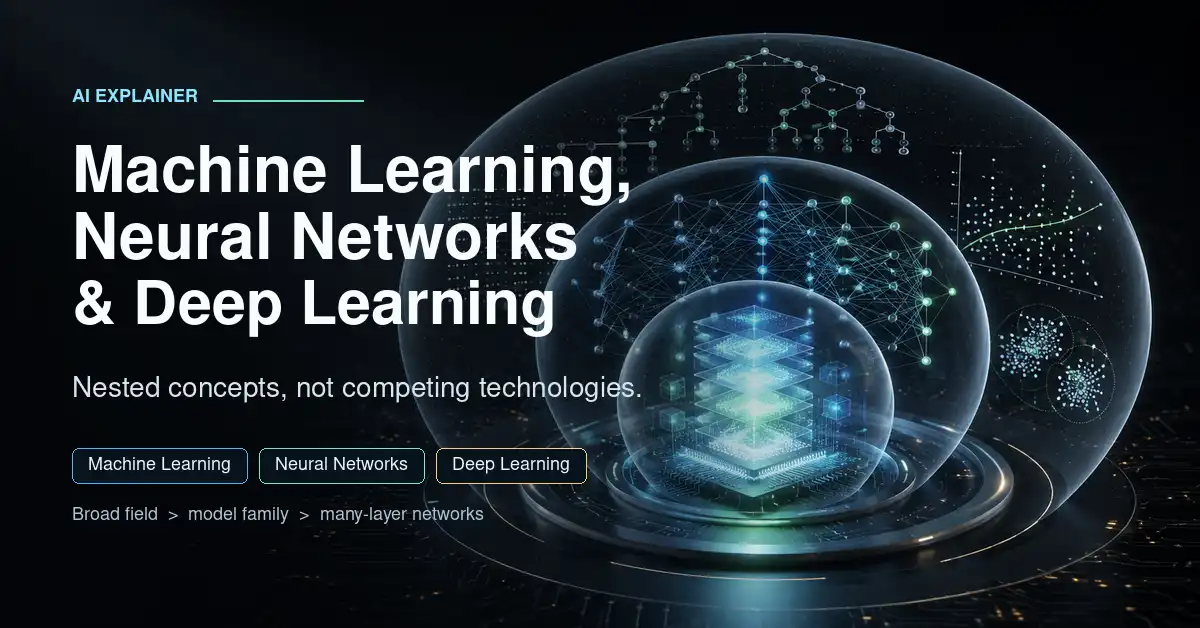
Here is the whole idea up front. Machine learning is the broad field of algorithms that learn from data. Neural networks are one family of machine learning models. Deep learning is what you call a neural network with many layers. So every deep learning model is a neural network, and every neural network is machine learning. But the reverse does not hold.
The nesting, at a glance
| Machine Learning | Neural Networks | Deep Learning | |
|---|---|---|---|
| Scope | The whole field | A subset of ML | A subset of neural nets |
| Feature engineering | Usually manual | Partly learned | Learned automatically |
| Data appetite | Low to moderate | Moderate | High |
| Typical hardware | A CPU is often fine | CPU or GPU | GPU or TPU |
| Example | Spam filter (decision tree) | Simple image classifier | ChatGPT, image generators |
Machine learning: the umbrella
Machine learning covers any algorithm that improves its performance on a task by learning from data rather than being explicitly programmed. That is a big tent. A decision tree deciding whether an email is spam, a linear regression predicting house prices, a clustering algorithm grouping customers, all machine learning, and not one of them is a neural network. Many of these classic methods are fast, interpretable, and perfectly suited to structured, tabular data. People sometimes forget that, reaching for deep learning when a boring, reliable model would have done the job better and cheaper.
Neural networks: one approach among many
A neural network is a specific kind of machine learning model, loosely inspired by the brain, built from layers of connected units that pass signals forward and adjust their weights during training. What sets neural networks apart is their ability to learn features on their own. A traditional model often needs a human to hand-craft the useful inputs; a neural network can discover them. That flexibility comes at a price: more data, more compute, and less transparency about why it decided what it decided.
Deep learning: neural networks, but deeper
Deep learning is not a different technology. It is simply what happens when you stack many layers in a neural network, hence “deep.” Those extra layers let the model build a hierarchy of features: early layers catch simple patterns, later layers assemble them into complex concepts. This is the engine behind the AI that has made headlines: image generators, speech recognition, and large language models are all deep learning.
The reason deep learning took off in the last decade is not a single clever idea. It is the collision of three things. Enormous datasets, powerful GPUs, and better training techniques all arrived at once, and deep networks that had been impractical suddenly became trainable.
How the three fit together in practice
Neural networks are older than most people expect, but they only became dominant in the 2010s. A turning point was the 2012 ImageNet result, in which Krizhevsky, Sutskever and Hinton trained a large deep convolutional network on GPUs and outperformed other image classifiers by a wide margin. In 2015, LeCun, Bengio and Hinton summarised the idea in Nature: deep learning lets models composed of multiple processing layers learn representations of data at multiple levels of abstraction, using backpropagation to adjust each layer’s parameters. That definition matches the nesting described above. Deep learning is a kind of neural network, and neural networks are one family inside machine learning. For how the main network designs differ, see our guides to artificial neural networks and transformers, RNNs and CNNs.
What the evidence says about spreadsheet-style data
The claim that classic methods often beat deep learning on structured data is backed by benchmarks. In 2022, Grinsztajn and colleagues compared deep learning and tree-based models, such as XGBoost and random forests, across 45 datasets with the characteristics of tabular data. They found that tree-based models remain state-of-the-art on medium-sized data, around 10,000 samples, even without counting their speed advantage. An earlier study by Shwartz-Ziv and Armon found that XGBoost outperformed the newer deep models they tested across the datasets, including those used in the papers that proposed the deep models, and needed much less tuning. They also found that an ensemble of deep models and XGBoost performed better than XGBoost alone. These are benchmark results on particular collections of datasets, so your own data may behave differently, but they explain why experienced teams often try a simple model first.
Common misconceptions
- “Deep learning replaces machine learning.” It is a subset of it, and many production systems still use simpler models, especially on structured data.
- “More layers always means a better model.” Depth helps when there is enough data and the task is complex. On small datasets, extra layers mostly add cost.
- “Neural networks work like brains.” They were loosely inspired by brains, but they are mathematical models trained with gradient-based optimisation.
- “A neural network is always the better choice for images or text.” Often true, but even there a pre-trained model usually beats training one from scratch. Our guide to supervised, unsupervised and reinforcement learning covers the learning setups these models are trained in.
When do you actually need deep learning?
This is where a lot of teams get it wrong. Deep learning shines on messy, high-dimensional data (images, audio, raw text) where features are hard to define by hand. But if your data is a clean spreadsheet with a few dozen columns, a classic machine learning model is often more accurate, far cheaper, and much easier to explain. The honest rule: reach for deep learning when the data is unstructured and abundant, and reach for simpler machine learning when it is structured and limited.
If you want to go one level deeper on the neural network side of this family, our ANN vs CNN vs RNN vs GNN cheat sheet breaks down the main architectures and what each is good for.
Key takeaways
- Machine learning is the whole field, neural networks are one family inside it, and deep learning means neural networks with many layers.
- Deep learning tends to win on large, unstructured data such as images, audio and text.
- On medium-sized tabular data, benchmarks show tree-based models are often as good or better, and cheaper.
Sources
- LeCun, Bengio and Hinton, “Deep learning”, Nature, 2015.
- Krizhevsky, Sutskever and Hinton, “ImageNet classification with deep convolutional neural networks”, Communications of the ACM, 2017.
- Grinsztajn, Oyallon and Varoquaux, “Why do tree-based models still outperform deep learning on tabular data?”, 2022.
- Shwartz-Ziv and Armon, “Tabular Data: Deep Learning is Not All You Need”, 2021.
- scikit-learn documentation, Supervised learning.
How we checked this: we compared the figures and findings above with each paper’s published abstract.