
You type a half-formed question into a chatbot, and it answers in clean, confident prose. It feels like the thing on the other end gets you. That feeling is the whole problem. Do large language models understand language, or are they just very good at guessing which word comes next?
It isn’t a settled question, and not for lack of trying. A 2022 survey asked 480 working NLP researchers whether text-only models could understand language in some nontrivial sense. The field split almost down the middle: 51% said yes, 49% said no (PNAS).
So the honest answer depends on who you ask, and on what you mean by “understand.” What we can do is look at how these systems actually run, then weigh both sides against the machinery. Start with the machinery.
How large language models actually work, one token at a time
Strip away the personality and an LLM does one thing. It predicts the next token. Given everything typed so far, it outputs a probability spread over what comes next, picks one, and repeats (IBM). A token is usually a chunk of a word.
Getting there takes a few steps. First, a scheme called byte-pair encoding chops your text into subword pieces. Common words stay whole. Rarer ones break into fragments. That keeps the vocabulary to tens of thousands of tokens while still covering any word you throw at it (byte-pair encoding).
Each token then becomes a long list of numbers, an embedding, that drops it into a kind of meaning-space. Related concepts land near each other. The classic demo: take the vector for “king,” subtract “man,” add “woman,” and the nearest point is “queen” (Plotly).
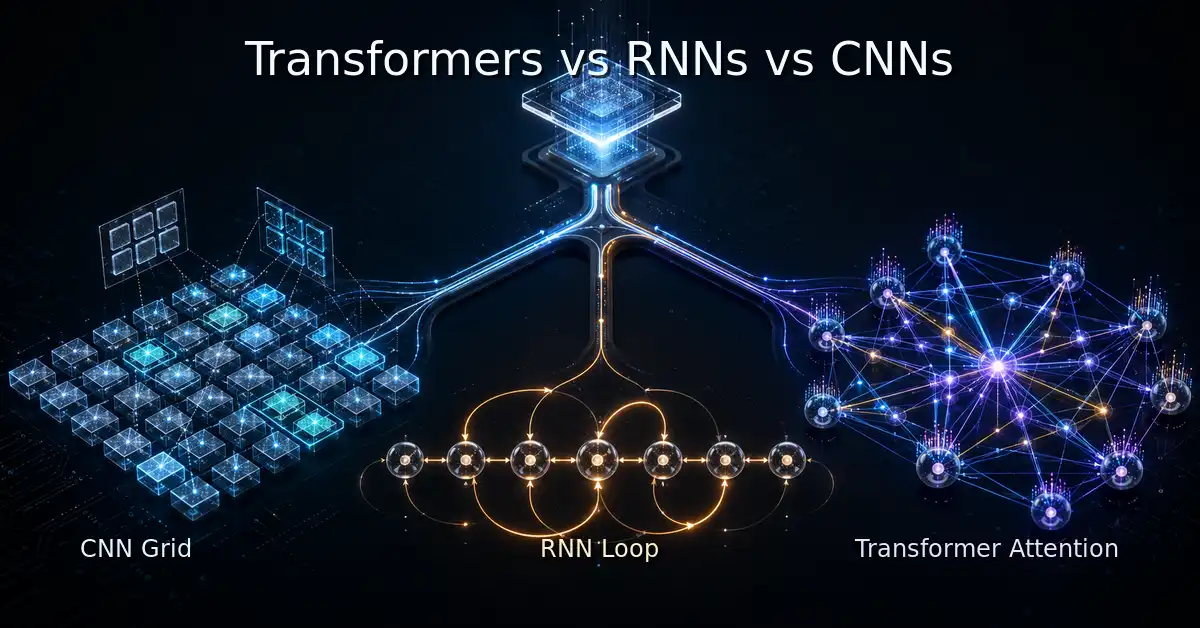
The real engine is self-attention. For every token, the model asks how much each other token in the context matters, then weighs them. This is what lets it track that “it” refers to the cat three sentences back. Self-attention arrived in a 2017 Google paper with a blunt title, “Attention Is All You Need,” and it threw out the older habit of reading one word at a time (arXiv).
That older habit powered recurrent neural networks. If you want the full family tree of architectures, we mapped it in our ANN vs CNN vs RNN vs GNN cheat sheet.
Scale did the rest. GPT-3, back in 2020, carried 175 billion parameters and trained on roughly 500 billion tokens of filtered web text, books, and Wikipedia (GPT-3). Nobody hand-coded grammar. The model just read, predicted, and adjusted, billions of times over.
None of that requires understanding a thing. Or does it? Here’s where it gets contested.
The case that LLMs don’t understand a word they say
Start with the sharpest version of the skeptic’s argument. In 2021, four researchers, including Emily Bender and Timnit Gebru, called these systems “stochastic parrots.” Their claim: an LLM stitches together linguistic forms “according to probabilistic information about how they combine, but without any reference to meaning” (stochastic parrot). A parrot that never learned what the words point to.
There’s harder evidence too. When researchers probed models solving language-inference tasks, the models leaned on cheap cues, like the mere presence of words such as “not” or “is,” instead of real reasoning. High benchmark scores can sit right on top of shaky understanding, and it shows the moment you test outside the training data (shortcut learning).
The most damning example is a map. Harvard and MIT researchers trained a model on turn-by-turn Manhattan directions. It gave correct directions 99% of the time. But when the team reconstructed the map implied by its answers, the model had invented streets, cut diagonals across Central Park, and broken the grid (Harvard Gazette).
“When I turn right, I am given one map of Manhattan,” said Harvard’s Keyon Vafa, “and when I turn left, I’m given a completely different map of Manhattan” (Harvard Gazette). Near-perfect output, no coherent world underneath it.
There’s a philosophical version of this. Cheryl Chen, who teaches philosophy at Harvard, put it plainly: “For genuine understanding, you need to be kind of embedded in the world in a way that ChatGPT is not” (Harvard Gazette). A text-only system never touches, sees, or acts. It only reads words about the world.
The Eliza effect: why fluency fools us
We’ve been falling for this since 1966. That year, MIT’s Joseph Weizenbaum built ELIZA, a simple chatbot running a script that mimicked a therapist. He was startled when people poured their hearts out to it, convinced it understood them (ELIZA effect). He built it to mock AI hype. It became a warning instead.
Psychologists call it the Eliza effect: our habit of reading comprehension and empathy into anything that sounds human. The researchers behind that 2022 understanding survey point straight at it. Fluency makes us over-credit the machine (PMC).
The case that something like understanding is going on
Now the other side, because it’s stronger than the parrot line suggests.
First, scale keeps producing surprises. Certain skills stay near random until a model hits a threshold size, then jump sharply: multi-digit arithmetic, word unscrambling, multi-step reasoning. You can’t predict them by extrapolating from smaller models (Wei et al.). That looks less like “more of the same” and more like something new switching on.
Second, and this one is hard to wave away, there’s Othello-GPT. Researchers trained a small transformer only to predict legal next-moves in the board game Othello. It never saw a board or a rulebook. Yet probing its internals revealed a working model of the board’s actual state, and when researchers edited that internal state, the model’s move predictions shifted to match (emergent world representations). A model of the world, built from nothing but next-move prediction.
Third, Anthropic pulled millions of interpretable “features” out of Claude 3 Sonnet, including abstract concepts and not just concrete nouns. They showed the features are causal. Force the “Golden Gate Bridge” feature to fire, and the model starts insisting, unprompted, that it is the Golden Gate Bridge (Anthropic). That’s structure, not word-frequency soup.
And the machines keep clearing the bars we set. Models passed the human baseline on the GLUE benchmark in 2019, then on the tougher SuperGLUE by January 2021 (VentureBeat). Skeptics fairly note that beating a benchmark isn’t the same as understanding, per the shortcut-learning problem above. Still, the functional performance is real.
Some of the field’s biggest names land here. Geoffrey Hinton, the Nobel laureate often called the godfather of AI, is blunt: “to predict the next word you have to understand the sentences… You have to be really intelligent to predict the next word really accurately” (CBS). Ilya Sutskever makes the same bet in different words: compressing text well enough to predict it forces a model to build an implicit picture of the reality behind that text. Compression is comprehension, he argues (Dwarkesh).
There’s a tidy middle position too. Developmental psychologist Alison Gopnik calls LLMs “compressed repositories of human knowledge more akin to libraries or encyclopedias than to intelligent agents” (PNAS). A library holds understanding without being a mind. Maybe that’s the shape of it.
Not everyone at the top buys any of it. Yann LeCun argues next-token prediction simply isn’t the same operation as reasoning or planning. “We’re never going to get to human-level intelligence by just training on text,” he says (Interesting Engineering).
How the human brain predicts language differently
Here’s where fresh 2026 research sharpens the whole debate. LLMs predict one token at a time. Does your brain?
Apparently not the same way. A study published in April 2026 in Nature Neuroscience recorded brain activity from Mandarin speakers, then cross-checked it against English data. The finding: the brain doesn’t predict word by word. It first predicts a grammatical chunk, a phrase-sized constituent, then fills in the individual words inside that structure (Nature Neuroscience).
The surprise signal in the brain runs measurably weaker for a word that stays inside an ongoing phrase than for one that crosses into a new phrase. Structure comes first. Words come second.
“While LLMs are trained and optimized to predict the next word,” said NYU’s David Poeppel, “the human brain makes predictions by grammatically grouping words into phrases” (NYU). Same broad job, anticipate what’s coming, different machinery underneath.
It isn’t a clean split, mind you. Other work shows an LLM’s internal activity lines up with brain recordings during comprehension, beyond what raw word-prediction alone would explain (arXiv). And one reviewed preprint cautions that some of that apparent alignment might reflect simpler stimulus effects, not shared prediction (eLife). The overlap is partial and still being argued. We dug into the wider gap in AI vs Human Intelligence.
So do large language models understand language, or just predict it?
Put the pieces together and the answer stops being yes or no.
An LLM clearly builds internal structure. Othello’s board and Claude’s Golden Gate feature both prove that, so “it’s only statistics” undersells what’s happening. But it also nails tasks while carrying an incoherent model underneath, like that Manhattan map, so “it understands the way we do” overshoots. It’s a third thing. A system that has learned a compressed, sometimes-coherent, sometimes-broken shadow of the world, purely by predicting text.
Which is exactly why the answer matters beyond philosophy.
A model that produces 99%-accurate output on top of a broken internal map is a model that can be confidently, fluently wrong. Worse, it can be tuned to sound convincing without being reliable. That’s the same mechanism behind why AI deception matters more than passing the Turing test: sounding right and being right come apart. If you’ve followed why AGI still can’t think like a human mind, this is the concrete, mechanism-level version of that gap.
What would actually settle the debate
Nobody wins this with a better opinion. It comes from cracking the models open.
Interpretability is the live front. Anthropic’s feature extraction and the Othello-GPT probes are early proof you can find real internal representations and test whether they’re causal (Anthropic; Othello-GPT). Do that at full scale, across many domains, and “does it understand” turns into a measurable question instead of a vibe.
The other half is better tests. We need benchmarks that punish shortcut learning and reward genuine world-modeling, plus more of the brain-versus-model comparisons that kicked off in 2026. Until then, the 51/49 split stands (PNAS).
My take, for now
If you pushed me, I’d say the parrot metaphor has aged badly, and the “it’s basically a person” crowd is racing ahead of the evidence. These systems understand something. Just not the world. They hold a compressed statistical echo of the text we fed them, close enough to fool us and wrong in ways we can’t always see.
So keep talking to your chatbot. Just don’t mistake the fact that it answers like it understands you for proof that it does. The gap between those two is where the interesting, and risky, part lives.