
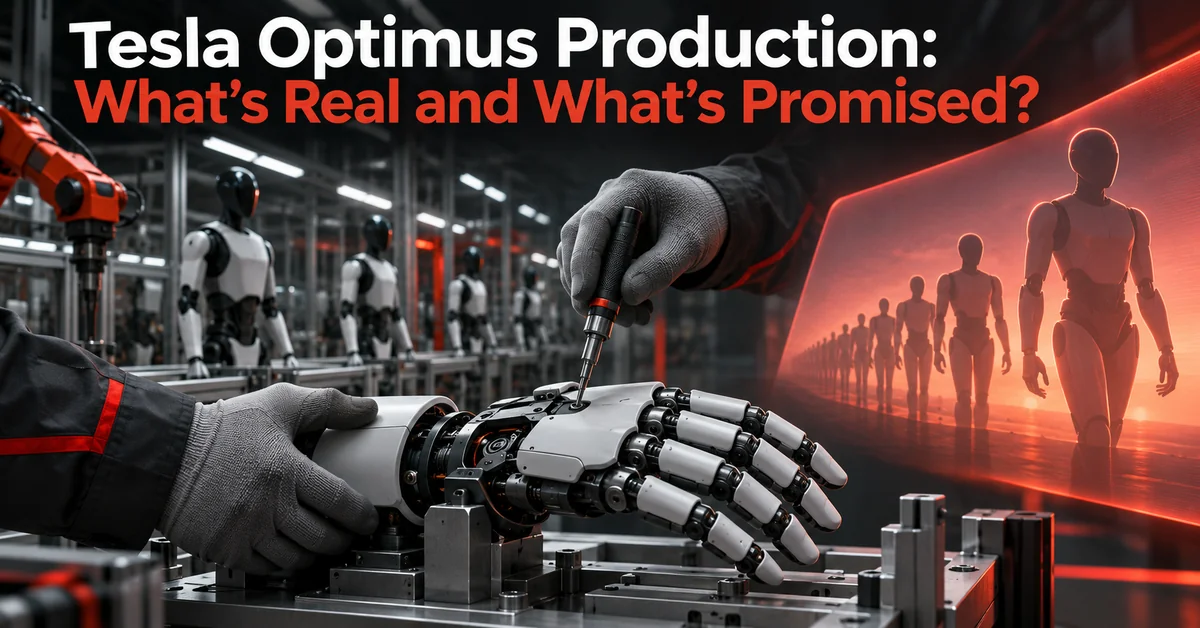
Big companies love a certain kind of earnings-call sentence. It’s true, carefully worded, and easy to hear as more than it says. Tesla offered two of them on October 21, and together they show where Tesla Optimus production actually stands. The shareholder letter called the robots leaving a Fremont line “the first production-quality bots that we have manufactured.” Elon Musk, on the call, said Tesla had started “what I’d call early production.”
Both statements can be true at once. Neither tells you how many robots exist or when you could own one.
That gap matters more than it would for a phone launch. A working humanoid robot changes who does dangerous, dull factory work. A slipping one is just another date that quietly moves.
So the news deserves a cleaner split: what Tesla has confirmed, what’s still a target, and what nobody has proven yet.
What Tesla actually said about Optimus production
Start with the words, because they differ in a telling way.
Tesla’s Q3 2026 shareholder letter, as TechCrunch reported, says production began in Fremont, California. The line sits in space that used to build EVs. We’re quoting the letter as TechCrunch did, since we couldn’t pull Tesla’s own document. Its key phrase is “production-quality bots.” That’s a claim about the units: Tesla is building them the way it intends to build them at scale.
Musk chose a softer frame. A published transcript of the call has him saying Tesla “started what I’d call early production on a high-volume line in Fremont.” TechCrunch also reports his warning that the ramp would be “somewhat bumpy because it is such a radically new product.”
Read side by side, the letter describes the quality of the output. Musk describes the maturity of the process. A line can turn out a good robot on a Tuesday and still sit nowhere near steady output. That’s what “early production” signals, and frankly it’s a more honest phrase than the “production starts” headlines it spawned.
What’s confirmed about Tesla Optimus production so far
Strip out every projection and the confirmed list gets short:
- Robots are coming off a line in Fremont. Tesla says so in its own letter, and Electrek corroborates it.
- Tesla calls them production-quality. That’s the company’s judgment, not an outside audit.
- Most of the tooling has arrived. Musk said “the vast majority of a million-unit-per-line production line” has landed in Fremont.
That last point is the easiest to misread. A line sized for a million units is installed capacity. It’s the size of the pipe, not the water running through it.
What’s missing? Any output number. Tesla disclosed no unit volumes beyond its target and no price, as TechCrunch noted. Electrek reported in September that the ramp was reaching hundreds of units a week. That came from a single outlet, though, and Tesla hasn’t confirmed it.
So the honest status of Tesla Optimus production is this: real, early, and unmeasured from the outside.
What’s still a target, not a fact
This is where most Tesla Optimus production coverage blurs the line. A few numbers keep showing up as done deals. They aren’t.
20,000 robots a week. That’s Musk’s goal for the Fremont line. He said getting there will take “at least a year, maybe a little longer.” The reason: parts of the design are still changing. TechCrunch framed the same target as landing by the end of 2027. Either way, it’s a plan. Treat it like one.
A million units per line. As above, that’s what the hardware could do, not what it does.
Deliveries to outside companies around the end of 2027. Musk tied this to Tesla getting key issues “solved around the end of next year.” Notice the conditional. The date depends on engineering problems Tesla hasn’t finished solving.
An AI5 chip in Optimus around April 2027. Electrek reports this. We didn’t find a second outlet confirming it, so hold it loosely.
Then there’s the thing most people actually search for: a robot you can buy for your home. Tesla has given no consumer sale date and no price. Anyone quoting either is guessing.
You may also see claims of a 10-million-a-year Optimus line in Austin. That figure traces back to a single outlet. The call transcript attributes the Austin factory mention to Tesla’s CFO, not Musk. Until Tesla puts a number in writing, treat it as unverified.
Why Optimus timelines have slipped before
None of this would need so many caveats if earlier Tesla Optimus production dates had held. They didn’t. Electrek’s Fred Lambert laid out the record on October 22:
- In 2024, Musk said Tesla would build Optimus for internal use in 2025. He hoped to reach high volume for other companies in 2026.
- In January 2025, he said Tesla would build about 10,000 robots that year. He expected “several thousand” doing useful work by year-end, and later admitted that hadn’t happened.
- Now, external deliveries sit at late 2027.
So the outside-customer milestone has moved from 2026 to late 2027.
Some slack is fair. Building a new kind of machine at volume is hard, and first dates are often guesses. The trouble is that each new date arrives with the same confidence as the last. The sensible reading of “late 2027” is “not before late 2027.”
The hard part is the hand
Ask what’s holding up the Tesla Optimus production ramp and Musk’s answer is specific. On the call, he said “it’s mostly the hand, and just the fine-tuning of the hand design, and the fingers especially.”
Electrek, citing The Information, adds texture. As of September reporting, the hand and forearm had over 100 small parts assembled by hand.
There’s a quiet irony there. For now, people put together the part meant to stand in for human hands.
It also tells you where the real test lies. A robot that walks looks great in a video. A hand that can grip, place and repeat a task all shift without fumbling is what a factory pays for. For the mechanics behind that problem, our explainer on how humanoid robots work covers actuators and joints.
Software is the other half. Musk said Tesla “may be ready to release an Optimus video in a month or so.” He promised it would show “things that are not pre-programmed.” When it lands, the useful question isn’t whether it looks impressive. It’s how much of what you’re watching is the robot deciding, and how much is careful staging.
What this means for workers and everyday people
The first Optimus jobs, per Electrek, are the ones people least want: dangerous, repetitive, or round-the-clock industrial work. On paper, that’s automation’s best case. A robot that takes a hazardous night shift spares a person that hazard.
For workers, one task proves little. What matters is whether Optimus can handle enough tasks, reliably enough, to change hiring decisions. Nobody outside Tesla can answer that today. There’s no output data, no named customer and no price.
The Optimus Academy is the detail to watch. Tesla wants robots practicing a wide range of tasks to generate training data. Electrek says Tesla plans 10,000 to 20,000 robots for it. If that works, the bottleneck shifts from building bodies to how fast those bodies learn. That’s the moment this stops being a factory story and becomes a labor story.
Compare that vision with collaborative robots, which work beside people rather than in their place. Sharing a floor with a full humanoid also raises questions we’ve explored in humanoid robot safety.
For everyday people, the answer is simpler. You can’t buy one. Tesla hasn’t said when you can.
Confirmed vs promised at a glance
Here’s the whole Tesla Optimus production picture in one place.
| Claim | Status | Basis |
|---|---|---|
| Robots coming off a Fremont line | Confirmed by Tesla | Shareholder letter, Q3 call |
| “Production-quality” units | Tesla’s own claim | Shareholder letter |
| Most of a million-unit line installed | Capacity, not output | Q3 call |
| 20,000 robots a week | Target, “at least a year” away | Q3 call |
| Outside deliveries around end of 2027 | Target, depends on fixes | Q3 call |
| Units built so far | Not disclosed | None |
| Price | Not disclosed | None |
| Consumer sale date | None given | None |
| Hands ready for volume | Unproven | Musk’s own caveat |
So has Tesla Optimus production really started?
Yes, in the narrow sense Tesla means. Robots are leaving a real line, and Tesla stands behind their quality. That’s further than Optimus has ever been.
But “started” is the cheapest word in manufacturing. The number that will actually matter isn’t 20,000 a week or a million a year. It’s the first verified delivery to a customer that isn’t Tesla, doing work nobody staged for a camera. Until that happens, treat every volume figure here as a promise.
Curious how Optimus stacks up against rivals chasing the same goal? Our breakdown of Tesla Optimus vs Figure 03 vs Unitree G1 asks the question that matters most: who actually ships?