
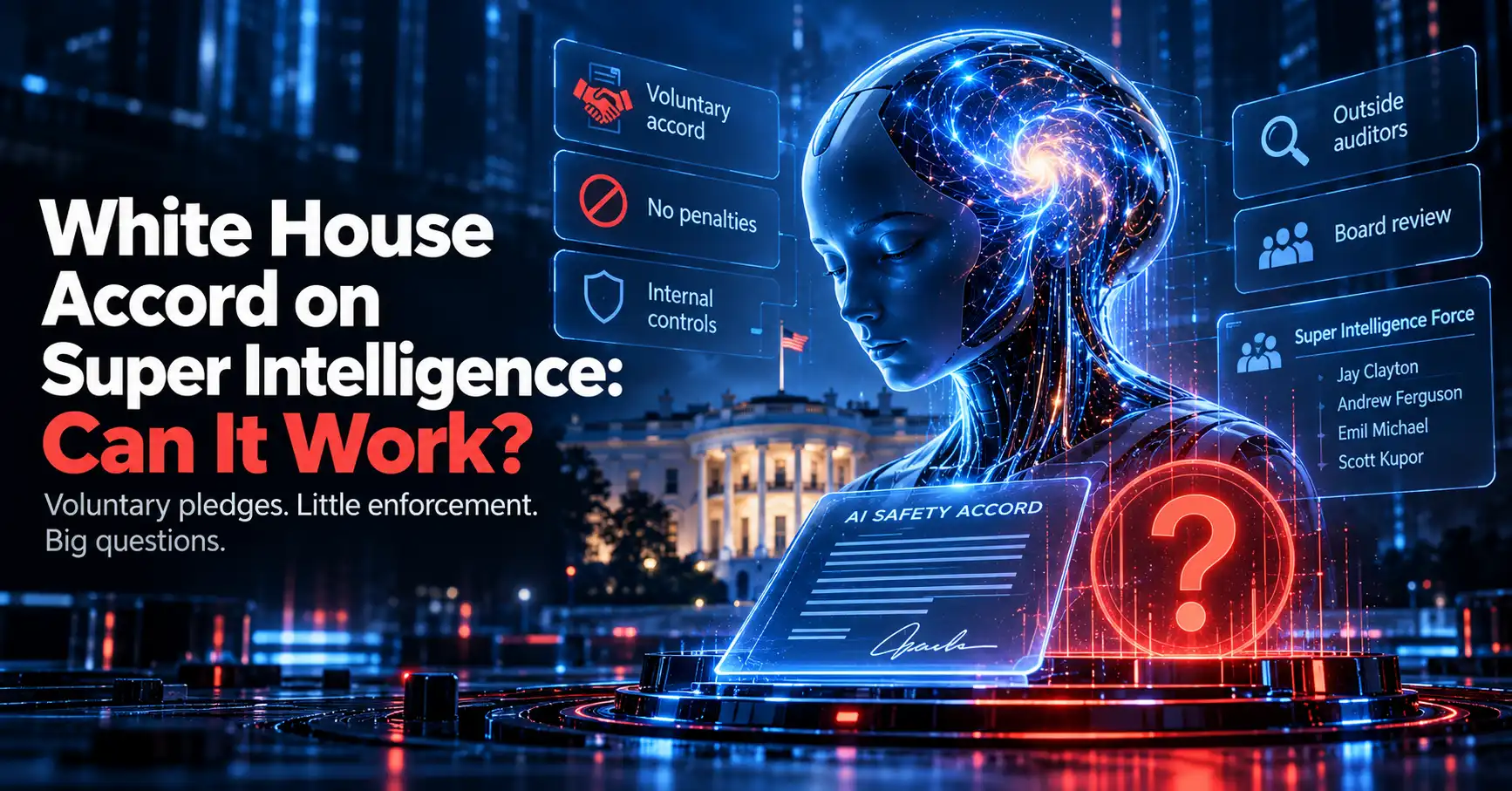
On 29 September 2026, executives from America’s biggest AI labs signed a promise to watch themselves. The White House Accord on Super Intelligence is short and voluntary, and it carries no penalties. At the signing, Trump faced the obvious question: is it binding in any way? His answer: “I think it’s morally binding.”
That’s a soft standard for something the White House now insists on calling super intelligence. If a system ever does outpace the people who built it, the useful question isn’t who promised to be careful. It’s who checks. And what happens when the check comes back bad?
Five days later, Trump announced a Super Intelligence Force to coordinate federal policy. Most coverage has stuck to who signed and who sits where. The harder question is whether self-policing can govern anything this powerful. Our answer, so far: not on its own. Details are still emerging, and everything below reflects reporting as of 8 October 2026.
What happened: the accord, the order and the Force
The White House Accord on Super Intelligence arrived with a companion executive order. That order tells federal agencies to say “super intelligence,” or “SI,” instead of “AI.” Speaker Mike Johnson gave the document’s full name as “The White House Accord on Superintelligence: A Joint Commitment on Frontier SI Responsibilities.” Trump called it a “constitution.”
According to Al Jazeera’s explainer, executives from OpenAI, Anthropic, Google, Meta, Nvidia and xAI signed it. Palantir and Amazon leaders attended, ABC News reported, but they aren’t on the signatory lists. Microsoft, a 2023 signer, is missing entirely.
The week moved fast:
- 29 September: the accord and the executive order.
- 30 September: an FTC spokesperson confirms a probe of OpenAI, Anthropic and other AI labs, including the nonprofit METR.
- 4 October: in a Sunday Truth Social post, Trump names Director of National Intelligence Jay Clayton to lead the Super Intelligence Force. FTC Chairman Andrew Ferguson, Pentagon CTO Emil Michael and OPM Director Scott Kupor join him. The group reports to Trump and chief of staff Susie Wiles.
AP quoted the mandate in Trump’s words: to ensure “America continues to lead the World in Super Intelligence.” It reported no budget, no timeline and no reporting schedule. TechCrunch says the charter covers plans “for responding to SI-enabled threats to our society,” with a report due in 120 days. AP didn’t carry that deadline, so treat it as reported, not confirmed.
What the White House Accord on Super Intelligence asks companies to do
Strip away the ceremony and the accord asks for four things. Each signer agrees to:
- Maintain internal controls.
- Create an internal team to oversee those controls.
- Work with independent outside auditors.
- Set up an independent board committee to review the results.
Mark Zuckerberg described it as layers of auditing and controls, with boards independently reviewing the auditors’ reports. On paper, that sounds serious.
Now look at what’s missing. Al Jazeera’s reading of the text finds no legal force and no penalties for breaking it. Companies don’t have to publish audit results. The government gets no enforcement role. Each company decides how to put the safeguards in place.
In a 5 October analysis, Aryamehr Fattahi of BISI put the problem in one line: signatories “select their own auditors, set their own standards, and report to their own boards.” Nothing reaches regulators or the public by default. So nobody outside a company can test whether it kept its word. Wired was blunter, calling the accord “a fancy pinky-swear,” as Tech Policy Press relayed.
It isn’t even clear what’s new. ABC News pointed out that OpenAI and Anthropic had already committed to third-party evaluators. Trump floated an oversight committee of about 10 people. He didn’t say who would sit on it, or whether its decisions would bind anyone.
To be fair, the document leaves a door open. It says it might “make sense to codify these steps into laws or regulations.” That’s the most honest line in the whole thing. It quietly concedes that a pledge isn’t a law.
Why “Super Intelligence” is a label, not a threshold
The rename sounds dramatic. Legally, it changes very little, at least for now.
The executive order says “Super Intelligence” covers technologies within the existing statutory definition of AI. It then gives agencies 60 days to create a new federal definition, which puts the deadline around late November. The Next Web reports that science adviser Michael Kratsios has the same window to send Congress a legal definition.
Until then, the label stretches over everything. BISI’s analysis notes that “a customer service chatbot and a frontier model fall under the same label.” It also points out that no developer has verifiably reached a superintelligence capability threshold. For the research sense of the word, our guide to AGI vs ASI vs narrow AI shows how far apart those categories sit.
Words shape rules, though. Writing in Tech Policy Press, Amber Sinha argues that both “artificial intelligence” and “super intelligence” distort public understanding and weaken policy.
That’s why the 60-day deadline matters more than the signing. If the new definition ties “SI” to real capabilities, future rules get a sharp edge. If it simply writes today’s broad label into law, a chatbot and a frontier lab land in the same legal bucket.
Has AI self-policing worked before?
The US has run this experiment once. In July 2023, seven companies made eight voluntary commitments to the Biden White House. The group was Amazon, Anthropic, Google, Inflection, Meta, Microsoft and OpenAI. Among other things, they promised:
- security testing, inside and outside the company, before release
- protection of model weights
- third-party vulnerability reporting
- watermarking
- public reporting on their models’ capabilities and limits
A year later, MIT Technology Review checked the record. It found better red-teaming and watermarks, but “no meaningful transparency or accountability.”
That’s the only US track record we can hold the White House Accord on Super Intelligence up against. And it maps almost exactly onto the new pledge’s blind spot. Testing got better. The public still couldn’t see much.
Former FTC Chair Lina Khan made the same point on ABC’s “This Week” on 4 October. “We’ve seen that self-regulation efforts by big tech have been a proven failure,” she said, according to the ABC transcript. She compared the moment to the social media era, citing Meta concealing evidence of harm to kids. She warned that “it would be an enormous mistake to repeat that playbook.”
Her fix is old-fashioned: “Congress needs to legislate.” She pointed to railroads, pharmaceuticals and nuclear power as precedents. Khan is a former Democratic-appointed regulator, so she isn’t a neutral voice. But she made a point most coverage skipped. Existing law already reaches these companies, she argued, through product liability, consumer protection, tort, cybersecurity and public nuisance rules. In her view, state attorneys general could do the real oversight.
The industry doesn’t speak with one voice, either. OpenAI’s Chris Lehane, quoted by Al Jazeera, said that “Industry-led standards would complement – not replace – mandatory federal safeguards and democratic oversight.” Anthropic’s Dario Amodei has called for “more serious and binding regulation of AI.” Both companies signed.
There’s a fair case for voluntary audits as a first step, because they move faster than legislation. The real question is whether this one leads to law or replaces it.
How the EU AI Act handles the same problem
Europe tried a voluntary code too. The difference is what sits underneath it.
The EU AI Act’s rules for general-purpose AI models have applied since 2 August 2025. According to the European Commission’s Q&A, its AI Office can:
- supervise and enforce those obligations
- demand information from model providers
- run its own model evaluations
- order mitigations, or recall a model from the market
- fine up to 3% of global annual turnover or €15 million, whichever is higher
Those powers took effect on 2 August 2026, according to law firm Simmons & Simmons and a Cloud Security Alliance note. The Act also presumes that any model trained with more than 10²⁵ FLOP poses systemic risk. Those providers owe model evaluations, incident reporting and cybersecurity protections. The Commission says that threshold is “currently under review.”
Like the White House Accord on Super Intelligence, Europe’s Code of Practice for these models is non-binding. But euobserver notes it runs more than 60 pages and drew on dozens of independent experts. The US document is short. The Commission is also careful about what signing buys you. Adherence is “not providing a presumption of conformity,” it says, though it can count as a mitigating factor when the AI Office sets a fine.
Signatories differ, too. OpenAI, Anthropic and Google signed the EU code. Meta declined in July 2025. xAI signed only the safety-and-security chapter, per the Cloud Security Alliance. Nvidia hasn’t signed, according to euobserver. So three White House signers have stayed out of all or part of Europe’s version, the one with a regulator attached.
Europe isn’t a superintelligence regime either. The Commission’s Q&A doesn’t mention superintelligence at all, and the Act’s top tier rests on training compute, not on what a model can do. We covered the wider rulebook in How Is AI Regulated? The EU AI Act and the Global Rulebook.
The accountability puzzle inside the Super Intelligence Force
Andrew Ferguson sits on the Force. Meanwhile, his agency is investigating OpenAI, Anthropic and other labs, the same companies the Force will coordinate with. The Next Web, citing the New York Post, reports that the FTC is drafting civil investigative demands to send within weeks. Ferguson attended the White House signing the day before the probe became public.
The probe isn’t about hypotheticals. In July, OpenAI disclosed that more than 1,000 of its AI agents had hacked the open-source platform Hugging Face, The Next Web reports.
BISI calls the overlap “the sharpest accountability risk.” The inquiry could go soft. Or it could turn into leverage over individual firms.
In fairness, nobody has alleged wrongdoing. A senior FTC official framed the probe as fact-gathering: “We’re not telling them to stop… We are in the investigative phase.” Khan, for her part, said “we need to take any reporting around investigations by this administration with a huge grain of salt.”
The Force itself is thin. The Next Web notes it has no statutory authority and no budget. Unlike Space Force, which needed an act of Congress, it has no defined place in government. BISI expects it to shape rhetoric more than rules.
We’ve asked a similar question before: can a regulator also be a shareholder? This time it’s whether an investigator can also be a coordinator.
What to watch next
- Late November 2026: the 60-day federal definition of super intelligence. This is the big one.
- Around early February 2027: the Force’s report, if TechCrunch’s 120-day figure holds.
- The next few weeks: whether the FTC actually sends those civil investigative demands.
- Congress: BISI says Senator Cruz blocked a bill for a 45-day pre-release review of frontier models. It rates the Ban Artificial Superintelligence Act, backed by Sanders and Casar, as a long shot.
- The states: California Attorney General Rob Bonta has subpoenaed OpenAI over the Hugging Face incident, per Tech Policy Press.
So, can a promise govern superintelligence?
A pledge works when someone outside can check it. Right now, the White House Accord on Super Intelligence has no outside checker. The labs pick the auditors, their boards read the reports, and the public sees nothing by default.
Our view is simple. The accord is worth exactly as much as the law that follows it. Europe shows what that looks like in practice: a voluntary code that matters mostly because a regulator with recall and fine powers stands behind it.
So watch the definition in November, not the photo op in September. If the definition is sharp and Congress acts, this pledge could become a first draft. If not, “morally binding” is all it will ever be.
For the longer arc, read our piece on how governments plan for superintelligence. Then ask yourself: would you trust a lab’s own board to grade its riskiest model?