

Ask a chatbot to tidy up an email and the reply lands in a second or two. No meter ticks on your screen. Yet somewhere a rack of chips woke up, pulled power from a grid, dumped heat into a cooling system and went quiet again. So how much energy does AI use for that one small favor? The honest answer is uncomfortable. It depends on who’s counting, and where they stop counting.
That gap matters more than it sounds. Look at a single prompt and AI seems almost weightless. Look at the data centers behind it and you’re staring at electricity use on the scale of a country. Both pictures are accurate.
The trouble starts when people pick one and ignore the other. Both scales deserve a hearing. So does a question most coverage of AI energy consumption skips entirely: who actually pays?
Why the AI energy question has no single answer
Search for the energy cost of one AI prompt and you’ll find figures that differ by a factor of 50 or more. That isn’t because someone is lying. Each estimate draws its box in a different place.
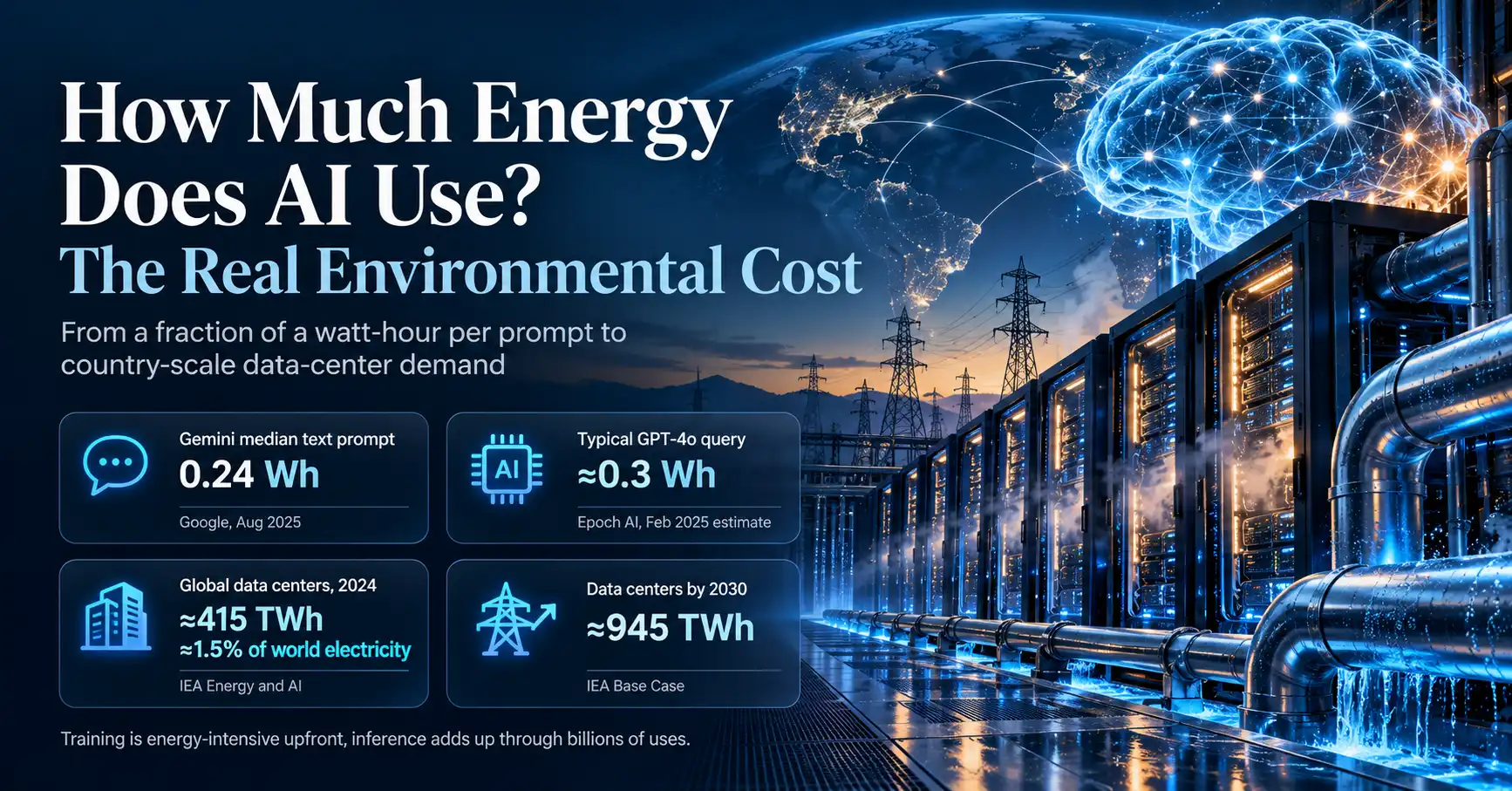
Google offers the clearest example. In August 2025 the company reported that a median text prompt to its Gemini Apps uses about 0.24 watt-hours. Then it showed what happens if you count only the chips doing the active work. The figure drops to 0.10 Wh for the very same prompt.
The bigger number adds idle capacity held in reserve, the host CPU and memory, and data center overhead like cooling. Even that fuller method leaves things out. According to Google’s own methodology note, it excludes the network, your device and the energy spent training the model.
So when two headlines disagree, check these before you pick a side:
- Model size. A small open model and a frontier model are different machines.
- Output length. Longer answers mean more tokens and more compute.
- Hardware. Newer chips do more work per watt.
- Accounting boundary. Chips only, or the whole building? Training included, or not?
- Who measured it. Some figures come from the companies running the models. Others come from outside researchers who have to estimate.
Neither company figures nor outside estimates are automatically wrong. They just deserve different kinds of trust, and we’ll flag which is which as we go.
Training vs inference: where the electricity goes
Every AI model has two energy lives. First it learns. Then it answers.
Training: a huge one-time bill
Training means feeding a model enormous amounts of text or images while its internal weights adjust, over and over, across thousands of chips. If you want the mechanics, our explainer on how large language models work walks through what’s happening inside. The energy side is easier to state. It’s big, and it’s front-loaded.
Epoch AI, an independent research group, estimates that training xAI’s Grok 4 in 2025 took about as much energy as a town of 4,000 Americans uses in a year. And the final run isn’t the whole story. Epoch notes that labs spend many times as much compute on experiments and dead ends as on the model they eventually ship.
Keep that in mind whenever you see a single training figure. It probably describes the final run, not the long search that led to it.
Inference: small sips, billions of times
Inference is the answering part. It happens every time someone types a prompt, and each one costs very little. But it never stops.
MIT Technology Review estimated in 2025 that 80 to 90% of AI computing power now goes to inference rather than training. That sounds like it contradicts Epoch’s point about training costs. It doesn’t.
For a single model, training can be the largest line item. Across a whole industry serving huge numbers of people every day, the answering adds up faster. The scale you choose decides which one looks bigger. This is the first place where “both are true” turns out to be the real answer, and it won’t be the last.
How much energy does AI use per prompt?
Here’s where the numbers get specific. They come from different sources using different methods, so read them as a ladder rather than a contest:
- About 0.03 Wh: one response from Meta’s small Llama 3.1 8B model, overhead included (114 joules, per MIT Technology Review).
- 0.10 Wh: Google’s median Gemini text prompt, counting active chips only.
- 0.24 Wh: the same Gemini prompt with Google’s fuller accounting.
- About 0.3 Wh: Epoch AI’s estimate for a typical GPT-4o query, assuming about 500 output tokens on H100 chips.
- About 0.34 Wh: Sam Altman’s stated average for a ChatGPT query.
- About 0.6 Wh: Epoch’s figure for a 100-word prompt to a free chatbot.
- About 1.9 Wh: one response from the far larger Llama 3.1 405B (6,706 joules, per MIT Technology Review).
- About 3 Wh: an earlier 2023 estimate from researcher Alex de Vries.
That last one needs context, because people still quote it. Epoch argued it runs roughly ten times too high for today’s systems. De Vries assumed 2,000-token answers on older A100 hardware. The chips moved on. The number didn’t.
Putting a fraction of a watt-hour in perspective
Numbers this small are hard to feel. Google compares its 0.24 Wh prompt to watching TV for under nine seconds. Epoch says a 100-word prompt uses less energy than running a microwave for ten seconds.
Epoch also ran the household math. A home would need to send more than 400 messages a day just to add 1% to its daily energy use.
So if your question is personal, the answer is reassuring. One person chatting with a text model isn’t what’s straining the grid. That’s worth saying plainly, because guilt about individual prompts tends to crowd out the bigger decisions.
Images and video cost far more
Text sits at the cheap end. MIT Technology Review measured about 2,282 joules for one image from Stable Diffusion 3 Medium, rising to 4,402 joules at 50 steps. That works out to roughly 0.6 to 1.2 Wh per picture, several times a typical chatbot answer.
Video is another league. A five-second clip at 16 frames per second from the CogVideoX model took about 3.4 million joules. That’s roughly 0.94 kWh, thousands of times the cost of a text prompt. If you’ve wondered why generating pixels is so demanding, our piece on how diffusion models work explains the step-by-step process behind it.
The implication is uncomfortable. By our rough math, that one five-second clip uses as much energy as nearly 4,000 text prompts at Google’s 0.24 Wh. Short video is where the per-prompt reassurance runs out.
Agentic AI changes the math
A chatbot answers once. An AI agent plans, calls tools, checks its own work and loops, sometimes for hours. Every loop is another round of inference. If that distinction feels fuzzy, see what an AI agent is and how it differs from a chatbot.
Writing in The Climate Brink in August 2026, Zeke Hausfather reported a striking headline finding. By his measurement, agentic work used about 600 times the energy of a simple prompt. Against Google’s 0.24 Wh baseline, 600 times lands at roughly 144 Wh.
Treat that as one researcher’s measurement of his own heavy use, not an industry average. Still, Epoch points the same way, noting that coding agents use substantially more energy than chatbots.
This is the trend we’d watch most closely. Per-prompt efficiency has improved fast. But if the basic unit of AI use shifts from a question to a task, per-prompt figures stop describing how people actually use these systems.
AI data center electricity demand: the big numbers
Now zoom out. Individual prompts are tiny, but there are an enormous number of them. Add training runs and everything else data centers already do, and the totals start to look national.
What the IEA projects
The International Energy Agency published its Energy and AI report in April 2025. As Scientific American reported, the IEA found data centers used about 415 TWh of electricity in 2024. That’s roughly 1.5% of the world’s supply. By 2030 the agency projects about 945 TWh, more than double.
AI is a growing slice of that total. In 2024, AI servers accounted for 24% of server electricity demand and 15% of all data center energy.
Geography is lopsided, too. The US, Europe and China account for 85% of current consumption. The IEA expects the US and China alone to drive nearly 80% of the global increase by 2030.
What the UN calculated
In June 2026, a United Nations University report put country-sized labels on these numbers, as the Associated Press reported. Global data centers used about 448 TWh in 2025. That’s more electricity than every country on Earth except ten.
They also emitted roughly 200 million tons of CO2, about the same as Argentina. And they consumed about 4.5 trillion liters of water.
“If you look at these numbers, we’re seeing scales comparable to nations,” said Kaveh Madani, director of the UN University Institute for Water, Environment and Health.
The UN’s 2030 projection is 935 TWh. That would make data centers the sixth-largest electricity consumer if they were a country. The report also expects AI’s share of data center energy to climb from 20% to 40%.
Notice how closely that matches the IEA’s 945 TWh. Two different bodies, two different methods, nearly the same answer. When independent forecasts converge like that, we take them more seriously than any single projection.
The counterpoint: still a small slice, for now
Epoch AI pushes back on the alarm, and its argument deserves a fair hearing. Epoch’s overview of AI energy use puts global AI demand at “tens of gigawatts,” comparable to New York state’s peak. In the US, that’s still only a few percent of electricity. Air conditioning (12%) and lighting (8%) use more.
But Epoch also sees the curve. It estimates US AI data center demand could reach 100 GW by 2030. For scale, the entire US industrial sector averaged about 120 GW in 2025.
MIT Technology Review adds its own data point. US data centers already used 4.4% of the country’s electricity in 2024. By 2028, it reported, AI alone could use as much electricity as 22% of US households.
So AI is small today and growing fast. Both halves of that sentence matter, and the second half is the one that shapes grids.
Beyond electricity: water, carbon and hardware
Electricity grabs the headlines. It isn’t the whole environmental impact of AI.
Water
Data centers have to shed heat, and many use water to do it. Per prompt, the numbers are tiny. Google reports 0.26 mL for its median Gemini text prompt, about five drops.
In aggregate, they aren’t tiny at all. The UN put 2025 data center water use at roughly 4.5 trillion liters, or 1.2 trillion gallons. It expects both water and energy use to roughly double within four years.
That’s the recurring pattern with AI. Five drops sounds like nothing. Five drops times every query on the planet becomes a real question for whoever shares that water source.
Carbon
The carbon footprint depends on what’s feeding the grid. Epoch estimates AI’s power mix in 2026 at roughly 65% nonrenewable, against about 57% for the US grid overall. MIT Technology Review found that US data center electricity was 48% more carbon-intensive than the national average in 2024.
Still, keep proportion. Citing IEA data, Epoch notes that data centers produced under 1% of global CO2 emissions in 2025. And Google reports just 0.03 grams of CO2-equivalent for its median text prompt.
So AI isn’t the main engine of climate change. But under 1% of global emissions is still a lot of carbon, and every projection in this piece points the same way: up.
Hardware
There’s one more cost: building the chips, servers and buildings in the first place. We looked for a solid, verified figure for these embodied emissions and didn’t find one we’d stand behind. Rather than invent a number, we’re leaving it as an open line on the bill. Treat any confident claim about it with care.
Who bears the burden?
Here’s the part most coverage skips. The benefits of AI flow to users everywhere. The costs land somewhere specific.
Power bills
The evidence on prices is mixed, and honest reporting should say so. Epoch points to a 2025 Lawrence Berkeley study. It found that states with lots of data centers often saw smaller price increases than average between 2020 and 2025.
Yet in the first quarter of 2026, wholesale prices in some mid-Atlantic and Midwest states rose 76%. Data center buildout contributed up to a quarter of that jump.
Put simply, it depends on where you live and how fast your local grid has to grow. In some regions, heavy data center growth sat alongside gentler price rises. In others, it helped drive a sharp spike.
Air quality
Some of the new power isn’t clean. In Memphis, xAI’s Colossus 1 data center ran gas turbines that reportedly lacked pollution controls. Nitrogen dioxide levels spiked in the surrounding areas, according to Epoch.
The people breathing that air didn’t sign up to train a chatbot. That’s the human-scale cost that per-prompt math will never show you.
The IEA’s outlook carries the same tension. Two-thirds of planned new capacity is renewable, but new gas-fired plants are expanding alongside it.
Who benefits, and who waits
The IEA figures show how concentrated all this is. The US, Europe and China account for 85% of data center electricity use. That concentrates both the economic gains and the local strain in a handful of places.
There’s an equity angle in the efficiency numbers, too. Researchers cited in AP’s coverage of the UN report said that cutting the words in requests by 30% could cut AI energy use by 25%. AP compared that saving to the yearly electricity use of about 700,000 people in Africa.
Sit with that comparison for a second. The power we’d all save by writing tighter prompts would match the annual needs of hundreds of thousands of people elsewhere.
Can AI be more energy efficient?
Yes, and quickly. Whether that shrinks the total is a separate question.
The efficiency wins are real
Google reports that between May 2024 and May 2025 it cut the energy per Gemini prompt 33-fold. It cut the carbon footprint per prompt 44-fold. That’s a company grading its own work on one product, so hold it loosely. Still, it shows how much slack there was.
Research backs up the size of the lever. A 2021 study by Google and UC Berkeley researchers, led by David Patterson, found that choices of model, data center and processor could shrink a model’s carbon footprint roughly 100 to 1,000 times. Among its findings:
- Sparse models can use under a tenth of the energy of dense ones.
- Location alone can shift the carbon-free share of power by about 5 to 10 times.
- Cloud data centers run about 1.4 to 2 times more efficiently than typical ones.
Where the power comes from matters as much as how efficiently the chips run. Clean, steady supply is a big part of the story behind why AI data centers are turning to nuclear power.
And you have a small lever of your own. That finding about 30% shorter prompts saving 25% of the energy isn’t going to save the planet. It costs you nothing, though.
The rebound problem
Here’s the catch. Cheaper, more efficient AI tends to mean more AI. Economists call this the Jevons paradox. Northumbria University’s Peter Howson put it bluntly in 2025: “any increase in resource efficiency generates an increase in long-term resource consumption, rather than a decrease.”
He wrote that in response to DeepSeek’s claims that it had cured AI’s environmental headache. The projection he cited put AI at 85 to 134 TWh by 2027.
The wider numbers fit his warning. Google’s per-prompt energy fell 33-fold in a single year. Yet Epoch finds that data center power requirements have roughly doubled every year. Both things are true at once. Each answer gets cheaper, and the total keeps climbing.
That’s why we’re skeptical of any claim that efficiency alone will solve AI’s energy problem. It helps. It just hasn’t been enough so far.
What we know, what’s projected and what’s still uncertain
Energy figures for AI blend very different kinds of evidence. Here’s how we’d sort the main ones.
Independent measurements and estimates
- Per-response energy for open models like Llama 3.1, plus image and video models (MIT Technology Review).
- About 0.3 Wh for a typical GPT-4o query (Epoch AI).
- US data centers at 4.4% of national electricity in 2024 (MIT Technology Review).
Company-reported
- Google’s 0.24 Wh, 0.26 mL of water and 0.03 g of CO2-equivalent per median Gemini text prompt.
- Google’s 33-fold energy and 44-fold carbon reductions in one year.
- Sam Altman’s 0.34 Wh average for ChatGPT.
Projections
- About 945 TWh of data center demand by 2030 (IEA) and 935 TWh (UN University).
- Up to 100 GW of US AI data center demand by 2030 (Epoch AI).
- AI using the equivalent of 22% of US household electricity by 2028 (MIT Technology Review).
Genuinely uncertain
- How fast agentic AI spreads, and how many simple prompts it replaces with long, looping tasks.
- The embodied emissions of making all that hardware.
- How people will use AI at all. The IEA itself says its projections are uncertain “partly because it is unclear to what extent people will use AI applications in the future.”
That last point is the humbling one. Every 2030 figure in this article rests on guesses about human behavior, not just engineering.
So should you feel guilty about your next prompt?
Probably not about that one. A text prompt uses less energy than a few seconds of TV. Pretending otherwise pulls attention away from where the real decisions sit.
Those decisions belong to the companies siting data centers and choosing their power sources. They belong to product teams deciding whether every app needs a video generator or an agent that runs for hours. They belong to regulators who set the rules for local grids and air quality. And they belong to the communities living next to the turbines, who rarely get asked.
Our bet is that the defining energy question of the next few years won’t be “how much does one prompt cost?” It’ll be “how many prompts does one task now take?” If agents become the default way we use AI, today’s reassuring per-prompt figures will age badly.
So the next time a company tells you its AI is efficient, ask the question this whole debate keeps circling back to. Efficient compared to what, and counted where?