
Ask ten AI researchers “what is AGI?” and you get ten answers. Not ten phrasings of one idea. Several of them contradict each other outright.
One camp says a system qualifies the moment it outperforms people at most paid work. Another says it qualifies only when it picks up a brand-new skill from a handful of examples. A third says the whole question stays confused until someone can show the machine understands anything at all.
This is not a squabble over wording. Corporate charters, safety policy and national regulation all lean on the term. A word carrying that much weight should not be this slippery.
There is a usable answer. It just isn’t one sentence. It’s four, and knowing which one a person means tells you most of what they are actually claiming.
What is AGI? The short answer, and the catch
Start with the version that survives most arguments:
AGI is a machine that matches or beats human capability across a broad range of cognitive tasks, including tasks nobody built it for.
Two phrases carry the weight there. “Broad range” rules out specialists. A chess engine that crushes every grandmaster alive has depth and no breadth, so it stays narrow AI forever. “Including tasks nobody built it for” blocks the other shortcut: bolting enough narrow systems together until the seams stop showing.
The label is younger than the idea. Mark Gubrud used “artificial general intelligence” in 1997, in a paper about defense automation. Shane Legg and Ben Goertzel popularized it around 2002. Marcus Hutter’s AIXI work in 2000 supplied the formal version, framing intelligence as an agent’s ability to achieve goals across a wide range of environments.
Now the catch. That definition tells you what to look for. It does not tell you when a system clears the bar.
How broad is broad enough? Measured against which humans? Every serious argument about AGI lives inside those two blanks.
IBM’s own explainer counts eight different definitions in active circulation, from the Turing test to “economically valuable work” to consciousness-based Strong AI. Eight. That comes from a vendor with no reason to make the field look messier than it is.
Narrow AI, AGI and ASI: where today’s systems actually sit
Most explainers hand you three boxes in a row. A grid works better.
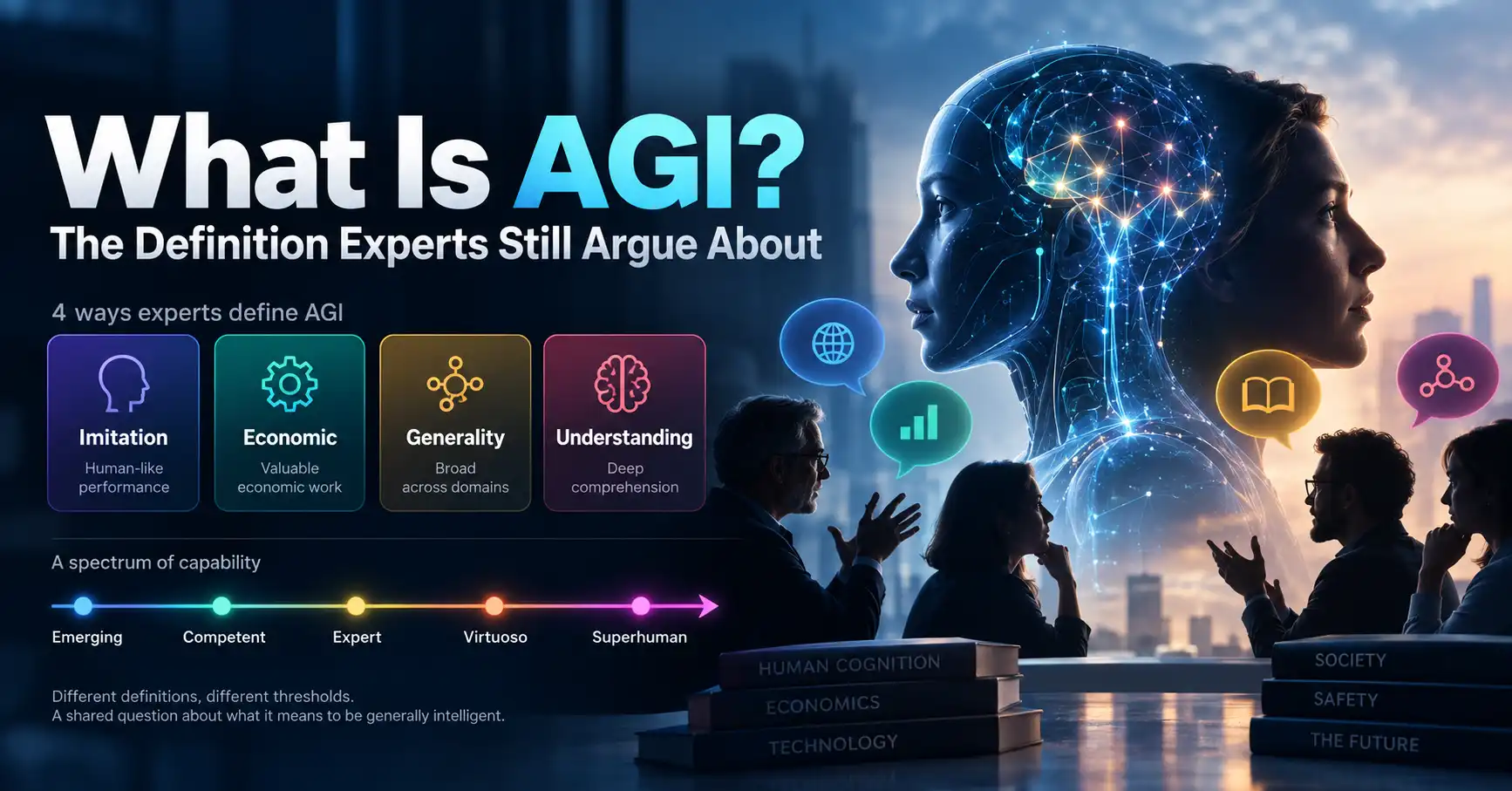
Google DeepMind’s “Levels of AGI” paper (Morris, Legg and colleagues, November 2023) splits the question along two axes. Performance is depth: how a system compares to human skill on a given task. Generality is breadth: how many kinds of task it handles at all.
Depth then gets five rungs:
- Emerging: roughly an unskilled human
- Competent: at or above the 50th percentile of skilled adults
- Expert: 90th percentile or better
- Virtuoso: 99th percentile or better
- Superhuman: better than every human
A narrow system can reach Superhuman and still occupy one thin column. ASI, artificial superintelligence, is that top rung stretched across the full width. AGI is the awkward middle.
The paper’s authors also set ground rules. Judge a system on capability, not on its internal machinery. Judge what it can do, not what someone has deployed it to do. That second rule has teeth, because it means a model sitting unreleased in a lab counts exactly the same as one shipped to millions.
If you want the whole ladder rung by rung, we’ve mapped the full narrow-to-superintelligent spectrum separately.
The four definitions experts actually argue from
Here is the part competing explainers skip. These four bars are not increasing degrees of strictness on one scale. They measure different properties, and they can rank the same two systems in opposite orders.
1. Can it pass for human? The imitation bar
This is the oldest bar and the one most non-specialists reach for. If you can’t tell it from a person, it’s thinking.
Researchers at UC San Diego ran a rigorous three-party version of the test. Given a humanlike persona prompt, GPT-4.5 got picked as the human 73% of the time, more often than the actual human participant did. Strip the persona prompt away and the figure fell to 36%.
Read those two numbers together. Less than half the outcome came from the model. The rest came from a costume.
That gap is why nearly every AGI researcher now treats imitation as necessary at best, never sufficient. Sounding right and being right come apart fast, which is also why AI deception matters more than the Turing test as a thing to worry about.
2. Can it do the work? The economic bar
OpenAI’s 2018 charter defines the goal as “highly autonomous systems that outperform humans at most economically valuable work.”
Notice what that sentence refuses to do. It says nothing about understanding, consciousness or architecture. It picks an outcome and measures it.
The appeal is obvious: you can audit economic output. Nobody has to settle metaphysics first. The weakness is equally obvious. A system could memorize its way through most paid work and still fall apart the moment conditions shift. Passing an exam and knowing a subject are not the same achievement.
3. Can it learn what it was never shown? The generality bar
François Chollet’s “On the Measure of Intelligence” (arXiv:1911.01547, 2019) makes the sharpest move in this whole debate. He defines intelligence as skill-acquisition efficiency over a scope of tasks, relative to prior knowledge and experience.
Skill itself doesn’t count. His reasoning: unlimited priors or unlimited training data let experimenters simply “buy” arbitrary levels of skill without the system generalizing at all.
Flip that around and it gets uncomfortable. Under Chollet’s definition, needing internet-scale data to reach a given skill level is evidence of low intelligence, not high. A child who learns the same rule from three examples scores better.
The ARC-AGI benchmark exists to enforce this. It restricts itself to core knowledge priors present in early human development, precisely so that pretraining scale can’t be used to game the test.
4. Does it actually understand? The mechanism bar
The last camp cares about what is happening inside.
Yann LeCun, Meta’s chief AI scientist, put it bluntly at CES 2025: “There’s absolutely no way … that autoregressive LLMs, the type that we know today, will reach human intelligence. It’s just not going to happen.” His argument is that these models only ever learn from text, while human intelligence grows out of multimodal, physical sensory experience. Pure scaling, he says, is saturating.
The strictest version of this bar is Strong AI, which demands genuine understanding or consciousness. The softer version just demands a working internal model of the world. Either way, benchmark scores alone won’t settle it. That question deserves its own treatment, and we’ve asked directly whether large language models understand language.
Why today’s models clear some bars and fail others
Take one class of system, frontier chat models, and run it past all four.
Imitation: cleared, loudly. See the 73% figure above.
Economic: partial, and genuinely hard to score. Microsoft Research’s “Sparks of Artificial General Intelligence” paper (Bubeck et al., March 2023) remains the most-cited optimistic claim, arguing GPT-4 “could reasonably be viewed as an early (yet still incomplete) version of an artificial general intelligence (AGI) system.” The evidence was unprompted competence across coding, math, medicine and law.
Gary Marcus answered within days. He called the idea that GPT-4 attains a form of general intelligence “a silly claim that would never survive serious scientific peer review,” and noted that hallucinations, reliability and planning on complex tasks all remained unsolved.
Both readings come from the same model. They differ on how much a glowing capability demo is worth.
Generality and efficiency: failed. This is the cleanest miss. Frontier models lag badly on ARC-AGI relative to how they perform on benchmarks that sit closer to their training distribution. The tasks are easy for people and resist being bought with more data, which is exactly the point of the design.
Mechanism: failed, by LeCun’s account. No grounded world model, no sensory grounding, degraded performance once you step outside familiar territory.
IBM’s editorial verdict lands in the same place, citing missing reliable reasoning, long-term memory, real-world understanding and autonomous learning.
So the honest summary is not “almost AGI” or “not AGI.” It’s that a single system can be simultaneously past one finish line and nowhere near another. Any headline that ignores this is selling you a bar it never named.
Does AGI have to be conscious?
Short answer: under most definitions in current use, no.
DeepMind’s framework says so directly by focusing on capabilities rather than processes. OpenAI’s charter sidesteps it. Chollet’s efficiency measure never raises it. Only Strong AI makes consciousness a requirement.
There’s a practical reason for that consensus, and it isn’t squeamishness. We have no agreed test for machine consciousness. Building it into your definition of AGI means you can never confirm you’ve arrived.
Which doesn’t make the question unimportant. It makes it a separate question, with separate stakes, and it belongs in the ethics conversation rather than the capability one.
Why the disagreement isn’t only about words
DeepMind built its levels framework for a stated reason: researchers, companies and policymakers needed a shared vocabulary so that capability claims and safety decisions stop resting on an undefined term.
Look at what rides on the definition right now.
Money and governance. OpenAI’s charter ties its structure and its obligations to whether and when AGI arrives. That makes the economic definition a live legal question inside one of the most influential organizations in the field, not a philosophy seminar. We’ve covered why the OpenAI definition and the Microsoft deal both matter.
Timelines. Every forecast you read is really a forecast about one specific bar. “AGI by 2030” under the economic reading and “AGI by 2030” under Chollet’s reading are not the same prediction. They might not even be compatible.
Regulation. Draft rules that trigger on “general-purpose” or “human-level” capability inherit whatever ambiguity sits in the term. A vague threshold is a threshold that lawyers argue about for years.
Safety research. Where you point your effort depends on what you think is coming. A brittle system that fakes competence needs different safeguards from one that genuinely generalizes.
How to read the next “AGI is here” headline
You will see that headline again. Probably soon. Five questions defuse almost all of them.
- Which bar is being claimed? If nobody names one, the claim is unfalsifiable by design.
- Does the demo involve genuinely novel tasks? Or tasks that resemble something already in the training data? Chollet’s whole argument turns on this distinction.
- How much scaffolding is doing the work? A persona prompt moved that Turing result from 36% to 73%. Prompting, tools and retrieval all inflate apparent capability.
- Does the performance hold up under repetition? Reliability is a capability. A system right 80% of the time cannot be trusted with a task that must be right every time.
- Who benefits from the word being used loosely? Sometimes the answer is nobody. Often it isn’t.
Run those five and you rarely need anyone else’s verdict.
So pick your bar, and say it out loud
My own view: the economic definition will probably be the one that “wins,” not because it’s the best but because it’s the easiest to argue about in public and the one with contracts attached. That’s a shame. Chollet’s is the more interesting bar, and the one that would actually tell us whether we’d built something new rather than something very well-read.
The useful habit is smaller than choosing a side. It’s just insisting that everyone name their bar before they make a claim. Do that and most AGI arguments either resolve in a minute or turn into a much better conversation.
Next time someone tells you a system has crossed the line, ask them which line. Then tell us in the comments what they said, because the answers are usually more revealing than the announcement.