
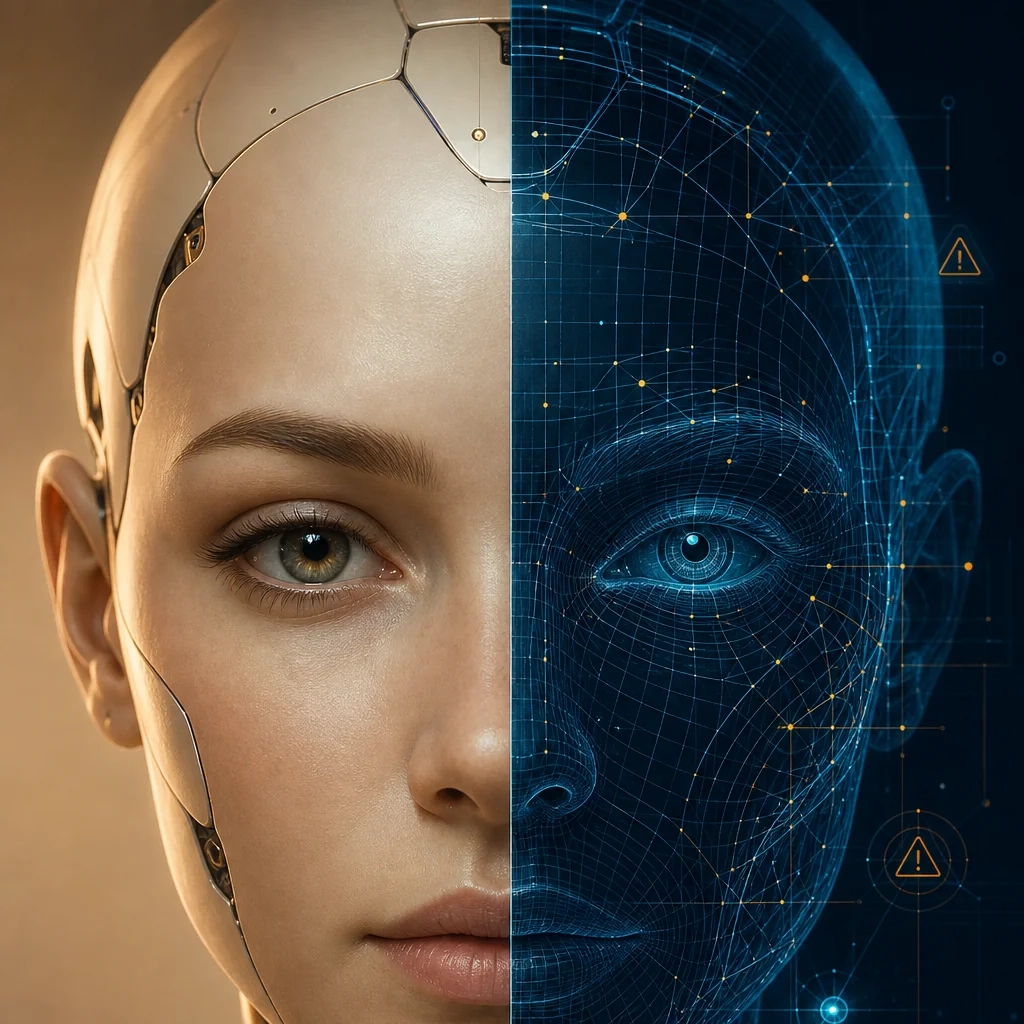
Two robots shipped this summer, eight days apart. One mimics a human so convincingly you might mistake it for a relative. The other exists to stop a robot from hurting the person beside it. Neither company mentioned the other. That gap sits at the heart of humanoid robot safety right now.
Here’s the tension worth holding. The realism is arriving faster than the rulebook. A machine designed to earn your trust is not the same as a machine proven to deserve it, and in 2026 the industry is selling the first while still drafting the second.
So the real question isn’t “are robots getting safer?” They are, on one front. It’s whether they’re becoming convincingly human faster than anyone can verify they’re safe to live with.
A Face and a Nervous System, Eight Days Apart
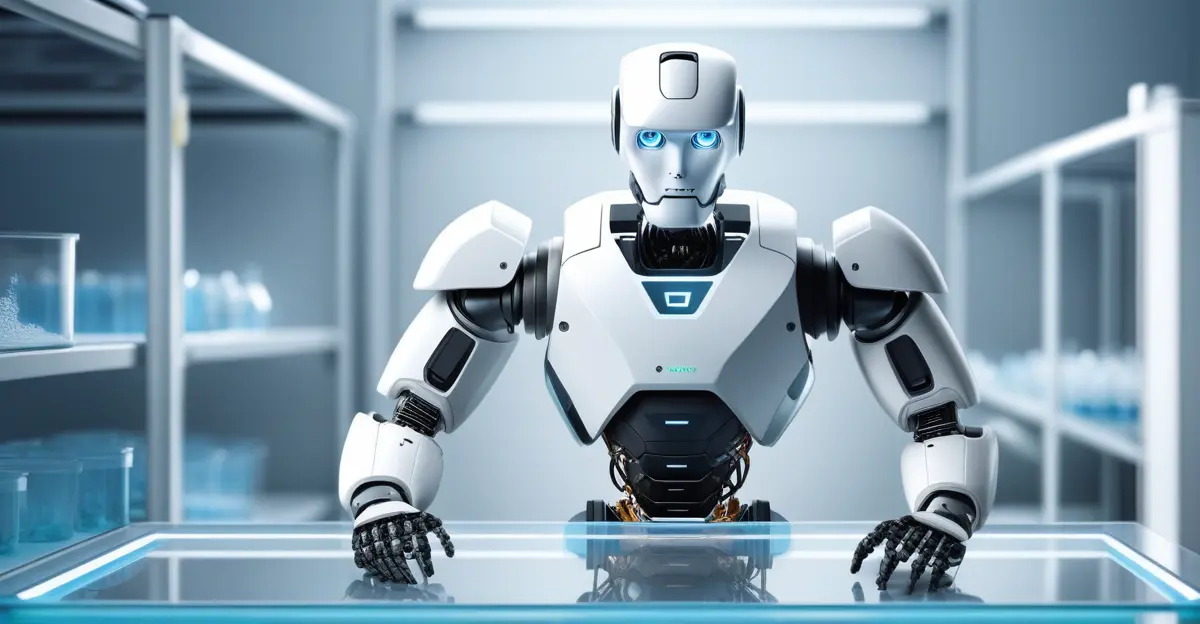
On June 30, 2026, UBTECH held its global launch in Shenzhen. It unveiled the UWORLD U1, billed as the “world’s first full-size, mass-produced ultra-bionic humanoid robot.” Pre-orders had already crossed 13,361 units by launch day (PR Newswire). This isn’t a lab demo. It’s a product with a waiting list.
Eight days earlier, on June 22, Nvidia announced Halos for Robotics at Automate 2026 in Chicago. Nvidia calls it the industry’s first full-stack functional-safety system for physical AI (NVIDIA Newsroom). One launch sells presence. The other sells protection.
One caveat has gone unnoticed. The U1 is aimed at living rooms. Halos is aimed at warehouses. Its named first adopters are all industrial: Agility Robotics, whose Digit humanoid already works at Amazon, GXO, Schaeffler, and a Toyota plant, plus Boston Dynamics (NVIDIA Developer Blog). Nvidia engineered the safety architecture for the factory floor. UBTECH sells the realism straight into the home, with no equivalent layer along for the ride.
Why Companies Are Racing Toward Hyper-Realism Right Now
The timing isn’t random. It traces to one specific breakthrough. In January 2026, Columbia Engineering published work in Science Robotics on a robot named Emo that taught itself realistic facial expressions. It learned by watching itself in a mirror and studying hours of human video, driving 26 facial motors with no hand-coded rules (ScienceDaily). Lead professor Hod Lipson put it plainly: “We are close to crossing the uncanny valley.”
Here’s the part that should make you sit up. The paper’s lead researcher, Yuhang Hu, also founded a company. Aheadform builds commercial hyper-realistic robots, has raised over $14 million led by Ant Group, and ships a 42-motor face called “Elf Xuan” (Mike Kalil). The academic breakthrough and the product are, in at least one documented case, the same lab bench.
Realism is one way to close the gap between machine and living thing. Growing robots from soft, biological parts, which we looked at in why some future robots may be grown, not built, is another. Both chase the same finish line from opposite directions.
Then there’s the market. UBTECH points its pitch at China’s roughly 120 million single adults and 320 million people over 60, calling it a “colossal market.” Buyers can customize the U1 to resemble “a loved one, a celebrity or an imaginary character” (Macau Business). Prices run from about $16,500 to roughly $145,700 for the top tier (PR Newswire). Cheaper realism, aimed at lonely people, sold at scale. That’s the business.
This race also carries an uncomfortable history. The Sophia robot’s creator, David Hanson, appears in unclassified Epstein files requesting $3 million for an “attractive female android,” and Hanson Robotics’ then-chief scientist took Epstein funding (Mike Kalil). “Realism as a business model” has a track record worth scrutinizing, not just applauding.
Can Nvidia Halos Actually Keep People Safe?
On the industrial side, Halos is the real thing. It’s full-stack. The base is IGX Thor compute, delivering up to 2,070 FP4 TFLOPs behind an IEC 61508 SIL 3 Safety Island with more than 22,000 safety mechanisms. Above it sit a sensor protocol certified to SIL 2, an OS-level safety layer, and an accredited inspection lab that signs off on the whole thing (NVIDIA Developer Blog). The stack draws on more than 18,600 engineering-years of self-driving-car safety work.
“Physical AI is transforming how factories, warehouses and logistics operations work, and robotics teams need a unified safety architecture,” said Deepu Talla, Nvidia’s VP of robotics and edge AI (NVIDIA Newsroom). Forty-three companies have already joined the program. These are the same industrial floors where collaborative robots have shared space with people for years.
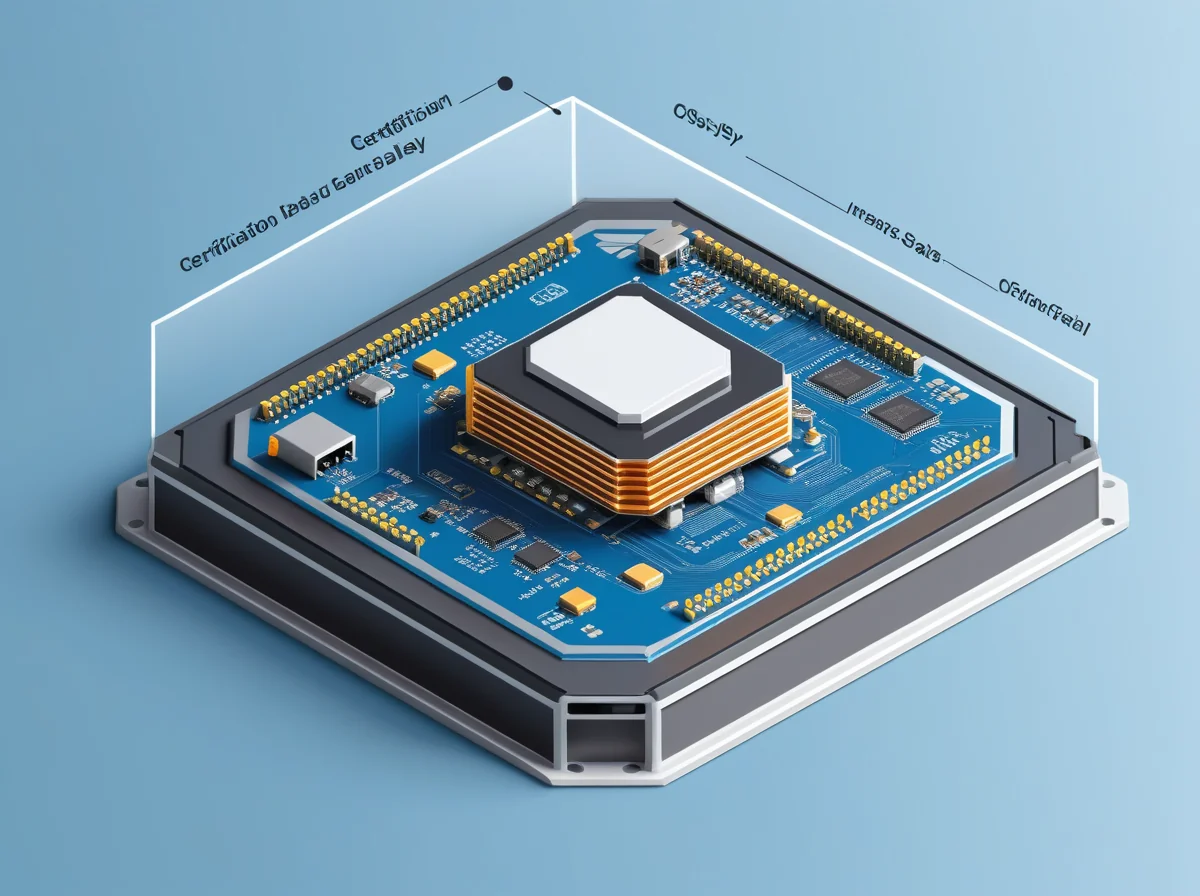
But read the fine print. Every named partner is industrial. Halos says nothing about the consumer companion robots that are actually shipping to homes. And that mirrors a wider blind spot. A scoping review of 121 studies found most humanoid robot safety research concentrates on physical human-robot contact, while cybersecurity, standardization, and social-ethical safety get far less attention (MDPI Electronics). Halos is superb at exactly the thing the field already over-invests in.
There’s also a governance wrinkle worth naming. Nvidia holds convenor roles in IEC 61508 and ISO/IEC TS 22440, and it contributes to ISO 25785-1 (NVIDIA Developer Blog). So the company selling the safety compute is also helping write the standard that compute will be judged against. That’s not illegal. It’s just a loop worth watching.
Where Humanoid Robot Safety Standards Really Stand in 2026
Now the awkward part. The standard meant to govern how a legged robot falls without hurting anyone, ISO 25785-1, still doesn’t exist. It’s a working draft. The group last met in Barcelona in October 2025, and publication may not land until 2026 or 2027 (ISO). One figure from the drafting work sticks with me: a 1.7-meter robot moving at 1.5 meters per second throws a fall zone about two meters wide in any direction (theresarobotforthat.com).
What does exist is narrower than it sounds. ANSI/A3 R15.06-2025, the current US standard, went on sale in September 2025. But it revises industrial and collaborative-robot rules, not humanoid or consumer ones (Business Wire). ISO is also updating ISO 13482 for personal-care robots this year, yet the revision sets no binding limits, test methods, or enforcement (IEEE Spectrum). It reframes the questions without answering them.
Europe isn’t ahead either. The EU AI Act’s high-risk obligations for exactly this class of product have slipped twice, now landing in December 2027 and August 2028, with draft classification guidance only opened for consultation in May 2026 (Debevoise Data Blog).
None of this is hypothetical. In February 2025, a robotic arm at Tesla’s Fremont plant knocked a worker unconscious during maintenance, with no proper lockout procedure in place. It’s one of the cases now feeding the standards rewrite (theresarobotforthat.com). The bodies are moving faster than the paperwork.
Is Physical Safety the Right Question for a Robot That Looks Like Grandma?
Notice who the standards actually protect. Factory workers. Trained adults near heavy machines. That is not who UBTECH is selling to.
The U1’s buyers are single adults and people over 60. They’re a psychological-safety population, not an industrial one, and no current standard touches psychological or deception harm at all. The discomfort here isn’t squeamishness. Neural-imaging research shows human brains produce a measurable error signal when they see a near-human face that isn’t quite right, which is the uncanny valley made literal (PLOS One).
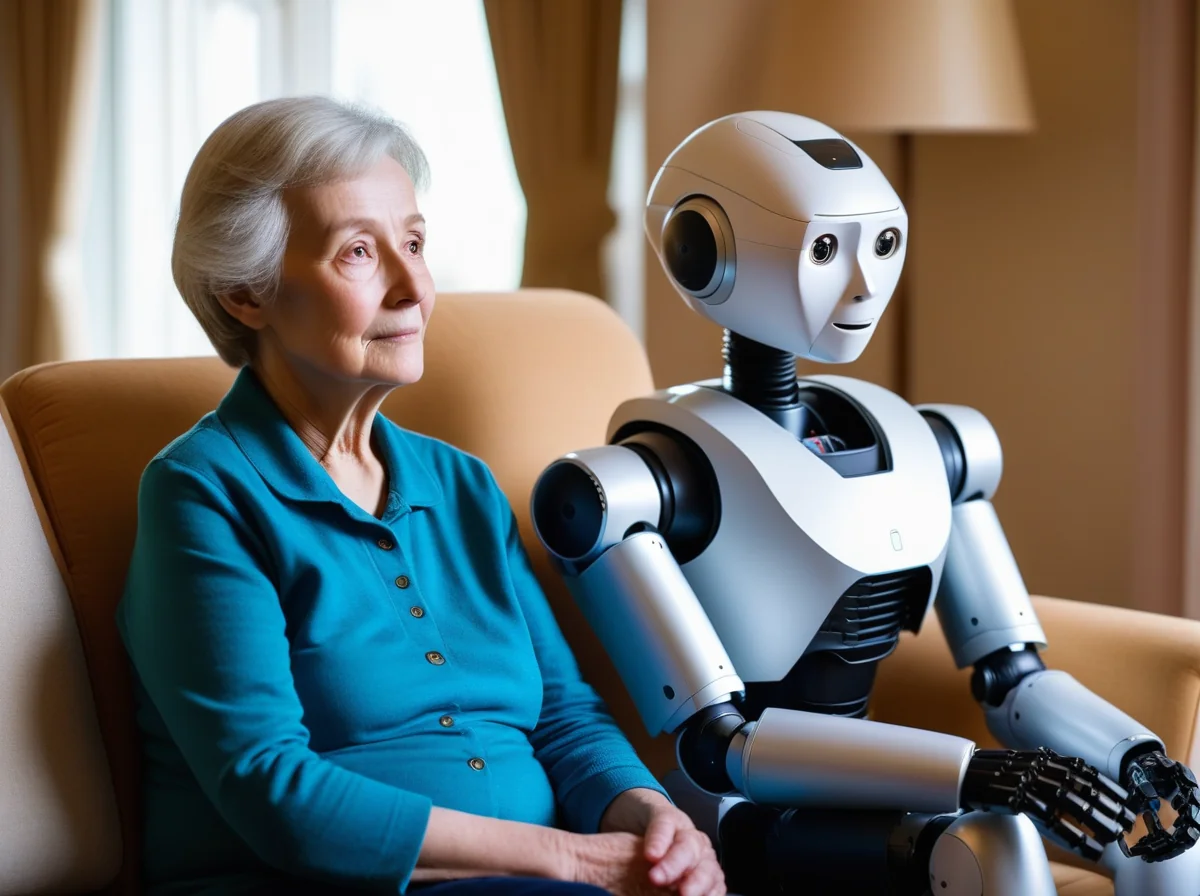
The end-user data is even more pointed. In a study of 825 older adults, 68.7% didn’t believe a companion robot would reduce their loneliness. Only 3.2% said “definitely yes.” And 69.3% felt uncomfortable being allowed to believe an artificial companion was human (Frontiers in Psychology). The premise the whole product category rests on is one its own target users mostly reject.
Ask the people who already live with assistive robots and it gets sharper. At a 2025 research workshop, researchers asked six experienced users with motor limitations about humanoid home robots. Not one wanted the humanoid form. Their reasons ran from “it’s creepy” to “it has to be 100 percent safe because I cannot escape it” (IEEE Spectrum). We made a version of this case about humanoid robots in the classroom: safe helpers, not nannies. The living room deserves the same caution.
When Deception Becomes the Business Model
Here’s what separates this from a normal safety story. The deception isn’t a bug. It’s the pitch. UBTECH markets the U1 as customizable to resemble “a loved one” and sells it as an “always loyal” companion (Macau Business). The attachment is the product. We’ve argued that AI deception matters more than passing the Turing test. A robot that convincingly plays human raises the same problem, now inside a body you can hold.
The U1’s specs are engineered for exactly that. It reads more than 20 emotional states, claims over 90% accuracy, and syncs speech to lip movement in under 20 milliseconds (PR Newswire). Every one of those numbers exists to help you forget you’re talking to a machine.
MIT’s Kate Darling has spent years on this problem. Her argument is direct: current laws “were not designed for technologies that act like friends while quietly collecting data or shaping behavior,” and “the only way to address it is with regulation” (Sanford School of Public Policy, Duke). Market pressure won’t fix it, because the market is the thing creating it.
The consumer-protection tools we already have weren’t built for this. Illinois’ biometric law sets damages of $1,000 to $5,000 per violation, COPPA demands verifiable parental consent for under-13 users, and the CPSC still assumes products stay “substantially unchanged after leaving the factory” (AI Frontiers). An always-on robot that scans faces and keeps learning breaks all three assumptions at once.
Who’s Accountable When a Humanoid Robot Fails?
Say a home humanoid does hurt someone. Who pays? Right now, nobody can tell you cleanly. US product-liability law grew up around Roombas and bolted-down robot arms, not autonomous machines that update themselves overnight (AI Frontiers). Manufacturer, software vendor, or owner: the law hasn’t settled it.
Legal scholars know it, too. Work in the German Law Journal is actively trying to “reconstruct” liability rules built specifically for humanoid-robot accidents (Cambridge Core). You don’t rebuild a framework that’s working fine.
The stakes keep climbing while the questions stay open. Goldman Sachs pegs the humanoid market at $38 billion by 2035. Figure AI has raised over $1.75 billion at a $39 billion valuation. Unitree’s R1 already sells for $4,900 (AI Frontiers). The price floor is dropping fast, and cheaper robots mean more of them in more homes before any of this is resolved.
What “Safe Enough” Would Actually Look Like
The industrial side has already figured out the shape of the answer. Safety is shifting from a property of the device to a property of the system. Nvidia’s Halos and the ISO 13482 revision both reframe it that way, treating safety as a relationship between human and machine rather than a number on a spec sheet (IEEE Spectrum).
The consumer side of humanoid robot safety has nothing like it. There’s no Halos for consent. No inspection lab for emotional manipulation. No certificate that a robot sold to a lonely 80-year-old won’t quietly reshape how she spends her days. The same reframing that industrial robotics accepted applies just as cleanly to a companion robot, and nobody has built it.
Maybe that’s the real test. Not whether a robot can pass as your grandmother, but whether the people selling it can prove they’ve earned the trust they’re engineering you to feel. On today’s evidence, they can’t yet. Fewer than one in ten Americans say rising AI use makes them more excited than concerned, and nearly half don’t trust the government to regulate it well (Pew Research Center). That skepticism looks less like technophobia and more like people reading the room correctly.
So watch the next launch. When a company shows off a face that fools you, ask what safety layer shipped with it. If the answer is a demo reel and a waiting list, you already know which race is winning.