
Picture a bed in a neuro ICU. The patient hasn’t squeezed a hand or opened their eyes in days. Then a computer reading their brainwaves picks up something: they’re trying. That’s the scene behind a new hidden consciousness BCI study from Columbia University, which appeared in the journal Brain on Oct 22, 2026.
The headlines say unresponsive patients controlled sound with their minds. That’s true. But “controlled a tone” and “can talk to their families” are not the same claim. In hidden consciousness BCI research, the gap between those two sentences is where the real story sits.
So here’s what the study actually found, how it works, and why the hardest part isn’t the technology at all.
What Columbia’s hidden consciousness BCI study found
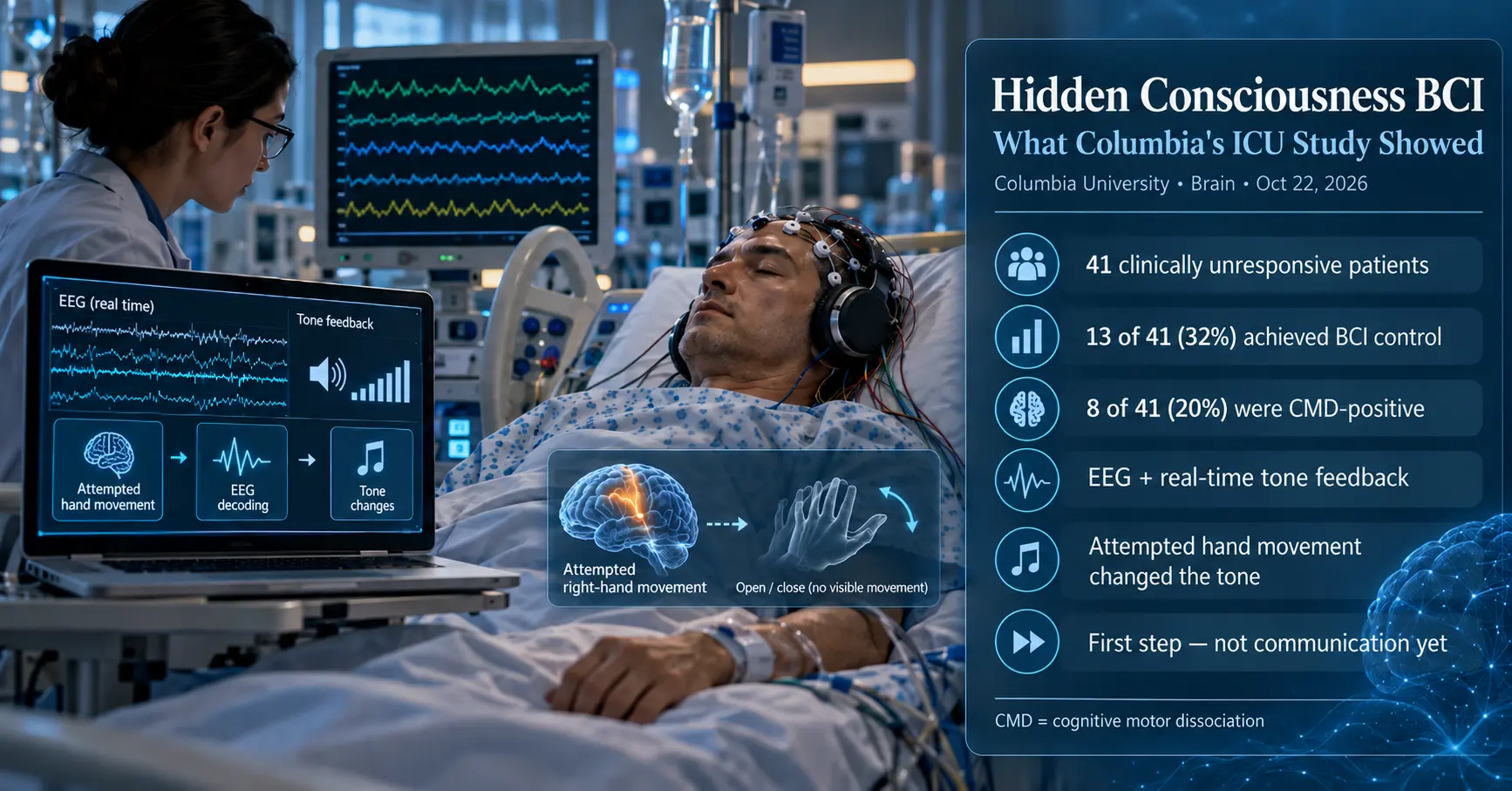
The paper is Shen et al., with Qi Shen as first author and neurologist Jan Claassen as senior author. The team tested a brain-computer interface on 41 clinically unresponsive patients with acute brain injury, a few days after they arrived in hospital.
The setup is almost charmingly simple. A beeping tone plays through headphones. Next, a recorded voice asks the patient to change the pitch by trying to open and close their hands. A bedside computer reads the EEG in real time, and the voice encourages or congratulates them as the tone shifts.
After a brief training period, about one in three patients controlled the tones, according to Columbia’s announcement. That group included every patient in whom a separate exam had already detected hidden awareness. And they did it within days of a severe injury.
Claassen is careful about the framing: “Our brain-computer interface is only a first step, but it shows that, in principle, we could hopefully in the future give some of these patients a voice.”
“In principle” is doing honest work in that sentence.
What is cognitive motor dissociation?
The clinical name for hidden consciousness is cognitive motor dissociation, or CMD. A patient with CMD doesn’t respond at the bedside. But their brain activity shows they tried to follow the instruction and couldn’t move. For hidden consciousness BCI work, Columbia’s team has found evidence that the problem is a broken link between the brain’s higher-thinking regions and its motor-control regions.
How often does this happen? The answer depends on who’s counting and how.
- A 2019 Columbia study using EEG and machine learning found signs of it in 16 of 104 unresponsive acute brain-injury patients, about 15%.
- A 2024 six-center study in the New England Journal of Medicine found CMD in 60 of 241 patients with no observable response to commands, or 25%. That cohort mixed acute and long-term patients, and it used fMRI, EEG or both.
Those numbers also matter for recovery. In the 2019 study, 41% of patients with early CMD reached functional independence within a year, versus 10% of those without it. However, Harvard Medicine Magazine calls the overall evidence on prognosis “mixed.” Some studies found CMD didn’t predict outcomes at all.
How a hidden consciousness BCI reads an attempt to move
The core idea is old and well tested. When you imagine or attempt a movement, your brain produces a pattern that looks a lot like the real thing. Joseph Giacino, quoted by Harvard, says these patterns “have a sort of signature” of doing or imagining the task. Researchers first checked that signature in healthy volunteers.
The field arguably traces back to a 2006 fMRI study in which a patient was asked to imagine playing tennis. Columbia’s twist is to close the loop:
- The patient hears the instruction and tries to move their hands.
- The EEG picks up the attempt.
- Software decodes it on the spot.
- The tone changes, so the patient gets feedback that it worked.
Claassen says “the only sophisticated part” is the real-time analysis software. If you want the general version of this pipeline, our explainer on how brain-computer interfaces work walks through each stage, from signal to decoder to output.
Why non-invasive matters in the ICU
Most BCIs in the news are implants. They’ve helped people with spinal-cord paralysis and ALS. But Columbia says the implant route “is not ideal” for patients who were injured days ago and are still critically ill. Nobody wants brain surgery as a diagnostic test.
EEG avoids that problem entirely, which matters for hidden consciousness BCI. “EEG is used in clinical practice every day in the ICU,” Claassen says. The wiring is already on many of these patients’ heads.
fMRI can do more in theory, including pulling yes/no answers out of a single patient. Still, Columbia calls it “not practical for routine use.” Harvard adds that few centers have the scanners or the experts, so Mass General is trialing remote “TeleConsciousness” assessments. We cover those trade-offs in more depth in EEG vs fMRI vs ECoG.
There’s an ethics angle here too. Nature Neuroscience’s October 2026 neurotechnology special issue carries a Comment arguing that implanted BCIs need clearer rules. It calls for separating research from care, long-term support for participants, and no disproportionate risk. That piece is about implants, not this study. My read is that an EEG approach sidesteps several of those burdens, which is part of the case we made in invasive vs non-invasive BCIs. Yet it raises different problems of its own.
What the hidden consciousness BCI study did not show
This is the part most rewrites of the press release skip.
- It isn’t communication yet. Patients raised or lowered a tone. They didn’t answer questions, report pain or say they were hungry. Those are Columbia’s future goals.
- Most patients didn’t control the tone. “About one in three” succeeding means roughly two in three did not.
- Failing doesn’t mean unaware. In the 2024 cohort, 112 patients could follow commands at the bedside. Yet 69 of them, over 60%, failed the fMRI/EEG tests. These tests miss conscious people. So the one-in-three figure works as a floor on awareness, not a ceiling.
- We don’t have the fine print. The press materials don’t report effect sizes, per-patient accuracy or false-positive rates. We couldn’t access the full paper, so we won’t guess.
- It’s not in hospitals. Columbia says CMD identification techniques “are still not available outside of research studies.”
Harvard also notes that using brain-imaging methods for yes/no answers “has only worked on rare occasions.” A tone you can nudge up and down is real progress. It’s also a long way from a conversation.
Can you trust a hidden consciousness BCI’s “yes”?
Here’s why this research keeps neurologists up at night. Harvard reports that about 70% of ICU deaths after traumatic brain injury follow the withdrawal of life support, often within the first three days. Families and doctors make those calls largely on whether the patient seems conscious.
Now add a test that can sometimes rule awareness in but can’t rule it out. For hidden consciousness BCI, Brian Edlow of Mass General puts it bluntly: “The question is, once you identify someone as being covertly conscious, what now?”
The open questions pile up fast:
- Do hospitals have a moral duty to test every unresponsive patient?
- Does sharing an uncertain result give families false hope?
- How do you enroll someone in a trial when they might be aware but can’t consent?
Penn neurologist David Fischer notes that it’s often impossible to know for sure that someone is unconscious. Michael Young at Mass General argues for “diagnostic humility.” He describes a recovered patient who remembered conversations at his bedside while clinicians assumed he couldn’t hear.
That’s a striking inversion of the debate we usually have on this site. Our piece on AI consciousness asks whether a machine that seems aware really is. Here the risk runs the other way: a person who seems absent may be fully there.
What happens next
Patients’ families told the Columbia team the BCI felt helpful. They suggested adding a loved one’s voice and culturally relevant details. They also asked for ways to detect pain, hunger and awareness. Those ideas now shape the team’s next steps.
Columbia isn’t alone, either. A University of Bath group reported in June 2026 that a wearable EEG headset with repeated audio feedback raised detection of a minimally conscious state from 39% to 69% when added to standard bedside tests. But Bath studied people with long-term disorders of consciousness. Columbia studied patients days after injury. Two groups pointing the same way is a trend, not a replication.
My take: this is one of the most humane uses of a BCI anyone has published this year, precisely because it asks for so little hardware. Yet the technology may move faster than our answers to Edlow’s question. A beep that rises on command is a knock on the wall from someone we thought was gone. What we owe them once we hear it is still up to us.