
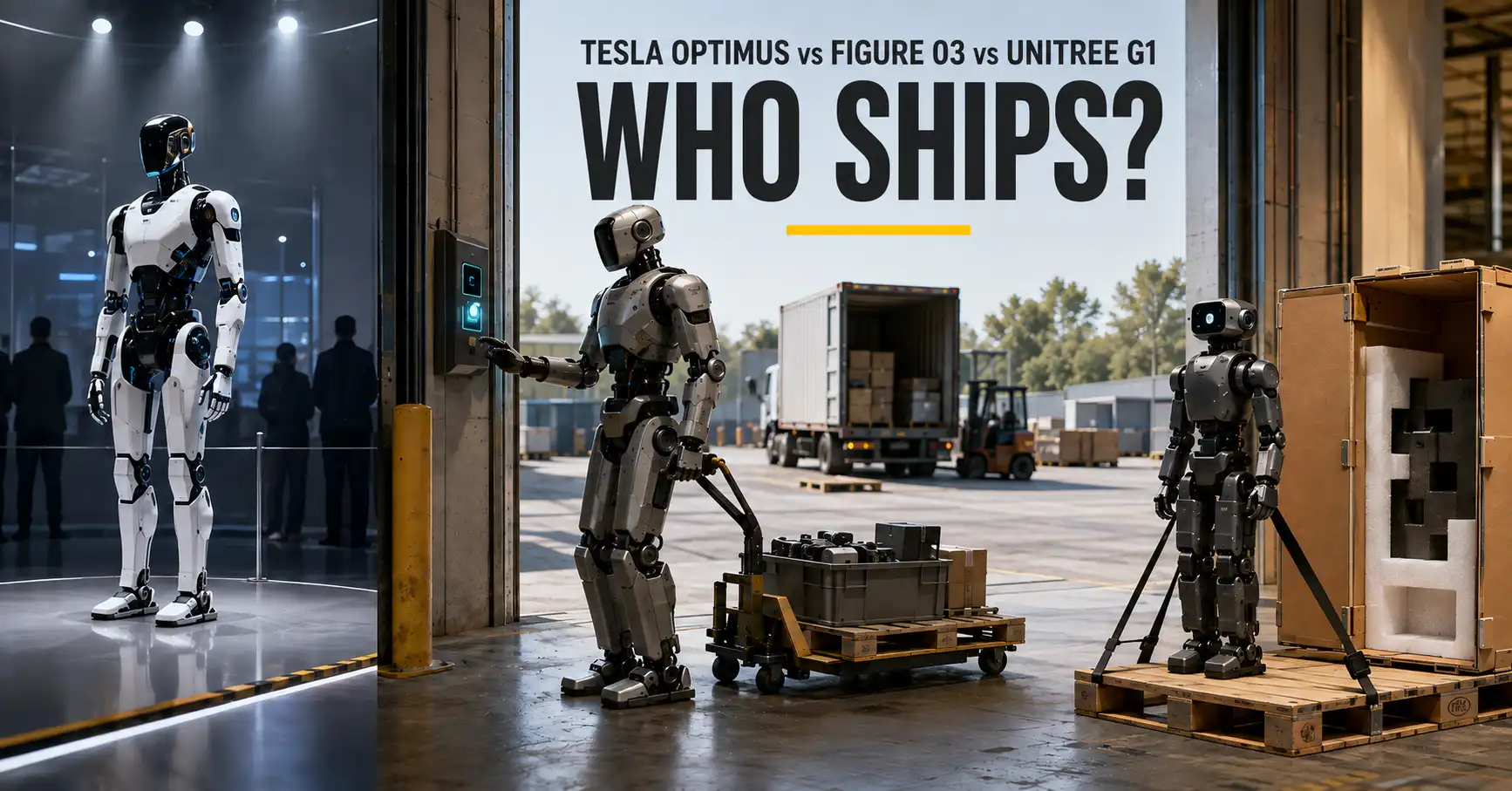
A robot in a demo reel and a robot clocking in at a loading dock are not the same product. That gap is the entire argument behind Tesla Optimus vs Figure 03 vs Unitree G1, the three names that swallow every humanoid robot conversation in 2026.
Most comparisons score them out of 100. Figure 03 gets a 78.9, Optimus gets a 45.1, someone declares a winner, everyone moves on. It’s a tidy answer to the wrong question.
These three machines aren’t competing yet. One is a research project living inside its maker’s own factory. One does a single job for a single paying customer. One you can add to a cart. Sorting them by degrees of freedom hides that, and the hiding is where the hype survives.
“Shipping” is the only spec that matters right now
Ask what a humanoid robot can do and you’ll get a spec sheet. Ask who is paying for it to do that thing, today, and the field thins out fast.
That’s the filter worth applying. Not top speed. Not actuator count. Who signed a purchase order, and what happens on Monday morning?
By that test, the three robots land in three different categories entirely.
Tesla Optimus: still in the R&D phase, in Musk’s own words
Tesla’s own earnings call did more damage to the Optimus timeline than any critic did. On 28 January 2026, Elon Musk described the program plainly: “It’s still in the R&D phase. We have had Optimus do some basic tasks in the factory.” He added that the robots working inside Tesla plants are there so the robot can learn, not to produce output (Tesla Q4 2025 earnings call transcript).
He went further. Tesla wouldn’t expect significant Optimus production volume until probably the end of 2026. The long-term plan is real and on the record, convert the Fremont Model S/X line into an Optimus line, eventually a million units a year. No delivery date attaches to any of it.
Then there’s the Gen 3 question, which trips up most coverage. “Gen 3” so far means a hand. A very good hand: 25 actuators and 22 degrees of freedom per hand, roughly 4.5 times the actuator count of Gen 2 and double the DoF. Musk posted demo footage of it in February 2026. The body underneath is still the Gen 2 design, and a full Gen 3 product has never been revealed publicly.
So the hands are ahead of the field on paper. Nobody outside Tesla has tested them on real work. We looked at what Optimus Gen 3 might mean for AGI separately, and the same caveat applies there: capability demos are not deployment.
Figure 03: one customer, one task, actual money
Figure took the opposite route. Instead of a reveal event, it got a factory.
BMW now deploys Figure 03 at its Spartanburg, South Carolina plant for just-in-sequence logistics, picking unsorted components and sorting them into sequencing trolleys that feed assembly workers. This follows an 11-month Figure 02 pilot that supported production of more than 30,000 BMW X3 vehicles in 2025 (The Robot Report).
That’s not a pilot repeating itself. That’s a second generation earning a second contract.
Figure CEO Brett Adcock framed the result bluntly: the 11-month Figure 02 deployment “proved that humanoids are no longer lab experiments. They can be a valuable asset in establishing a flexible, reliable manufacturing workforce.”
The hardware matches the job. Figure 03 stands about 5’8″, weighs 61 kg, carries a 20 kg payload, runs five hours, and tops out at 1.2 m/s. Its hands carry tactile sensors and embedded palm cameras. It charges wirelessly and handles speech-to-speech audio. Every one of those choices points at dexterous picking in a warehouse aisle.
Now the counterweight. Yann LeCun, speaking at MIT in October 2025, dismissed the whole cohort of humanoid companies: “They have no idea how to make these machines smart enough to be generally useful.” His critique lands on vision-language-action models generally, Figure’s Helix approach included. Read it as a claim that impressive behaviour and general intelligence are different things. Figure sorts parts very well. Sorting parts is not thinking.
One customer is also one customer. It’s the strongest evidence in this comparison, and it’s still narrow.
Unitree G1: the only one with a buy button
Here’s where the ranking flips. You cannot buy an Optimus. You cannot buy a Figure 03. You can buy a G1 today.
Unitree lists the base G1 at $13,500 direct, currently backordered, with US dealers pricing it around $17,990 to $21,800 (Unitree G1 product page). The widely repeated $16,000 figure is the 2024 launch price and no longer reflects what anyone pays.
The base machine stands 1.32 m, weighs about 35 kg, has 23 degrees of freedom, runs roughly two hours, and carries about 2 kg per arm.
And then the catch that almost every buyer’s guide skips. Unitree’s own store listing says the base G1 does not support secondary development. No SDK. No code deployment. You get a very capable robot you cannot program. Real programmability starts at the G1 EDU tier, which US resellers price between $43,900 and $73,900 depending on configuration.
So the “accessible developer robot” narrative needs an asterisk roughly three times the size of the sticker price.
The specs carry real trade-offs too. Two hours of battery against Figure 03’s five. Two kilograms of arm payload against twenty. That isn’t a bargain version of an industrial humanoid. It’s a different class of machine wearing a similar silhouette.
Tesla Optimus vs Figure 03 vs Unitree G1: the head-to-head table
| Feature | Tesla Optimus | Figure 03 | Unitree G1 (base) |
|---|---|---|---|
| Can you buy it? | No public price, not for sale | No public price, enterprise only | Yes: $13,500 direct, $17,990–$21,800 via dealers |
| Height | Not published (Gen 2 body) | ~5’8″ | 1.32 m |
| Weight | Not published | 61 kg | ~35 kg |
| Payload | Not published | 20 kg | ~2 kg per arm |
| Runtime | Not published | 5 hours | ~2 hours |
| Top speed | Not published | 1.2 m/s | Not published |
| Hands / DoF | Gen 3 hand: 25 actuators, 22 DoF each | Tactile sensors, palm cameras | 23 DoF total (whole body) |
| Real deployment | Tesla’s own factories, learning only | BMW Spartanburg, just-in-sequence logistics | Research, education, developers |
| Programmable? | Internal only | Enterprise integration | Not on base tier; EDU from $43,900 |
| Status | R&D phase (Musk, Jan 2026) | Second-generation production deployment | On sale, backordered |
Read the top row twice. It settles more than the other ten combined.
Why China’s production numbers change the argument
There’s a structural fact behind the G1’s availability that rarely makes it into these comparisons.
TrendForce forecasts China’s humanoid robot output growing 94% in 2026, with Unitree and AgiBot together projected to take close to 80% of total shipments. That’s a manufacturing story, not an intelligence story. Nobody is claiming the G1 out-thinks Figure’s Helix stack.
But manufacturing scale is exactly what puts a robot on a shelf with a price on it. Tesla and Figure are building capability first and volume later. Unitree built volume first. In 2026, volume is what “shipping” looks like.
Longer term, Morgan Stanley’s projection of roughly 930 million humanoid robots in industrial and commercial use by 2050 (302.3 million of them in China, 77.7 million in the US) points the same direction. Treat that number as a forecast, not a fact. Thirty-year robotics predictions have a poor track record.
So who takes the factory job first?
Nobody, this year.
Trade coverage broadly treats 2026 as a validation year rather than an adoption year, with factory-scale rollout expected in the 2030s. The deployments running now supplement narrow, repetitive tasks. Optimus collects data at Fremont. Figure 03 sequences parts at Spartanburg. Neither replaces a headcount line item.
That timeline matters more than any spec argument, because it shapes what people prepare for. If you’re a logistics worker reading breathless coverage of a robot that walks, the honest answer is that the machine coming for your role does one task, badly at first, under supervision, for a single employer. The pattern looks a lot more like the gradual arrival of collaborative robots than a sudden swap.
It also raises the questions this site keeps circling. A robot that shares floor space with people is a safety problem before it’s a productivity one, which is why the gap between humanoid realism and the rules governing it keeps widening.
What I’d actually watch
If you want one signal to track over the next year, ignore the reveal events. Watch for a second named customer.
Figure has BMW. That’s one. The moment a second manufacturer signs, the “humanoids are real” claim stops resting on a single deployment and starts looking like a market. Until then, Figure is a very good proof of concept with a purchase order attached.
For Tesla, the signal is simpler still: an Optimus doing work Tesla would otherwise pay someone to do. Not learning. Working.
And for Unitree, watch whether the base tier ever opens up. A locked-down robot at $13,500 sells hardware. An open one at that price would do something much more interesting, put a programmable humanoid in a few thousand garages, which is historically how platforms stop being products. The strangest possibility is that the machine that changes this field isn’t the most advanced one. It’s just the one enough people got their hands on.
Which of the three would you actually bet on? Tell us in the comments. And if you want the longer view on where machine bodies are heading, start with why some future robots may be grown rather than built.