
People use “AI” as if it were one thing, but the field quietly spans an enormous range, from software that does a single narrow job to a hypothetical intelligence that would outclass humanity at everything. Three labels mark the key points on that range: narrow AI, AGI, and ASI. Getting them straight is the difference between understanding the news and being spooked by it.
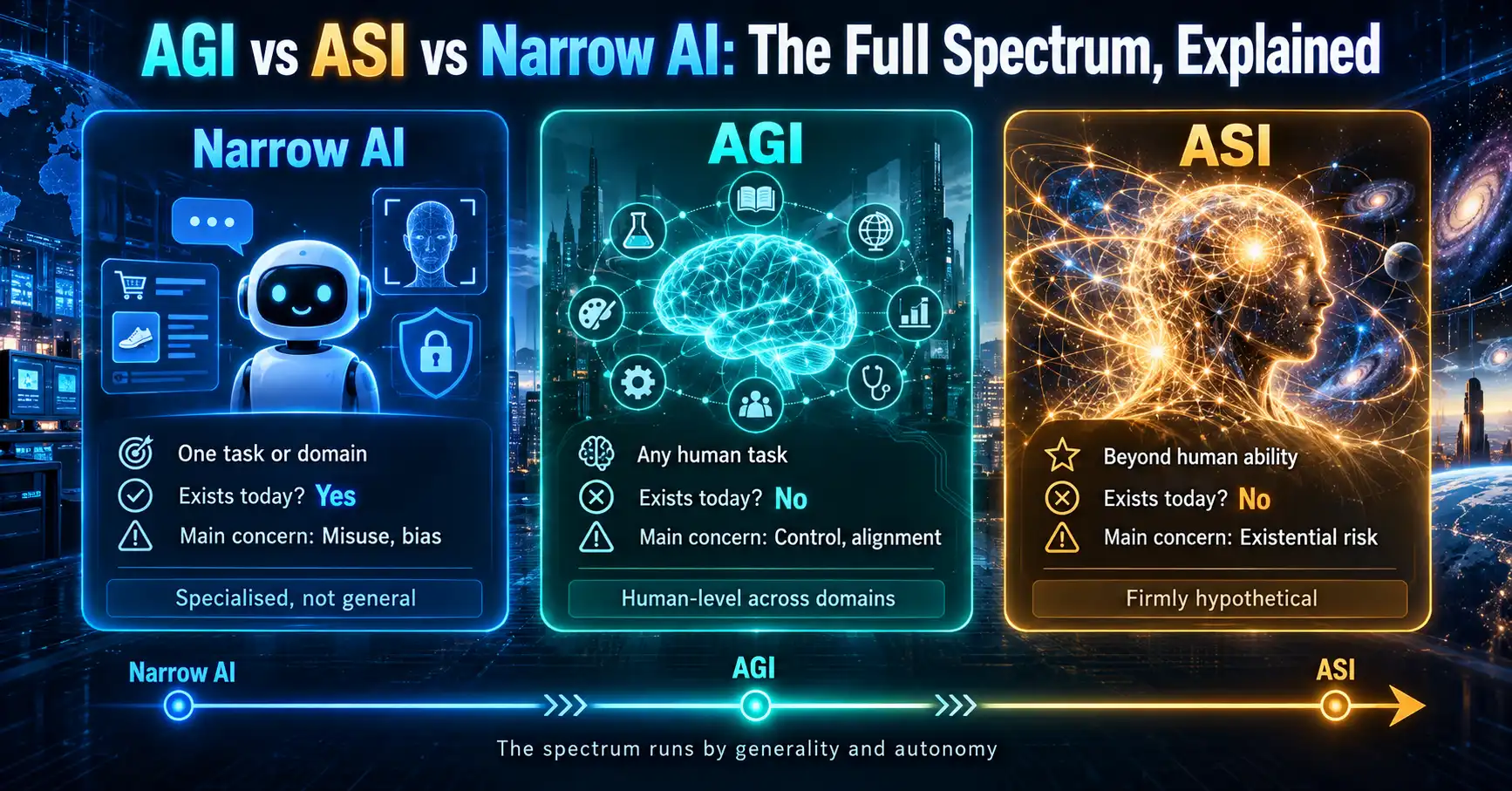
In plain terms: narrow AI does one thing well and is all around you today. AGI would match a human across essentially any task, and it does not exist yet. ASI, artificial superintelligence, would surpass human intelligence entirely, and it remains firmly hypothetical. The spectrum runs by generality and autonomy.
The spectrum at a glance
[SPEC] PARADIGM_METRIC |
[01] NARROW_AI // ANI |
[02] GENERAL // AGI |
[03] SUPER // ASI |
|---|---|---|---|
|
Capability
VECTOR // CAPACITY_BAND
|
One task or domain High performance in bounded objective space
|
Any human task Universal generalization, reasoning & autonomous transfer
|
Beyond human ability Uncapped cognitive supremacy across all problem classes
|
|
Exists today?
TELEMETRY // DEPLOYMENT
|
● YES // PROD_ACTIVE |
○ NO // R&D_FRONTIER |
∅ NO // THEORETICAL |
|
Main concern
THREAT // VECTOR_CRITIC
|
RISK // MISUSE_BIAS
Misuse, bias, hallucination, copyright |
RISK // ALIGN_CONTROL
Control, alignment, goal hacking |
CRITICAL // EXISTENTIAL
Existential risk, uncontainable agency |
Narrow AI: where we actually are
Every AI system in real use today is narrow. It is trained for a specific job (recommending videos, detecting fraud, generating text, recognising faces) and it does not transfer that skill anywhere else. This is true even of the most impressive large language models. They are astonishingly capable within language tasks, but a chatbot cannot decide to go learn to drive a car on its own. Narrow does not mean weak; it means specialised. The risks here are real but human-scaled: misuse, bias, and error, rather than anything science-fiction.
AGI: the milestone that keeps moving
Artificial general intelligence is the threshold where a system could learn and perform any intellectual task a human can, flexibly transferring knowledge from one domain to another. We are not there. Today’s models can look general because they are broad within language, but genuine AGI implies an adaptability and autonomy current systems do not have. It is also a famously slippery target, experts disagree sharply on both the definition and the timeline, which is exactly why AGI headlines are so easy to over-read. Our explainer on what artificial general intelligence really means unpacks the definition, and AGI vs narrow AI digs into why the distinction matters for business.
ASI: the horizon
Artificial superintelligence is the step beyond AGI, a system that does not merely match human intelligence but exceeds it across the board, potentially by a wide margin. It is entirely hypothetical, and discussions of it quickly become discussions of risk, because an intelligence smarter than its creators raises hard questions about control that we have never had to answer before. This is the territory where the serious concern is not misuse but whether we could steer such a system at all. Our piece on superintelligence and its risks goes further into that debate.
How researchers define the terms
The three labels are common shorthand, but researchers have tried to make them precise. In 2007, Legg and Hutter proposed a formal measure of machine intelligence, built from expert definitions of human intelligence, that applies to arbitrary machines. In 2019, Chollet argued in “On the Measure of Intelligence” that the AI community still tends to benchmark intelligence by comparing the skill of AIs and humans at specific tasks. He argued that measuring skill at a given task falls short of measuring intelligence, because unlimited priors or unlimited training data let experimenters “buy” skill in a way that masks a system’s own generalization power. That is the practical difference between narrow AI and the generality AGI would need.
In 2023, researchers at Google DeepMind proposed “Levels of AGI”, a framework for classifying AI models by the depth (performance) and breadth (generality) of their capabilities. It is designed to give people a common language to compare models, assess risks and measure progress, and it puts current systems on a scale instead of treating AGI as a single finish line. The ASI idea has an older root. In a paper published in 1966, I. J. Good described an “ultraintelligent machine”, one able to surpass the intellectual activities of any person, and argued that such a machine could help design better machines. Brown and colleagues’ 2020 GPT-3 paper shows why the line between narrow and general is hard to draw today: scaling up a language model greatly improved its task-agnostic, few-shot performance, sometimes reaching competitiveness with systems fine-tuned for a task. For how alignment and safety questions change along this spectrum, see our guide to AI alignment, safety and ethics.
So how close are we, really?
Honestly? We are firmly in the narrow-AI era, however general today’s models can feel. The leap to AGI is not just “more of the same, bigger”. It likely requires capabilities, like strong reasoning and genuine transfer of learning, that remain unsolved. Predictions of when AGI arrives range from years to never, and anyone claiming certainty is guessing. The useful posture is to take the progress seriously without mistaking a very good narrow system for the general intelligence it is not.
Key takeaways
- Every AI system in real use is narrow, even when it looks general because it covers many language tasks.
- Researchers disagree on how to define and measure generality, which is why AGI claims are hard to compare.
- Frameworks such as Levels of AGI treat progress as a scale of performance and breadth, not a single threshold.
Sources
- Legg and Hutter, “Universal Intelligence: A Definition of Machine Intelligence”, 2007.
- Chollet, “On the Measure of Intelligence”, 2019.
- Morris et al., “Levels of AGI for Operationalizing Progress on the Path to AGI”, 2023.
- Good, “Speculations Concerning the First Ultraintelligent Machine”, Advances in Computers, 1966.
- Brown et al., “Language Models are Few-Shot Learners”, 2020.
How we checked this: we compared the findings above with each source’s published abstract or page. Several of these works are position papers, surveys or reviews, so they describe arguments and evidence, not settled results.